Mentoring—an experienced individual coaching or advising a more junior partner or peer —is increasingly recognised in Europe as a tool for advancing the labour market integration of disadvantaged individuals. However, the scope, methods, and sustainability of mentoring efforts vary widely by national and local context, and depend on a variety of actors and conditions. This report identifies promising mentoring and job-coaching practices across Europe and North America, with a case study of Belgium.
The labour market outcomes of immigrant populations are worse than those of the native population in many countries of Europe and North America, and the recent economic crisis has exacerbated these negative outcomes. The unemployment rate of the foreign-born population of Organisation for Economic Cooperation and Development (OECD) countries rose faster (at 5 per cent) than that of the native-born population (3 per cent) between 2008 and 2012.3
In addition, young adults and the low-skilled have been hit hardest by the economic crisis. Among OECD countries, 26 per cent of foreign-born youth are not in employment, education, or training (so-called NEETs), compared to 20 per cent of native-born youth.4 In the 28 EU countries, just under one-third of foreign-born youth were unemployed in 2013 (see Figure 1). In Belgium, France, the Netherlands, and Sweden (among other countries), the difference in unemployment rates between foreign-born and native youth was approximately 10 per cent or more in 2013.

The study centres on highly skilled newcomers and youth with immigrant background—two groups that are particularly vulnerable on the labour market. Highly skilled newcomers are first generation immigrants who have obtained their higher education skills and credentials abroad. Youth with immigrant background include these newcomers as well as the descendants of first generation immigrants. While many of the mentoring programmes illustrated in this paper do not specifically target jobseekers with an immigration background, many participants in the broader programmes—particularly in densely populated and superdiverse urban areas in Western Europe and North America—have immigrant roots.
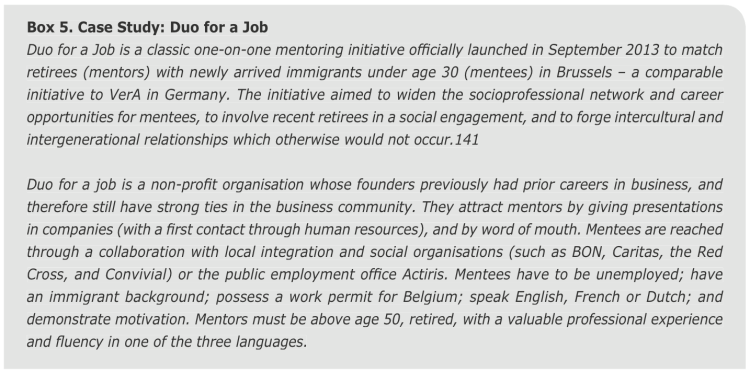
The report highlights a number of relevant “classic” one-on-one mentoring practices in Europe and North America, focusing on the role of different initiators and stakeholders, forms of collaboration, methods, and target groups. Many programmes are driven through a combination of government funding and civil society initiative, and sometimes private sector involvement. Active private sector engagement is less common in Europe, as opposed to North America, but can be found in Austria, Germany, the Netherlands and the United Kingdom. Overall, the comparative overview of mentoring projects highlights the strength and long-term opportunities of such multi-actor strategic collaboration.
In the particular case of Belgium, classic one-on-one mentoring initiatives are relatively new and small-scale. The employment policy landscape in Belgium is highly scattered—both in terms of political governance and the actors involved. Correspondingly, mentoring and job coaching projects across the country utilise different approaches and methods, have varying objectives and target groups, and involve a diversity of actors, with limited active involvement of the private sector.
Overall, sustainable funding and harmonised multistakeholder collaboration are two main challenges to the effective use of mentoring initiatives to advance the labour market integration of immigrants. Having a generally shared political priority and goal can facilitate the creation and sustainability of such partnerships for mentoring. Youth unemployment is currently high on the political agenda in many countries – as opposed to a more uneven policy attention for highly skilled immigrants across countries – which may increase policy focus on these types of schemes.
Chosen excerpts by Job Market Monitor. Read the whole story at Mentoring Practices in Europe and North America: Strategies for Improving Immigrants’ Employment Outcomes | migrationpolicy.org.



 Job Market Monitor
Discussion
No comments yet.