Canada and the United States have recently experienced an increased regional dispersion of entering immigrants. American research suggests that a mixture of economic push factors (away from states like California) and pull factors (toward states with growth of low-wage jobs), as well as changing government policies and regulations contributed to the development of the ‘New Gateways.’ Very few Canadian studies have provided comprehensive explanations for the geographical redistribution of entering immigrants, although studies of changes in immigration policy suggest that the Provincial Nominee Programs (PNPs) were, at least in part, responsible for increased numbers having chosen the western provinces. However, these studies did not consider other possibilities, such as changes in immigrant source regions. This paper assesses the relative importance of immigrant selection programs and immigrant source regions in accounting for changes in the regional dispersion of entering immigrants.
The analysis is conducted separately for two different samples. The first focuses on the intended destinations identified on the landing records of all immigrants who arrived in Canada between 1999/2000 and 2009/2010. The second focuses on the actual destinations of immigrants who filed a tax return for the first full year after landing. A comparison of actual and intended destinations shows that there is a discrepancy between the two for many entering immigrants. However, while most regions lose some immigrants who intended to settle there, they gain immigrants from other regions. For the three major destinations—Toronto, Vancouver, and Montréal—the difference between the intended and actual number of immigrants is about 6%. Furthermore, the factors accounting for changing settlement patterns are very similar, whether actual or intended destinations are used.
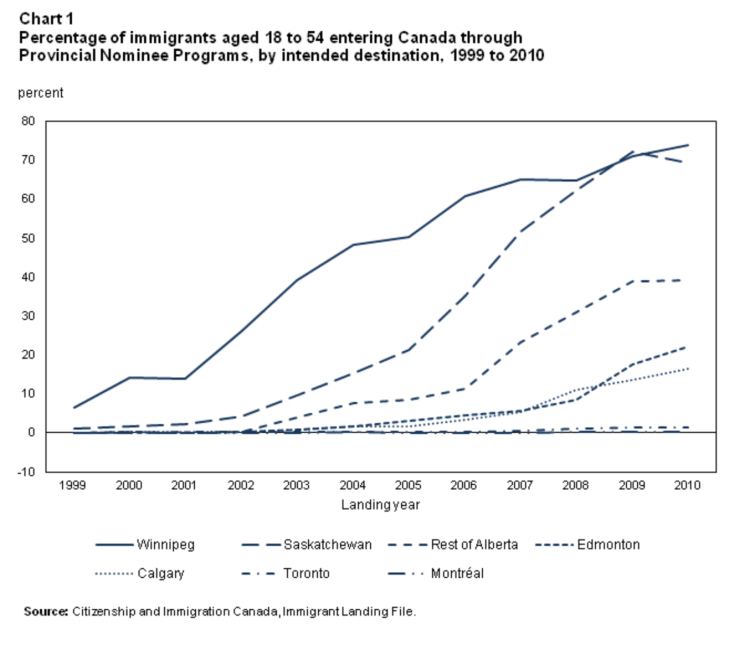
A regression decomposition method is employed to assess the effect of changes in entry programs and source regions on the destination choice of new immigrants. Destinations were defined as major cities and the remaining provincial areas outside of those cities. Seven intended destinations experienced more than a one-percentage-point change in their share of new immigrants. They were Toronto, Montréal, Winnipeg, Calgary, Edmonton, Saskatchewan and Alberta (outside of Calgary and Edmonton). The regression analysis is restricted to these seven regions.
The results show that changes in the type of programs under which immigrants entered (specifically, the PNPs) accounted for virtually the entire rise in the shares of new immigrants going to Saskatchewan and Winnipeg, and played an important role in Alberta outside of Edmonton and Calgary. Changes in immigrant programs also tended to reduce the share of immigrants to Montréal.
Changes in source regions can also influence immigrants’ destination choices. Immigrants from a particular country or ethnic group tend to enter destinations with a pre-existing community of earlier immigrants from the same region or ethnic group, although the establishment of the pre-existing community might originate from certain regional characteristics, such as climate, dominant language, distance to home country, and labour market niches, that are attractive to a given immigrant group. The analysis suggests that the change in source regions was an important factor in the fall in immigration to Toronto and the increase in immigration to Montréal, but played a small role for any other destination.
Changing immigrant programs played a minor role in the remaining three destinations: Toronto, Calgary and Edmonton. Changes in regional economic conditions were likely important factors contributing to the changing shares of new immigrants going to Toronto, Montréal, Calgary and Edmonton.
In summary, although the changing entry program mix was significant, it was not the sole contributor to the geographic dispersion of immigrants who have come to Canada since 2000.
via Changes in the Regional Distribution of New Immigrants to Canada.



 Job Market Monitor
Discussion
No comments yet.