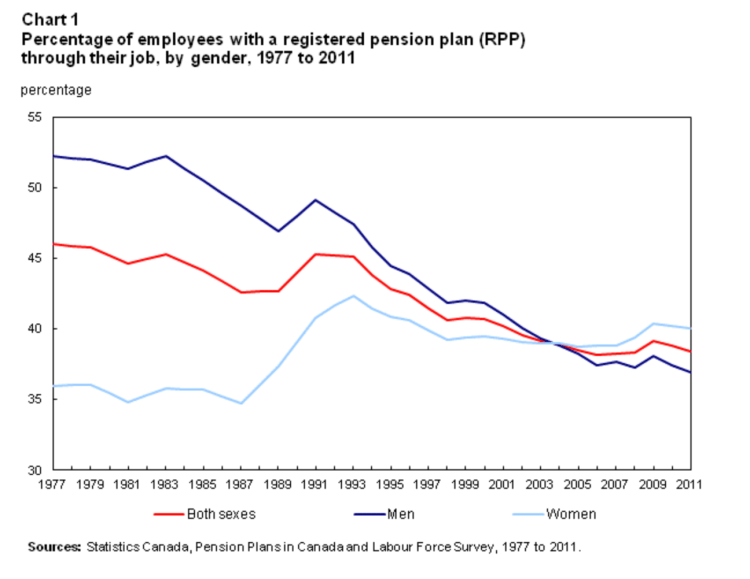
Registered pension plans (RPPs) are a key component of workers’ compensation packages and one of the pillars that Canadians use to build retirement income. As the social and economic landscape evolved over the last three decades, the extent to which Canadians held jobs providing RPP coverage changed substantially. Among employed workers at least 15 years of age, the percentage of men with RPP coverage in their job fell from 52% in 1977 to 37% in 2011 (Chart 1). In contrast, women’s RPP coverage rose from 36% in 1977 to roughly 40% in the mid-1990s, and remained at this level for the rest of the period.
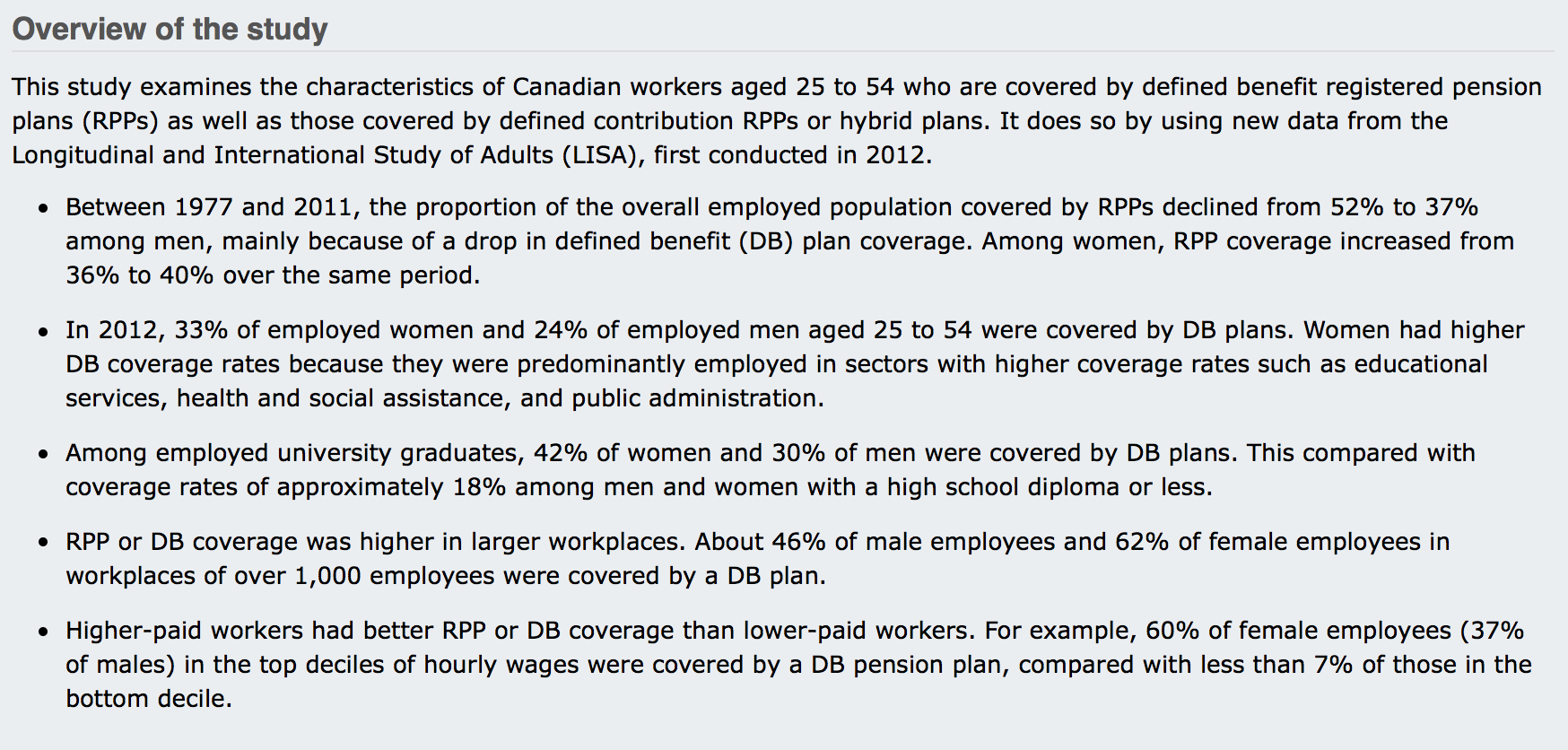
In 2012, one-third of employed women and one-quarter of employed men aged 25 to 54 were covered by a defined benefit (DB) pension plan. Women had higher coverage rates mostly because they were more likely than men to be employed in sectors with higher rates of pension coverage.
These sectors included educational services, health care and social assistance, and public administration, which, in 2012, employed 42% of women and 17% of men.
The finding is part of a new study that sheds light on the relationship between the type of pension coverage and the individual characteristics of employed people. It is based on recently released data from the Longitudinal and International Study of Adults.
While the study mainly focuses on DB plans—which predetermine the benefits workers will receive based on a formula in their plan—other information is also available on defined contribution plans and hybrid/mixed plans.
Higher education associated with more generous pension benefits
Among employed university graduates, 42% of women and 30% of men were covered by a DB plan in 2012. This compared with DB coverage rates that hovered around 18% among men and women with a high school diploma or less.
Young university graduates were also more likely to be covered by a DB plan than their less-educated counterparts.
In 2012, 35% of female university graduates and 22% of male university graduates aged 25 to 34 were covered by a DB plan, compared with 15% of females and 9% of males in the same age group with a high school diploma or less.
When they were covered by a DB plan, those with a university education were also entitled to more generous benefits.
Of all university degree holders with DB plans, 96% had plans where the pension formula was based on ‘average best earnings,’ or ‘final average earnings.’ This compared with 69% among DB plan members who had a high school diploma or less.
Larger workplaces and better paid workers also have higher rates of defined benefit plan coverage
Pension coverage, particularly by DB plans, was higher in larger workplaces.
For example, 46% of men working in workplaces with over 1,000 employees were covered by DB plans. This compared with 14% among men working in workplaces with 10 workers or less.
Since workers in larger firms and highly educated individuals are better paid than those in smaller firms and with a lower level of educational attainment, higher wages were also associated with higher pension coverage rates.
Among those in the top 10% of wage earners, 60% of female employees and 37% of male employees were covered by a DB pension plan.
This compared with less than 7% among men and women in the bottom 10% of wage earners.
Chosen excerpts by Job Market Monitor. Read the whole story at The Daily — Study: New facts on pension coverage in Canada, 2012.



 Job Market Monitor
Discussion
No comments yet.