During the 1980s and 1990s, immigration was associated with the rise in low-income rates and family-income inequality in Canada. Over the 2000s, there were significant changes in the labour market and in immigrant selection. This paper focuses on the direct effect of immigration on the change in low income and family-income inequality over the 1995-to-2010 period. The paper outlines recent trends in low-income rates and income inequality for both the Canadian-born and immigrants. The low-income rate in Canada fell during the 2000s. Was this driven in part by changes in economic outcomes among immigrants? Inequality increased considerably in the late 1990s. Did immigration contribute to this increase?
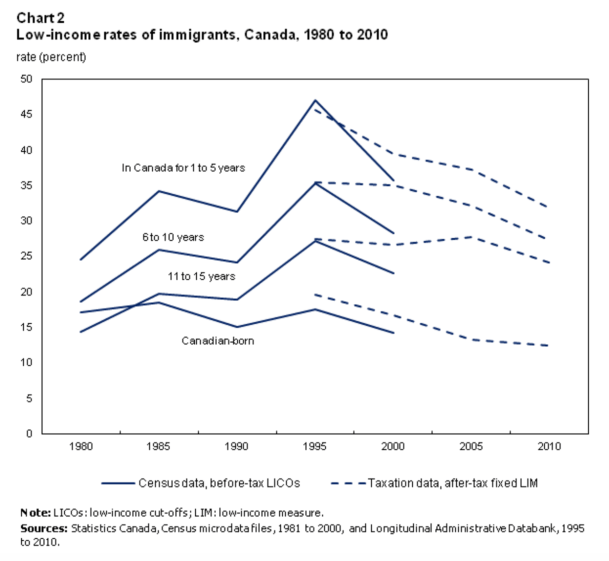
Low-income rates among immigrants declined significantly over the 2000s, although their relative (to the Canadian-born) low-income rates did not improve. There were three regional exceptions to this general pattern: immigrant low-income rates did not fall in Toronto as in other regions during the 2000s; low-income rates did not fall among the Canadian-born in Toronto as in other regions during the 2000s; and rates among immigrants decreased the fastest in Manitoba and Saskatchewan, where relativerates among recent immigrants fell back to around 1.2 times those of the Canadian-born, levels of relative rates not seen since the early 1980s.
At the national level, changes in immigrant characteristics—notably rising educational attainment and changing source regions—accounted for about one-third of the decline in the low-income rate among recent immigrants (in Canada five years or less) during the 2000s. The effect of compositional changes differed across regions. Changes in immigrant characteristics and entry programs accounted for between one-fifth and one-half of the decrease in low-income rates among recent immigrants, depending on the region.
Declining immigrant low-income rates contributed little to the fall in low-income rates among the general population in Canada during the 2000s. Unlike the 1990s, when rising immigrant population shares and low-income rates accounted for most of the increase in low-income rates in Canada, the decrease in the rates during the 2000s was driven primarily by falling rates among the Canadian-born.
High-income rates rose between 1995 and 2010 among both immigrants and the Canadian-born, although they were higher among the latter group. Immigration contributed little to the increase in the overall high-income rate in Canada over that period.
Both family-income inequality and family-earnings inequality increased in Canada from 1990 to 2010, but the majority of the rise occurred during the late 1990s. The paper concludes that for Canada as a whole, immigration contributed little to the increase of the late 1990s in either income or earnings inequality. Family income and earnings inequality rose among the immigrant population during the late 1990s, as it did among the Canadian-born, but the immigrant population did not contribute disproportionately to the overall increase. There was little increase in income inequality in the 2000s.
Chosen excerpts by Job Market Monitor. Read the whole story at Immigration, Low Income and Income Inequality in Canada: What’s New in the 2000s?.



 Job Market Monitor
Discussion
Trackbacks/Pingbacks
Pingback: Immigrant Women’s Labour Market Activity in Canada – The enduring influence of source-country gender-role attitudes | Job Market Monitor - January 28, 2015