The 2000s saw a significant increase in the foreign-born working-age population in the United Kingdom, in part because of the decision to forgo restrictions on the inflow of workers from the new European Union Member States. Starting in 2004, a large influx of labor from Eastern European countries—especially Poland, Latvia, and Lithuania—transformed the country’s immigrant population and labor market.
This report analyzes the labor market integration of recent immigrants to the United Kingdom, based on UK Labour Force Survey data. The report is part of a series of six case studies on labor market outcomes among immigrants to European Union countries.
The analysis distinguishes between different cohorts based on the year of their arrival in the country. Newcomers—especially those who have arrived since 2000—were far more likely than natives to be in the lowest-skilled jobs. And new arrivals from within the European Union were almost three times more likely to be in low-skilled work than natives in 2012. However, over time all groups showed some progress in moving out of the lowest-skilled jobs.
In part as a result of their relative youth and high education levels, many new arrivals especially those from the European Union and in particular the EU-12 countries moved straight into work. The plentiful supply of labor from immigration coupled with the United Kingdom’s flexible labor market encouraged job creation during the 2000s. While the economic crisis of 2008 and subsequent recession affected employment rates, the United Kingdom did not experience the large-scale unemployment that other countries suffered. However, immigrants who entered after 2008 found it more difficult to get work. Newcomers countries of origin, level of education, and time since arrival all shaped their occupational mobility and employment outcomes.
A number of factors shape occupational mobility in the United Kingdom:
Country of origin. Mobile citizens from the EU-12 (countries that joined the European Union since 2004) displayed exceptionally high employment rates (more 80 percent, compared to 75 percent for natives for most of this period) only a few years after arrival, but were far more likely to be in the lowest-skilled work (especially among more recent cohorts). Their high levels of education point to a degree of “brain waste.” Arrivals from elsewhere in the European Union started off with lower employment rates (around 70 percent) but improved over time, leveling out at around 80 percent. Immigrants from outside the European Union were a mixed group, comprising high-skilled labor migrants on the one hand and asylum seekers and family members on the other. Overall, this group had lower employment rates but better occupational outcomes: they achieved employment rates of around 70 percent after a decade of residence and were much less likely to be employed in low-skilled work (in line with the selective approach to labor migrants from outside the European Union).

Level of education. Workers with a high level of education enter the labor market strongly and their employment rates exceed 80 percent after eight years of residence (and even more rapidly for recent cohorts). At lower levels of education, however, employment rates do not improve considerably over time. Those who left school before age 17 have more volatile employment rates, killed work (from 44 percent to 30 percent for those arriving from 2000-01) although from a higher baseline.
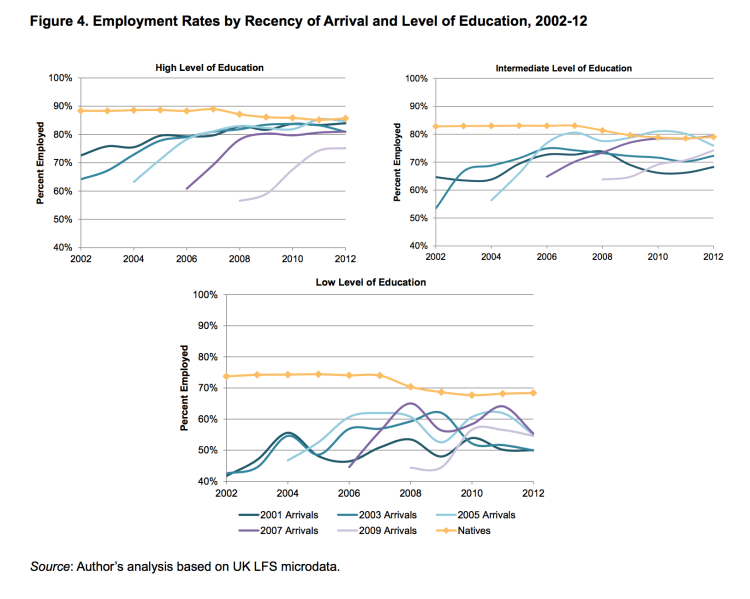
Time of arrival. Subsequent cohorts showed better employment rates. After a year of residence, the 2000-01 cohort’s employment rate was 59 percent, whereas it was 70 percent for the 2004-05 cohort. The native employment rate was 75 percent in both cases. These trends are directly reversed when it comes to low-skilled work, suggesting a degree of selective labor market participation. The rapidly changing composition of the cohorts of arrival is also likely to underpin these trends. The effects of the crisis can be observed in the employment rates of the 2008-09 cohort, which entered the labor market with employment rates under 60 percent, around the same as the first cohort in this study.
Chosen excerpts by Job Market Monitor. Read the whole story at Moving Up the Ladder? Labor Market Outcomes in the United Kingdom amid Rising Immigration | migrationpolicy.org.
Related articles
- New Immigrants in France – Fare badly in the first few years, but improvement over time finds research
- Immigrant Workers in the U.S. Labor Force in Charts
- Sweden – New immigrants are catching up says report
- Points-Based Immigration Systems in Australia, Canada, and the United Kingdom
- Germany / Immigrants struggle in job market – Arab immigrants most affected
- US / Young skilled immigrants raise the overall employment of skilled workers in firms study finds
- Brain Waste in US – 1.6 million, or 23 percent, of the college-educated immigrants ages 25 and older
- UK – Migration of low-skilled workers is too high says Ed Miliband




 Job Market Monitor
Discussion
No comments yet.