From the 2000-to-2002 period to the 2010-to-2012 period, average real weekly wages fell marginally for male bachelor’s degree holders who were aged 20 to 34 and employed in full-time jobs and rose about 5% for their female counterparts.
In contrast, average real weekly wages among full-time job holders rose roughly 9% for men and 11% for women aged 20 to 34 who had a high school diploma. Thus, wage differences between young bachelor’s degree holders and young high school graduates employed in full-time jobs narrowed in recent years.
Despite this narrowing between these two groups, differences in full-time paid employment rates widened. For example, full-time paid employment rates of young male bachelor’s degree holders exceeded those of young male high school graduates by 7.4 percentage points during the 2010-to-2012 period, up from 4.3 percentage points during the 2000-to-2002 period. Among young women, the difference widened from 13.8 percentage points to 18.6 percentage points.

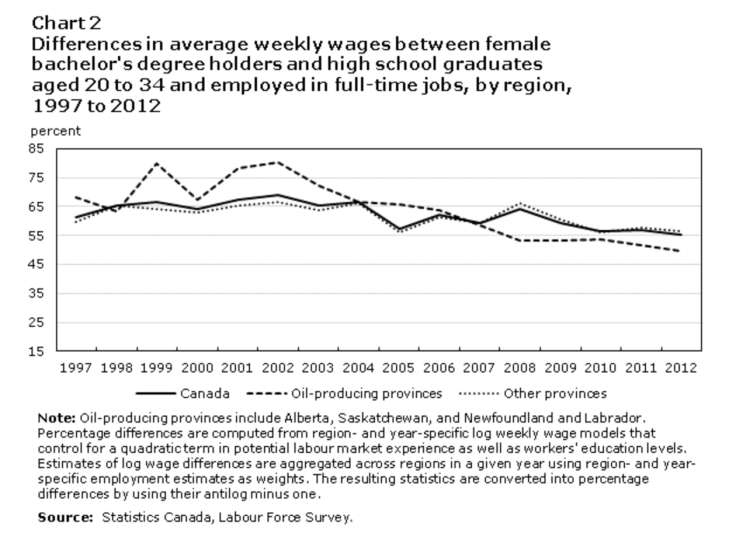

This study examines which factors underlie the narrowing of wage differences seen between young bachelor’s degree holders and high school graduates from the 2000-to-2002 period to the 2010-to-2012 period and the widening of differences in full-time paid employment rates between these two groups.
Four types of factors are considered: those associated with changes in labour supply, labour demand, institutions and employer–employee contracts, and general economic conditions.
Related articles
- Canada / Men who had obtained a bachelor’s degree by 1991 had earned $732,000 more than those whose education ended at a high school diploma, women$ 448,000
- Canada / Is the widespread assumption that Canada is suffering from a growing shortage of labour true? (jobmarketmonitor.com)
- UK / Youth unemployment and the growing failure of education (jobmarketmonitor.com)
- More than half graduates not working or underemployed (jobmarketmonitor.com)
- Born in the bottom without higher education: 45% chance of remaining there (jobmarketmonitor.com)
- Graduates in Canada – A ‘lost generation’ really ? (jobmarketmonitor.com)
- Canada | Some 40 pc of Canadian university graduates aged 25 to 29 are employed in low-skill jobs (jobmarketmonitor.com)




 Job Market Monitor
Discussion
Trackbacks/Pingbacks
Pingback: High school graduation in US – Rate could hit 90 percent (1.7 million more students received diplomas) | Job Market Monitor - April 29, 2014