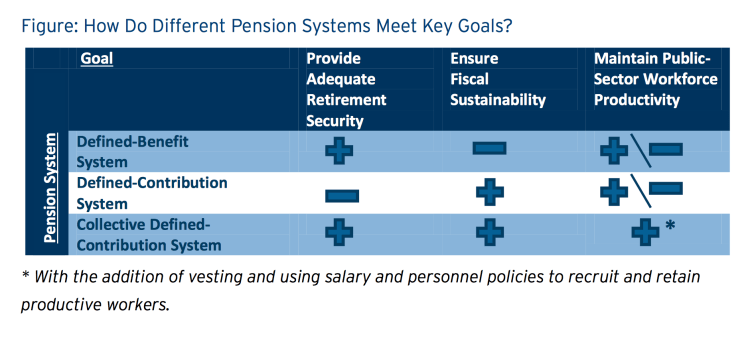
Improving Public Pensions: Balancing Competing Priorities by Patten Priestley Mahler, Chingos, and Whitehurst makes a significant contribution to the public pension discourse by providing policymakers and stakeholders with a framework for evaluating proposed reforms to pension systems – even in light of the frequently competing objectives of such systems. The authors begin by defining three essential goals of a pension system: to provide adequate retirement security; to ensure fiscal sustainability; and to maintain/improve public-sector workforce productivity. By analyzing the performance of various pension system designs against these three goals, the authors conclude that a collective defined-contribution plan is best suited to meet the complex objectives of a pension system.
The collective defined-contribution approach to pension reform combines many of the advantages of the defined-benefit plan currently favored in the public sector with those of the defined-contribution plan prevalent in the private sector.
Whereas Improving Public Pensions provides a means by which to evaluate proposed reforms, and identifies an ideal pension plan, Pension Politics: Public Employee Retirement System Reform in Four States by Patrick McGuinn provides actionable policy recommendations for those states that are looking to enact such reforms. McGuinn examines recent pension reform efforts in four states with diverse political climates. Two of the states (Utah and Rhode Island) succeeded in passing significant structural changes to their pension systems, while the others (New Jersey and Illinois) enacted more limited, less innovative changes. McGuinn highlights what activities have and have not been successful in producing meaningful reform, and details a number of recommendations for other states seeking to successfully improve their underfunded pension systems. Key recommendations include:
- Avoid turning pension reform into an ideological issue
- Enlist a credible and visible reform champion (having a Democrat lead the effort goes a long way towards countering the charge that reforms are merely a conservative attack on labor)
- Clearly communicate the reality of their state’s pension liability and demonstrate pensions’ impact on taxes and other state spending priorities, such as education
- Sell the benefits of pension reform to state workers (as ultimately in the best interests of pension participants, relative to a system that can’t meet its obligations)
- Sell the benefits of pension reform to school reformers
- Anticipate and plan for legal challenges
Chosen excerpts by Job Market Monitor. Read the whole story at Public Pension Reform Series | Brookings Institution.
Related articles
- From Defined Benefits To Defined Contributions / Firms save 2.7-3.6% of payroll per year research finds
- US / Pension / John Bogle on defined benefit programs
- US / The retirement system fails most americans by creating a few big winners and many losers
- A worldwide retirement crisis is coming
- Benefits Overview in US / 68 % of workers have access to a pension plan
- Saving for Retirement in US – Who’s not ?
- US / Retirement / 45 % of all working-age households don’t hold any retirement account assets




 Job Market Monitor
Discussion
Trackbacks/Pingbacks
Pingback: US – Only 19 percent of lower-Income Individuals individuals aged 50-58 participated in a pension of any kind at their current jobs | Job Market Monitor - April 13, 2014
Pingback: US – The retirement crisis it’s not what some people want you to believe it is | Job Market Monitor - April 28, 2014
Pingback: Ontario – How would the Retirement Pension Plan work ? | Job Market Monitor - May 8, 2014