Aysegul Sahin, Joseph Song, Giorgio Topa and Giovanni L. Violante develop a framework where mismatch between vacancies and job seekers across sectors translates into higher unemployment by lowering the aggregate job-finding rate in Mismatch Unemployment (Federal Reserve Bank of New York Staff Reports ).
They use this framework to measure the contribution of mismatch to the recent rise in U.S. unemployment by exploiting two sources of cross-sectional data on vacancies: JOLTS and HWOL (a new database covering the universe of online U.S. job advertisements).
Mismatch across industries and occupations explains at most one-third of the total observed increase in the unemployment rate. Geographical mismatch plays no apparent role. Occupational mismatch has become especially more severe for college graduates, and in the West of the United States.
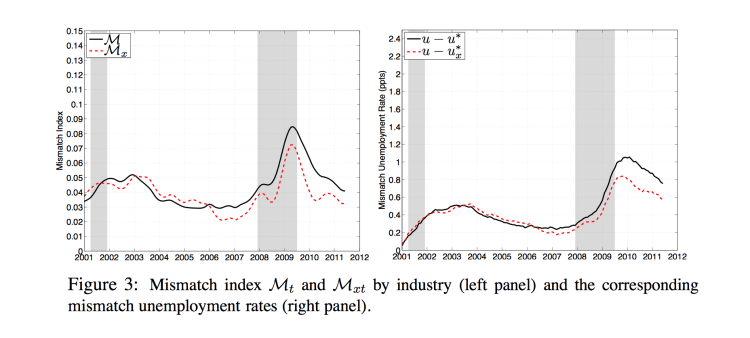
This figure shows that, before the last recession, the fraction of hires lost because of misallocation of unemployed workers across industries ranged from 2-3 percent per month, depending on the index used. At the end of the recession, in mid 2009, it had increased to roughly 7-8 percent per month, and it has since dropped again to almost its pre-recession level. To sum up, both indexes indicate a sharp rise in mismatch between unemployed workers and vacant jobs across industries during the recession, and a subsequent fairly rapid decline.
How much of the observed rise in the unemployment rate can be explained by mismatch? The right panel of Figure 3 shows mismatch unemployment (i.e., the difference between the actual and the counterfactual unemployment rates) at the in- dustry level for the 2001-2011 period, computed as described in Section 3.2. Table 1 shows the change in mismatch unemployment between October 2009 and the aver- age of 2006.32 The main finding is that worsening mismatch across these seventeen industries explains between 0.59 and 0.75 percentage points of the rise in U.S. unemployment from 2006 to its peak, i.e., at most 14 percent of the increase. Mismatch unemployment has declined since early 2010, but remains above its pre-recession levels.
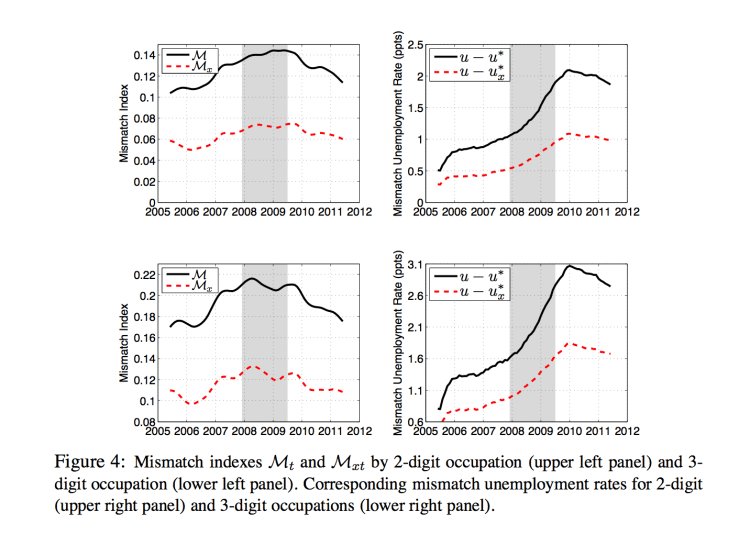
Moreover, around 1.1 percentage points (or around 21%) of the recent surge in U.S. unemployment can be attributed to occupational mismatch measured at the 2-digit occupation level. At the 3-digit level, the portion of the increase in unemployment attributable to mismatch is around 1.6 percentage points (or roughly 29% of the rise in the unemployment rate).
Chosen excerpts by Job Market Monitor. Read the whole story at Mismatch Unemployment
Related articles
- US / Mismatch increased during the Great Recession finds FRBSL
- US / What explains the yawning gap between jobs open and jobs filled?
- US / Long- term unemployment spans all industries, education levels, age groups, and among blue- and white-collar workers
- US / Long-term unemployment has less impact on the behavior of wages study says
- US / The unique importance of UI for today’s unemployed workers




 Job Market Monitor
Discussion
Trackbacks/Pingbacks
Pingback: The Skills Gap – North America is the only place in the world that thinks of companies as consumers of skills | Job Market Monitor - March 12, 2014
Pingback: Long-term unemployment – Why does it matters | Job Market Monitor - April 7, 2014
Pingback: Skills Gap in US – We need to kill this zombie writes Krugman | Job Market Monitor - April 8, 2014
Pingback: UK – Talent mismatch costs more than £1bn to employers | Job Market Monitor - April 10, 2014
Pingback: US – Long-Term Unemployment is elevated across all education, age, occupation, industry, gender, and racial and ethnic groups | Job Market Monitor - April 11, 2014
Pingback: The Job Gap in US – Lack of jobs is still a very big problem | Job Market Monitor - April 26, 2014
Pingback: Skills Gap in US Manufacturing – 75 percent of manufacturers surveyed report a moderate to severe shortage of skilled resources | Job Market Monitor - June 8, 2014
Pingback: US – The Skills Gap | Job Market Monitor - June 9, 2014
Pingback: US – Evidence demonstrating a skills shortage is not found in wage data | Job Market Monitor - July 31, 2014
Pingback: Skills Gap in US – Sixty-one percent says it exists but not me! | Job Market Monitor - September 17, 2014