This report is designed to inform the debate over the health of U.S. manufacturing through a series of charts and tables that depict the position of the United States relative to other countries according to various metrics. Understanding which trends in manufacturing reflect factors that may be unique to the United States and which are related to broader changes in technology or consumer preferences may be helpful in formulating policies intended to aid firms or workers engaged in manufacturing activity. This report does not describe or discuss specific policy options.
The main findings are the following:
- China displaced the United States as the largest manufacturing country in 2010, as the United States’ share of global manufacturing activity declined from 30% in 2002 to 17.4% in 2012.
- Manufacturing output has grown more rapidly in the United States over the past decade than in most European countries and Japan, although it has lagged China, Korea, and other countries in Asia.
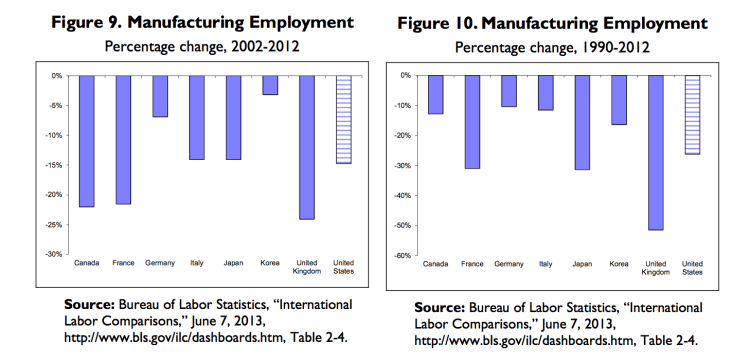
- Employment in manufacturing has fallen in most major manufacturing countries over the past two decades. The United States saw a disproportionately large drop between 2000 and 2010, but its decline in manufacturing employment since 1990 is in line with the changes in several European countries and Japan.
- U.S. manufacturers spend far more on research and development (R&D) than those in any other country, but manufacturers’ R&D spending is rising more rapidly in China, Korea, and Taiwan.
- A large share of manufacturing R&D in the United States takes place in high- technology sectors, particularly pharmaceutical and electronic instrument manufacturing, whereas in other countries a far greater proportion of manufacturers’ R&D outlays occur in medium-technology sectors such as motor vehicle and machinery manufacturing.
Manufacturing Work
International comparisons of manufacturing employment trends are hampered by inadequate data, particularly for emerging economies. Among the top-ranking manufacturing countries, China, Brazil, and India do not report complete information on manufacturing employment at the national level. Mexico has a nationwide statistical sampling program, but due to definitional and methodological changes a consistent time series is available only since 2005.
All of the advanced economies for which data are available have experienced long-term declines in manufacturing employment. Manufacturing employment in the United States, as measured by surveys of workers (rather than surveys of establishments), fell by 15% from 2002 through 2012. Canada, France, and the United Kingdom saw much greater declines over that period, while the employment declines in Italy and Japan were similar to that in the United States (see Figure 9). Over the 22-year period since 1990, manufacturing employment fell by a much lower percentage in the United States than in in France, Japan, and the United Kingdom (see Figure 10). These figures indicate that the diminished importance of manufacturing as a source of jobs is not limited to the United States.
Chosen excerpts by Job Market Monitor. Read the whole story at U.S. Manufacturing in International Perspective
Related articles
- US / The decline of manufacturing employment and trade with China
- Reshoring in US / How Walmart says it will do
- Manufacturing Jobs in US / The debate
- Reshoring in US / More Manufacturing Coming Back




 Job Market Monitor
Discussion
Trackbacks/Pingbacks
Pingback: Manufacturing jobs are shrinking everywhere | Job Market Monitor - April 28, 2014