Recent economic news has been encouraging. Gross domestic product (GDP) has grown for 10 straight quarters (growing by 4.1 percent at an annual rate in the third quarter of 2013), the economy has added private-sector jobs for 46 consecutive months and the housing market continues to strengthen. Despite the current economic recovery, the income inequality that began to rise more than three decades ago continues to increase. Income inequality is now near a record high.
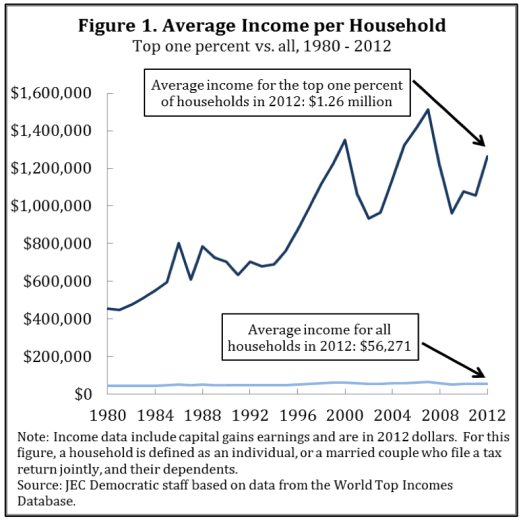
As income inequality has increased, middle- and low-income households have had a harder time making ends meet. Middle-class incomes have stagnated, with the average American household making less in 2012 than it did in 1989 (adjusted for inflation), at the same time that healthcare and education expenses have increased significantly. Even being employed is not always enough to keep someone out of poverty. In 2012, 7.3 percent of workers aged 18 to 64 lived in poverty. Raising the minimum wage would help reduce the number of working Americans in poverty. If the minimum wage were raised to $10.10 per hour (as proposed in legislation currently before Congress), 4.6 million Americans could be lifted out of poverty.
Rising income inequality has contributed to lower economic mobility: 43 percent of Americans raised in the bottom income quintile remain there as adults, while 40 percent of those raised in the top quintile maintain that status. Economic mobility in the United States is lower than in most other advanced economies.
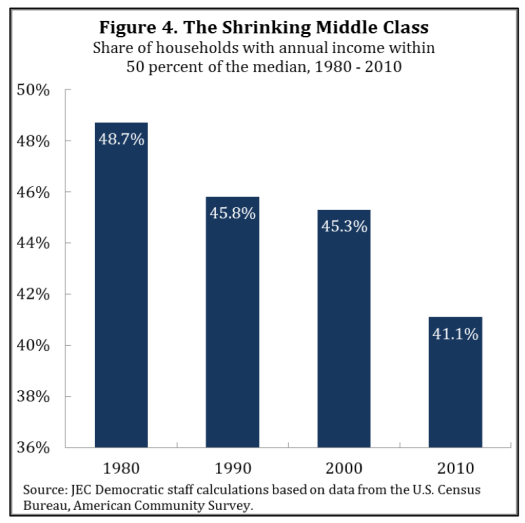
This report examines trends regarding poverty, the middle class, income inequality and economic mobility in the United States. It also suggests policy changes that can be implemented to ensure that our economy provides good opportunities for all workers.
Chosen excerpts by Job Market Monitor. Read the whole story at Income inequality in the United States

Related articles
- US / Addressing income inequality is not government’s job voters says to Fox Poll
- OECD / Countries with greater skills inequality have higher income inequality
- Robert Shiller, Nobel prize for economics / Income Inequality Is ‘Most Important Problem’




 Job Market Monitor
Discussion
Trackbacks/Pingbacks
Pingback: US / Income inequality is now near a record high reports a Senate Joint Economic Committee | MemePosts - February 11, 2014
Pingback: Poverty and Unemployment and Full Employment / The Early Debate between Beatrice Webb, Sidney Webb and William Beveridge | Job Market Monitor - February 18, 2014
Pingback: US – The White House economic case for raising the minimum wage | Job Market Monitor - February 28, 2014
Pingback: US – The 10 states where income inequality has soared | Job Market Monitor - March 3, 2014
Pingback: Minimum Wage and Poverty in US – The income boost would be less than $1.00 for each $1.00 increase in gross earnings writes Congressional Research Service | Job Market Monitor - March 13, 2014
Pingback: IMF – There is growing evidence that high income inequality can be detrimental to achieving macroeconomic stability and growth | Job Market Monitor - March 18, 2014
Pingback: Low-Wage Workers and Poverty in US – Harder to Escape | Job Market Monitor - March 20, 2014
Pingback: US – The entrenched class system | Job Market Monitor - March 26, 2014
Pingback: Inequality in US – the top 20% of earners accounted for more than 80% of the rise in household income from 2008-2012 | Job Market Monitor - April 18, 2014
Pingback: Humanity has an Answer to those Horrendous 'Anti-Homeless' Spikes...and it's Brilliant - July 3, 2014
Pingback: Wealth in US – Gains occurred only among households wealthier than the most wealthy 5% | Job Market Monitor - September 19, 2014