The Alliance for a Just Society’s 15th annual Job Gap Study examines employment opportunities and outcomes nationally, in 10 states (Colorado, Connecticut, Idaho, Florida, Maine, Montana, Nevada, Oregon, Virginia and Washington State), and in New York City. The study calculates living wage levels in each geographic area for different household structures, the percentage of available jobs that pay median wages at or above those living wage levels, and the number of job-seekers for every living wage job opening.
The study finds that a small, and shrinking, proportion of jobs pay enough for families to make ends meet, and that the number of job-seekers far exceeds the number of job openings that pay a living wage in every geography studied. The study also finds that recent and proposed minimum-wage increases fall short of the income levels it takes to get by in America today.
The Job Gap Study examines what workers need to earn in a full-time job for their families to make ends meet.1 The study assumes workers receive no public assistance and covers five distinct household types, from a single individual to a married couple with two children.
The 2013 Job Gap Study’s national findings include:
- The National Job Gap: 7 Job-Seekers for Every Job that Pays above the Low-Wage Threshold: For every projected job opening above a low-wage threshold of $15 an hour, there were 7 job-seekers in 2012.
- Nearly 18 Million Job-Seekers Out of Luck: With 20.8 million job-seekers and 2.9 million projected job openings that pay better than $15 an hour in 2012, there were 17.9 million more job-seekers than jobs that pay above the low-wage threshold.
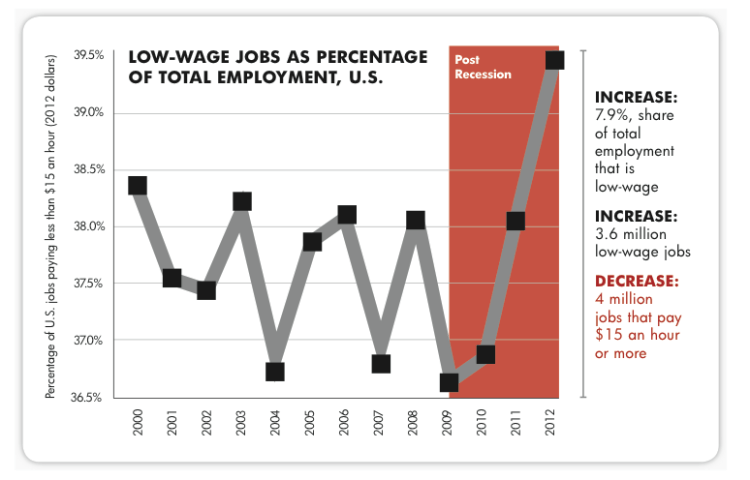
- An Increasing Share of Low-Wage Jobs since End of Great Recession: In terms of actual employment rather than projected openings, the share of U.S. jobs that pay below the $15 an hour low-wage threshold increased from 36.55% in 2009 to 39.45% in 2012. There were 51.4 million low-wage jobs in 2012.
- ‘Jobless Recovery’ Masks Loss of Higher-Wage Jobs, Replacement with Low-Wage Jobs: The number of jobs in occupational categories with median wages above $15 an hour dropped by 4 million from 2009 to 2012, masked by an increase of 3.6 million jobs with median wages below $15 an hour.
The 2013 Job Gap Study’s findings for the 10 states analyzed and New York City include:
- In Households Comprised of a Single Individual: Living wages range from $13.92 in Montana to $22.66 in New York City. The percentage of projected job openings that pay less than living wages ranges from 41% in Washington State to 64% in Florida. The Job Gap, or the number of job-seekers to living wage job opening, ranges from 5 to 1 in Colorado to 25 to 1 in Connecticut.
- In Households Comprised of a Single Adult with a School-Age Child (Age 6-8): Living wages range from $19.36 in Montana to $30.02 in New York City. The percentage of projected job openings that pay less than living wages ranges from 61% in Washington State to 80% in Florida. The Job Gap ranges from 8 to 1 in Colorado and Washington State to 41 to 1 in Connecticut.
- In Households Comprised of a Single Adult with a Toddler (12-24 Months) and a School-Age Child: Living wages range from $25.25 in Idaho to $39.64 in New York City. The percentage of projected job openings that pay less than living wages ranges from 78% in Washington State to 90% in Florida. The Job Gap ranges from 14 to 1 in Colorado to 101 to 1 in Connecticut.
- In Households Comprised of Two Adults (One Working, One Caring for Children) with a Toddler and a School-Age Child: Living wages range from $27.99 in Montana to $36.64 in New York City. The percentage of projected job openings that pay less than living wages ranges from 76% in Colorado to 93% in Montana. The Job Gap ranges from 12 to 1 in Colorado to 61 to 1 in Connecticut.
- In Households Comprised of Two Adults (Both Working) with a Toddler and a School-Age Child, Per Adult: Living wages per earner range from $17.69 in Idaho to $24.52 in New York City.The Job Gap Study’s findings point to a national crisis in creating the types of jobs workers and families need to make ends meet. The findings have serious implications for low-wage workers and for communities of color (since people of color make up a disproportionate share of low-wage workers). They also have serious implications for economic growth, as the trend toward lower-wage jobs undermines consumer purchasing power and the economy-boosting potential of new job creation.These trends call for action from Congress and state legislatures to address the job gap through a balance of raising wage floors and strengthening safety net programs. These actions are needed both to create new opportunities for workers and families to make ends meet, and to re-orient job creation toward growth jobs that boost the economy and the local, state and national levels.
Chosen excerpts by Job Market Monitor. Read the whole report at




Discussion
Trackbacks/Pingbacks
Pingback: US / 72 percent approve minimum wage hike, including a majority of Republicans pool says | Job Market Monitor - January 9, 2014
Pingback: Minimum wage in US – Over 500 economists sign a petition to the President against an increase | Job Market Monitor - March 12, 2014
Pingback: US – The national jobs gap relative to November 2007 has been closed in July 2017 | Job Market Monitor - August 19, 2017