Federally funded extended unemployment insurance (UI) benefits are set to expire at the end of this year. These benefits serve two very useful public purposes. Most obviously, they provide a lifeline to the long-term unemployed and their families during the deepest and longest economic downturn since the 1930s.1 Less understood but equally crucial, the UI benefit extensions boost spending in the economy and thereby create jobs. We find that continuing the extensions through 2014 would generate spending that would support 310,000 jobs. If this program is discontinued, the economy will lose these jobs.
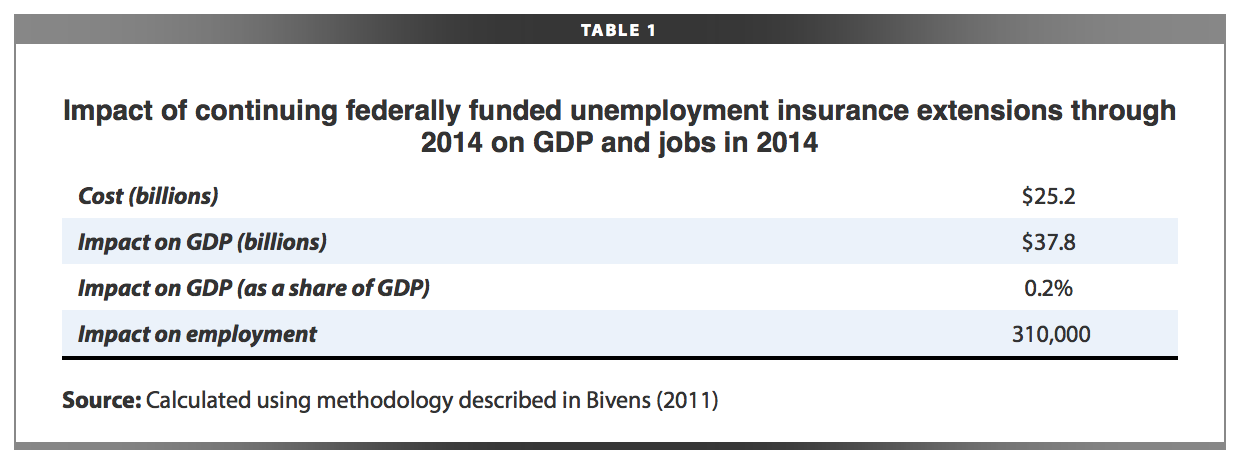
Table 1 shows the impact on gross domestic product (GDP) of continuing the federally funded UI benefit extensions through 2014 and the consequent impact on employment in 2014. These estimates are calculated using the methodology described in Bivens (2011). Spending $25.2 billion on unemployment insurance extensions in 2014 would increase consumer spending and expand GDP by an estimated $37.8 billion, raising our $16.7 trillion GDP by roughly 0.2 percent. This increase in economic activity would translate into around 310,000 jobs.
 Chosen excerpts by Job Market Monitor. Read the whole story at





Discussion
Trackbacks/Pingbacks
Pingback: UI Extension in the US / 1.3 million people to lose access to an emergency program | Job Market Monitor - November 18, 2013
Pingback: US / CBO estimates that extending the emergency unemployment compensation (EUC) program for one year would cost $25.7 billion | Job Market Monitor - December 3, 2013
Pingback: Unemployment Extension / White House will push when Congress comes back to work | Job Market Monitor - December 23, 2013
Pingback: Long-term unemployment benefits expire / Who, why, where …? | Job Market Monitor - December 30, 2013
Pingback: US / ‘Extended’ Unemployment Benefits ending: less active jobless persons looking for work | Job Market Monitor - January 2, 2014
Pingback: UI benefits extension in US / Obama to speak on Tuesday | Job Market Monitor - January 4, 2014