In early 1995, a young Avery Shenfeld was in attendance when a young Bank of Canada research director, Steve Poloz, presented a controversial talk on Canada’s labour market. In it, he argued that full employment at that time might be consistent with as much as a 9% jobless rate. Below that so-called NAIRU rate, wage-price pressures would emerge.
You won’t hear now Governor Poloz talk about “full employment” or the NAIRU rate these days. The Bank is careful to express the degree of slack in the economy through reference to the “output gap,” a measure tied to real GDP. That avoids ever having to say that too few Canadians are unemployed to meet the inflation target, but that’s really what’s implied when the output gap turns positive.
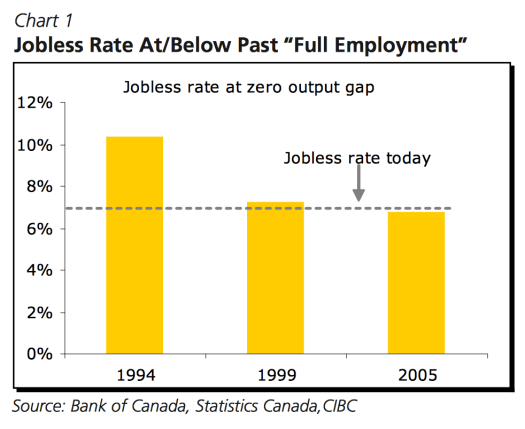
Of late, it seems like full employment ain’t what it used to be, and that’s actually good news for those still job hunting. In both 1999 and 2005, the jobless rate was roughly in line with today’s 6.9% level, but at that point, the Bank of Canada thought the output gap was zero (Chart 1), and rate hikes were underway to cool the economy’s fires.
These days, the central bankers still see a lot of slack. The BoC’s estimate of the output gap actually widened even as the unemployment rate fell (Chart 2), an unprecedented divergence in terms of how long it’s lasted. Some of that reflects temporarily poor productivity growth—lots of hiring, not much output. But it also captures the lack of tightness in the job market itself.

The implication: Poloz’s team can give free reign to let growth take the unemployment rate to still lower levels without fear of breaching its 2% inflation target. Full employment is, it seems, a lower jobless rate than it used to be, just as the jobless rates achieved in 1999 and 2005 were miles below rates seen when the output gap was judged to be zero when Poloz spoke in the mid-1990s.
Chosen excerpts by Job Market Monitor. Read the whole story at




 Job Market Monitor
Discussion
Trackbacks/Pingbacks
Pingback: Canada / No shortage of workers, invest in training say studies | Job Market Monitor - November 19, 2013