It has been well documented that the share of the working-age population employed in “middle-skill” occupations has been falling for some time, while the share in lower- and higher-skill jobs has been rising–i.e. “polarization” of the labor market (e.g. Autor 2010). However, the dynamics and related mechanism behind these employment trends are not fully understood; nor is it well understood what happens to workers who are displaced from middle-skill jobs.
This paper attempts to make progress on some of these issues by using a variety of data sources to explore the following specific questions:
- What happens to middle-skill workers when they become unemployed?
- How have transition rates between employment states and job types changed for low-, middle-, and high-skilled jobs, and how have these changes contributed to observed labor market polarization (i.e. to changes in the aggregate share of workers employed in these jobs)?
Thus, the purpose of this paper is to explore the dynamics that underlie changes in employment shares by job type, by examining the transition rates into and out of job types. In doing so, this research helps “explain” why the share of workers in middle-type jobs has been falling over time, and contributes towards understanding the mechanisms behind polarization.
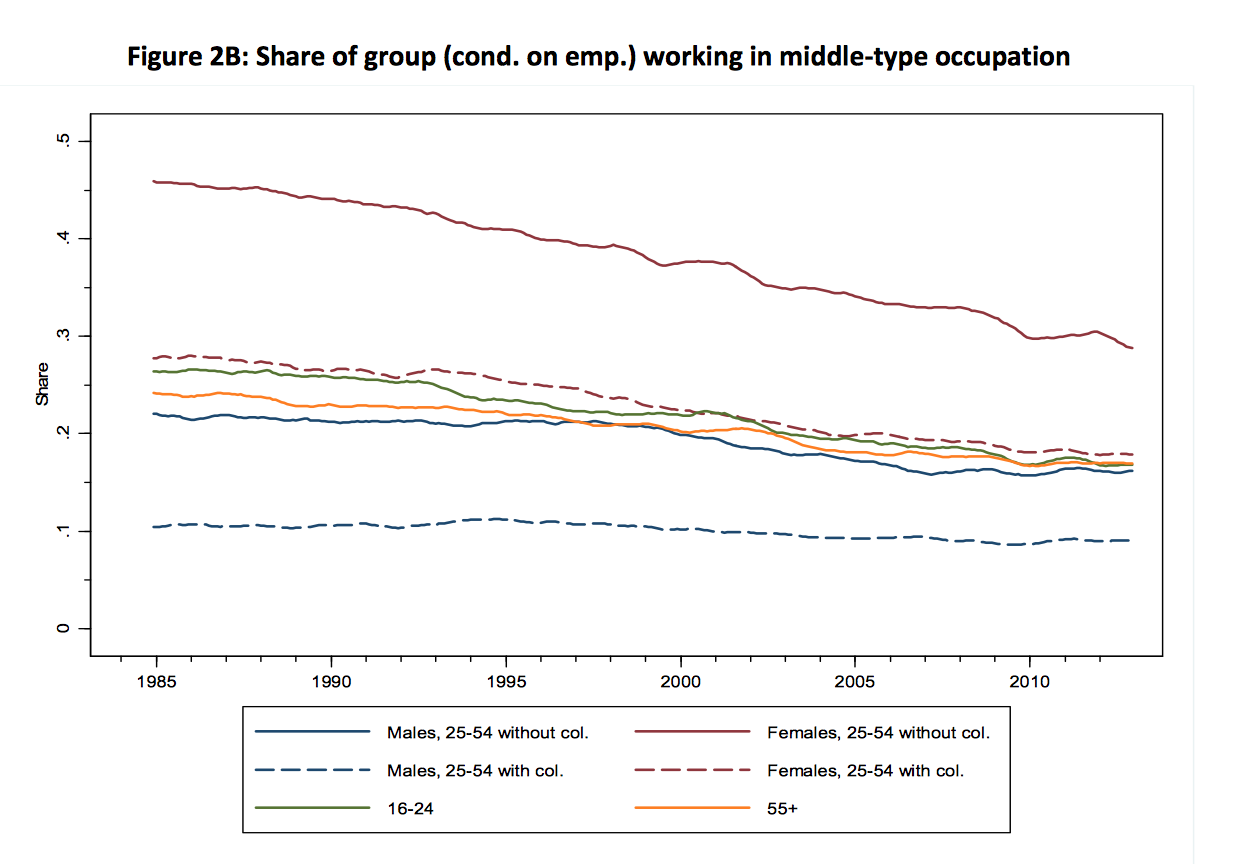
The share of workers in middle-skill occupations has been declining over the past few decades in part both because the outflow rate from these jobs (to non-employment as well as to jobs of other types) has been increasing and because the inflow rate to middle-skill jobs from non-employment or jobs other types has also been declining (particularly for younger workers). Thus, the labor market dynamics of polarization are complicated, depending on changes in the rate of inflows and outflows by job-types, and differ across demographic groups. Any theories regarding the labor market impact of polarization (e.g. on the weakness of the aggregate labor market since the 1990s) should therefore recognize the importance of trends in both inflows and outflows rates by job types.
To summarize: the share in middle-type jobs has fallen for all types of workers. The declines have been most significant for younger workers and non-college workers, and for these groups the decline in middle-type employment has been almost entirely mirrored by an increase in low-type employment. And even for college-educated workers, there is a modest increase in the share employed in low-type jobs since the early 2000s.
Unsurprisingly, younger workers tend to be in low-type jobs, non-college workers are rarely observed in high-type jobs, and women are rarely observed in the other-type jobs.
The variety of data on transition rates from unemployment to employment provide little to suggest that unemployed middle-type workers are increasingly likely to transition to a non-middle-type job; instead, they are increasingly likely to remain non-employed, though this is also true for unemployed workers who were employed in other types of jobs as well. The most striking and consistent trend is that unemployed non- middle-type workers are increasingly less likely to transition to middle-type jobs than in the 1980s. That is, inflow rates to middle-type jobs from non-middle-type unemployment have fallen, and seem likely to contribute, at least in part, to the declining share of employment in these jobs.
Putting this all together, the author finds that the decline in the share of workers in middle-skill jobs is due both to a decline in inflows into these jobs (particularly from non-employment and for younger workers) and because of a rise in outflows from these jobs (to non-employment and to other jobs); the increase in the share of workers in lower-skill jobs appears due to an increase in worker transitions from other job types (evident within all demographic groups); and the increase in the share of workers in higher-skill jobs appears due to an increase in worker transitions from other job types and is also somewhat compositional in nature (because there are more college-educated workers).
Chosen excerpts by Job Market Monitor. Read the whole story at



 Job Market Monitor
Discussion
Trackbacks/Pingbacks
Pingback: Skills Gap in US – We need to kill this zombie writes Krugman | Job Market Monitor - April 8, 2014
Pingback: Skills Gap in US Manufacturing – 75 percent of manufacturers surveyed report a moderate to severe shortage of skilled resources | Job Market Monitor - June 8, 2014
Pingback: US – The Skills Gap | Job Market Monitor - June 9, 2014
Pingback: Polarization in US – The declining prominence of middle-skill jobs | Job Market Monitor - June 10, 2014
Pingback: Skills Gap in US – Sixty-one percent says it exists but not me! | Job Market Monitor - September 17, 2014