Education is at a critical juncture in the United States. It is vital for workforce development and economic prosperity, yet is in need of serious reform. American education was designed for agrarian and industrial eras, and does not provide all the skills needed for a 21st century economy. This creates major problems for young people about to enter the laborforce.
Mobile learning represents a way to address a number of our educational problems. Devices such as smart phones and tablets enable innovation and help students, teachers, and parents gain access to digital content and personalized assessment vital for a post-industrial world. Mobile devices, used in conjunction with near universal 4G/3G wireless connectivity, are essential tools to improve learning for students. As noted by Irwin Jacobs, the founding chairman of Qualcomm, Inc., “always on, always connected mobile devices in the hands of students has the potential to dramatically improve educational outcomes.”
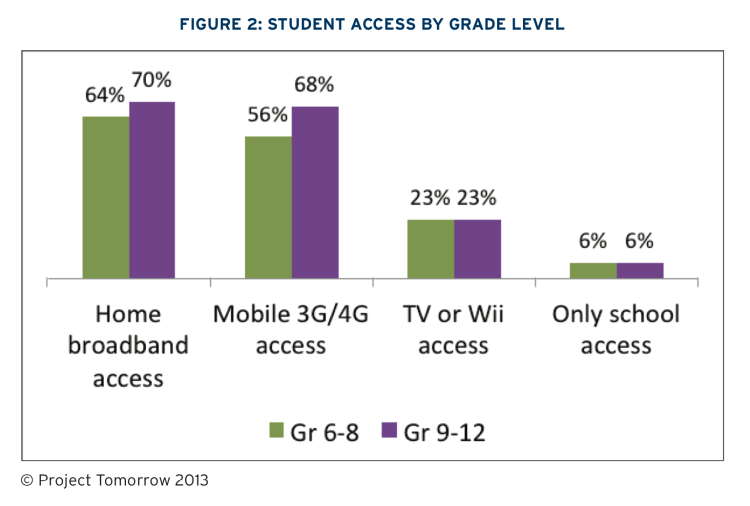
According to Project Tomorrow data shown below, 68 percent of high school students say that they access the Internet via a 3G/4G mobile device – including a number of students who don’t have broadband access at home.1 Julie Evans of Project Tomorrow notes that “this is the real story as to why mobile devices can help to solve the home broadband problem.” According to her, “even amongst students who say they have high speed Internet access at home, in many cases though students never get to use that access. If there is one family computer that is hard wired for that high speed access, students today need to contend for access with siblings who are also trying to do their homework, parents looking for jobs or doing their own work, and family entertainment activities using that computer. Students tell us that having their own mobile device that is not a shared device give them better, more reliable access to the Internet than trying to use the family broadband connection.”
A number of public schools typically do not have sufficient information technology staffing so aren’t able to take advantage of recent advances in mobile networks. Many rely on “bring your own device.” This complicates the education IT environment because schools end up with a myriad of devices and operating systems, which makes it difficult to link hardware and connect students to each other. The result is an IT “Tower of Babel” with interoperability problems and poor communications. And, above all, “bring your own device” is only fine for those students who have devices. Those who do not are left behind.
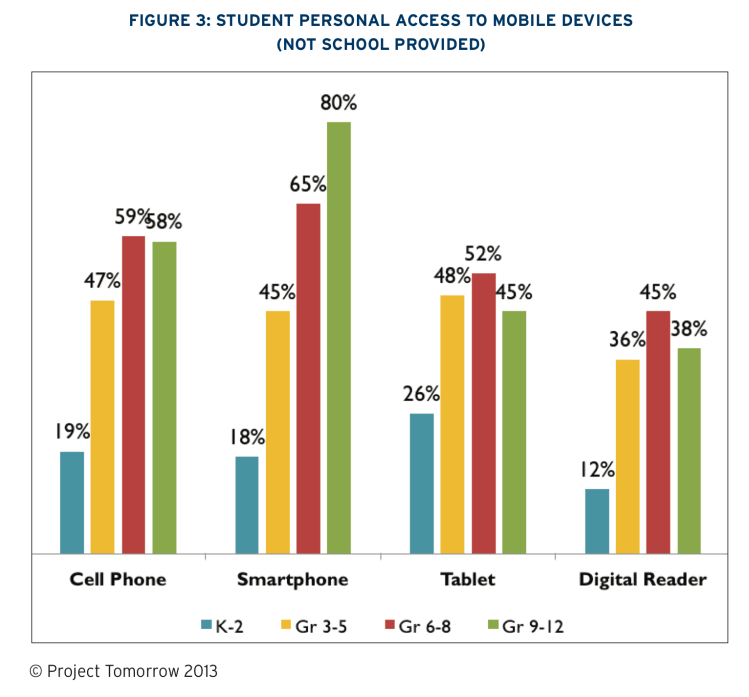
There are a number of ways in which mobile technology enables educational innovation. Research by Project Tomorrow shows how access has improved across various mobile platforms. Eighty percent of high school students said they had a smartphone, 45 percent had tablets, 38 percent had digital readers, and 58 percent had a cellphone.
These percentages are up over just a few years ago. In 2008, only 28 percent of high schoolers had a smartphone. And in 2011, only 26 percent of students in grades 6-8 had a tablet computer, compared to 52 percent now.
Chosen excerpts by Job Market Monitor. Read the whole story at




 Job Market Monitor
Discussion
No comments yet.