In homes across America, fathers are launching a quiet revolution. Catalyzed by the women’s movement and women’s steady and certain progress toward greater prom inence in higher education and the fastest growing professions, men and women have come to understand that traditional gender roles only hinder today’s fathers and mothers in their efforts to succeed at integrating their work and family endeavors.
The Changing Role of Fathers
Several key changes have contributed to the evolving role of modern day fathers. The first is women’s educational and professional achievements, which have impacted family structures. Women now earn 57% of bachelor’s degrees, 60% of master’s degrees, and about 50% of professional degrees and PhD’s (Mason, 2009). Working mothers make up just under half of the U.S. workforce and 23% of mothers in dual-career couples earn more than their husbands. Including single mother-led families, women are now the primary breadwinners in 40% of U.S. households (Pew Research Center, 2013b). Furthermore, while women have traditionally placed their career aspirations second to their spouses’ careers, it appears that young women no longer differ from young men in their aspirations for high- responsibility jobs (Pew Research Center, 2012). 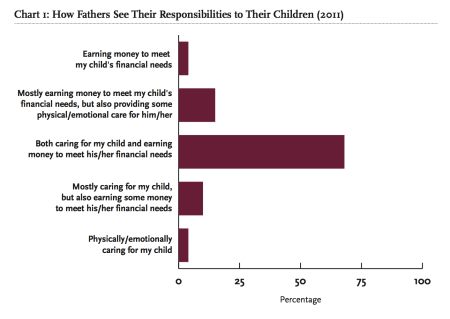
While some of the changes that face today’s fathers are the result of women’s prospects and the shifting, uncertain economic fate of men, these changes are equally born of a new, growing spirit of determination among men to fully embrace their roles as fathers. They no longer want to be seen simply as economic providers operating at arms – length from their families. Fathers today seek roles that are much more integral to the lives of their families and require greater presence and engagement.
 Since 2009, the Boston College’s Center for Work & Family has conducted research and published a series of annual reports on the changing roles of fathers titled “The New Dad.” These reports have studied the transition to fatherhood, how men manage career and family priorities, how they share caregiving responsibilities with their spouses, and what supports fathers look for and, at times thankfully, receive in their workplaces.
Over this time period The Center has interviewed or surveyed nearly 2,000 dads – mostly white collar fathers in professional and managerial position s – to learn about their joys, their struggles, their achievements and their setbacks. The Center believe that the work has helped to create a more complete, and hopefully accurate, portrait of today’s fathers as men who care deeply about their work and their families, who strive to be active, engaged parents while at the same time investing significant energy in building successful careers.
BCCWF Executive Director Brad Harrington discusses the 2013 report on fatherhood The New Dad: A Work (and Life) in Progress and issues a call to action for fathers and organizations
Chosen excerpts by Job Market Monitor



 Job Market Monitor
Discussion
Trackbacks/Pingbacks
Pingback: Mothers in US / More fatigued than dads | Job Market Monitor - October 10, 2013