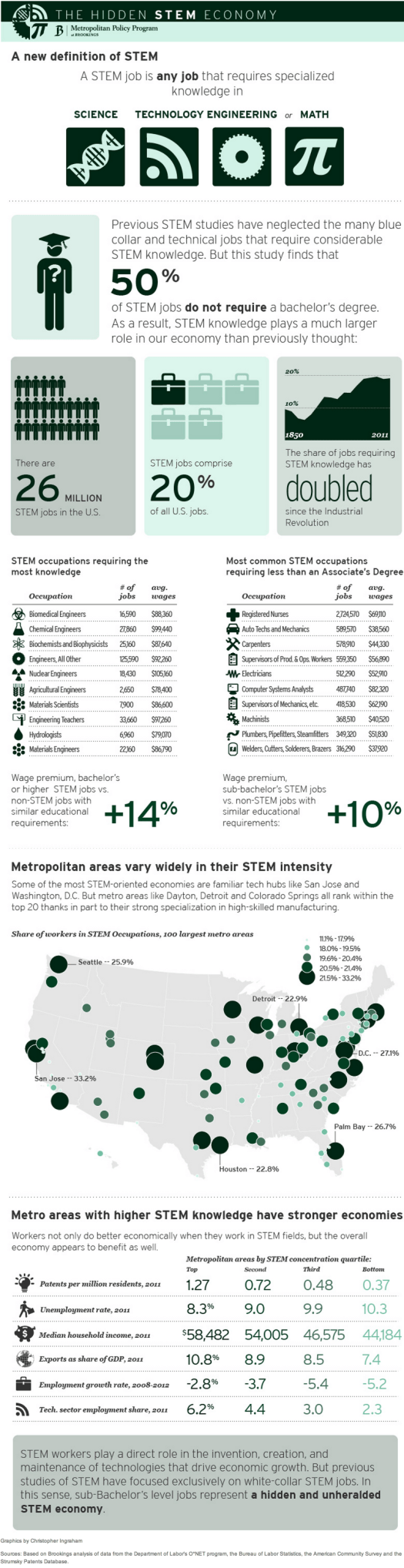
Workers in STEM (science, technology, engineering, and math) fields play a direct role in driving economic growth. Yet, because of how the STEM economy has been defined, policymakers have mainly focused on supporting workers with at least a bachelor’s (BA) degree, overlooking a strong potential workforce of those with less education but substantial STEM skills.
An analysis of the occupational requirements for STEM knowledge finds that:
- As of 2011, 26 million U.S. jobs—20 percent of all jobs—require a high level of knowledge in any one STEM field. STEM jobs have doubled as a share of all jobs since the Industrial Revolution, from less than 10 percent in 1850 to 20 percent in 2010.
- Half of all STEM jobs are available to workers without a four-year college degree, and these jobs pay $53,000 on average—a wage 10 percent higher than jobs with similar educational requirements. Half of all STEM jobs are in manufacturing, health care, or construction industries. Installation, maintenance, and repair occupations constitute 12 percent of all STEM jobs, one of the largest occupational categories. Other blue-collar or technical jobs in fields such as construction and production also frequently demand STEM knowledge.
- STEM jobs that require at least a bachelor’s degree are highly clustered in certain metropolitan areas, while sub-bachelor’s STEM jobs are prevalent in every large metropolitan area. Of large metro areas, San Jose, CA, and Washington, D.C., have the most STEM-based economies, but Baton Rouge, LA, Birmingham, AL, and Wichita, KS, have among the largest share of STEM jobs in fields that do not require four-year college degrees. These sub-bachelor’s STEM jobs pay relatively high wages in every large metropolitan area.
Chosen excerpts by Job Market Monitor

via The Hidden STEM Economy | Brookings Institution.
Related Posts
Search Results
REpower Systems to cut 750 jobs
REpower Systems SE, the Indian wind turbine maker Suzlon Group’s German arm, said on Friday it would reduce up to 750 jobs across the world as part of its plan to achieve cost savings of about 100 million euros ($130 million) in the current fiscal year. “Whilst the long-term outlook for the sector remains strong, … Continue reading »
US / There is no shortage of STEM workers says the Economic Policy Institute
In a new EPI paper, Hal Salzman of Rutgers, Daniel Kuehn of American University and B. Lindsay Lowell of Georgetown University find little evidence to support expansion of high-skill guestworker programs as proposed in the immigration bill being debated in the Senate. Contrary to many industry claims, the study finds that U.S. colleges and universities … Continue reading »
The 21st Century Workforce and the STEM Dilemma (Infographics)
“The 21st Century Workforce: Skills Gap and the STEM Dilemma,” outlines the current lack of qualified workers and the pressing need to engage students with STEM education. Raytheon believes that in order to build the next pipeline of technologists and innovators to ensure a competitive U.S. workforce and future economic growth, students must be shown … Continue reading »



 Job Market Monitor
Discussion
Trackbacks/Pingbacks
Pingback: Canada / Less than 50 per cent of high school students graduate with senior STEM courses | Job Market Monitor - October 8, 2013
Pingback: The decline of middle-class workers / Job polarisation and wages | Job Market Monitor - February 10, 2014
Pingback: Jobs in US Tech-Sector – About 3.9 million workers, roughly 3% of the nation’s payroll workforce | Job Market Monitor - March 12, 2014
Pingback: Doctoral Scientists and Engineers in US – Unemployment has increased | Job Market Monitor - April 21, 2014
Pingback: US – Employment and wages in STEM by the BLS | Job Market Monitor - May 12, 2014
Pingback: Skills Gap in US – We are not doing an adequate job of preparing our workforce says Philadelphia Fed President | Job Market Monitor - May 12, 2014
Pingback: College Grads in US – Wages are terrible | Job Market Monitor - July 24, 2014
Pingback: Young US Scientists – Too few university jobs | Job Market Monitor - September 16, 2014
Pingback: STEM workforce in Australia – 2.3 million people with qualifications | Job Market Monitor - April 1, 2016