« Rising income inequality and wage stagnation threaten the future of America’s middle class » writes the Democratic staff of the U.S. House Committee on Education and the Workfororce in The Low-Wage Drag on Our Economy: Wal-Marts low wages and their effect on taxpayers and economic growth (Adapted chosen excerpts by Job Market Monitor to follow), adding that while corporate profits break records, the share of national income going to workers’ wages has reached record lows.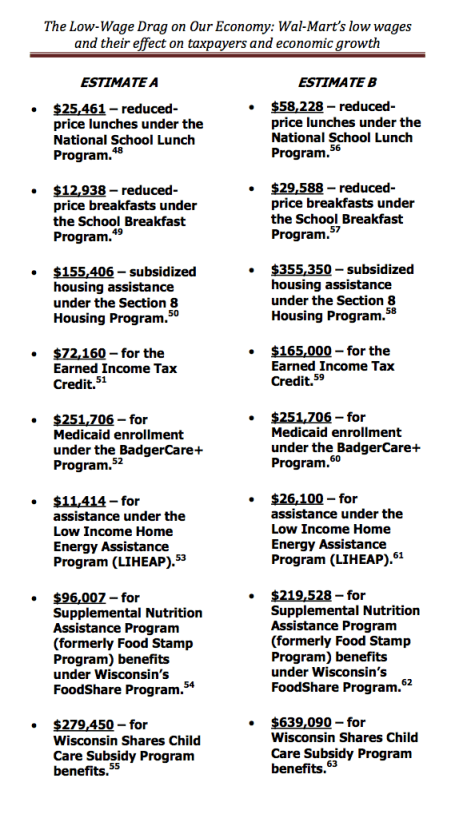
Wal-Mart plays a leading role in this story. Its business model has long relied upon strictly controlled labor costs: low wages, inconsiderable benefits and aggressive avoidance of collective bargaining with its employees. As the largest private-sector employer in the U.S., Wal-Mart’s business model exerts considerable downward pressure on wages throughout the retail sector and the broader economy. This model has multiplied across the sector. While employers like Wal-Mart seek to reap significant profits through the depression of labor costs, the social costs of this low-wage strategy are externalized. Low wages not only harm workers and their families – they cost taxpayers.
When low wages leave Wal-Mart workers unable to afford the necessities of life, taxpayers pick up the tab. Taxpayer- funded public benefit programs make up the difference between Wal-Mart’s low wages and the costs of subsistence.
When low wages leave Wal-Mart workers unable to afford the necessities of life, taxpayers pick up the tab. Taxpayer- funded public benefit programs make up the difference between Wal-Mart’s low wages and the costs of subsistence.
Accurate and timely data on Wal-Mart’s wage and employment practices is not always readily available. However, occasional releases of demographic data from public assistance programs can provide useful windows into the scope of taxpayer subsidization of Wal-Mart. After analyzing data released by Wisconsin’s Medicaid program, the Democratic staff of the U.S. House Committee on Education and the Workforce estimates that a single 300- person Wal-Mart Supercenter store in Wisconsin likely costs taxpayers at least $904,542 per year and could cost taxpayers up to $1,744,590 per year – about $5,815 per employee.
Alternative Models in Retail Labor Relations
Wal-Mart’s low-wage model is not a function of necessity. Other retailers have proven that success in the hyper- competitive retail sector does not depend on ever smaller labor costs, but can be a consequence of robust investment in high quality labor. In fact, a growing body of scholarship suggests that higher wage retail business models result in higher productivity and sales.
Full Report @



 Job Market Monitor
Discussion
No comments yet.