The most recent U.S. recession and recovery have been accompanied by a sharp decline in the labor force participation rate. The largest declines have occurred in states with the largest job losses. This suggests that some of the recent drop in the national labor force participation rate could be cyclical. Past recoveries show evidence of a similar cyclical relationship between changes in employment and participation, which could portend a moderation or reversal of the participation decline as the current recovery continues.
Since the beginning of the recession in 2007, the U.S. labor force participation rate has dropped sharply. Some of this decline reflects long-term demographic trends and other factors that helped push down the participation rate before 2007. But the recent withdrawal of prime-age workers from the labor market is unprecedented and may reflect a cyclical component that could reverse as the labor market recovery solidifies. The return of these workers to the labor force would partially offset the longer-term demographic influences and potentially cause the participation rate to bounce back. Moreover, the increase in the number of active jobseekers in the labor force associated with higher participation could slow the decline in the unemployment rate.
Assessing the contribution of cyclical factors and the likelihood of a reversal or slower decline in labor force participation is difficult based on aggregate labor market data alone. Such data cannot perfectly distinguish between long-term trends and shorter-term cyclical factors, particularly given the severity of the labor market dislocation during the past recession. To assess the role of cyclical factors in the current recovery, the authors examine state-level variation in the relationship between changes in the labor force participation rate and changes in employment over several business cycles.
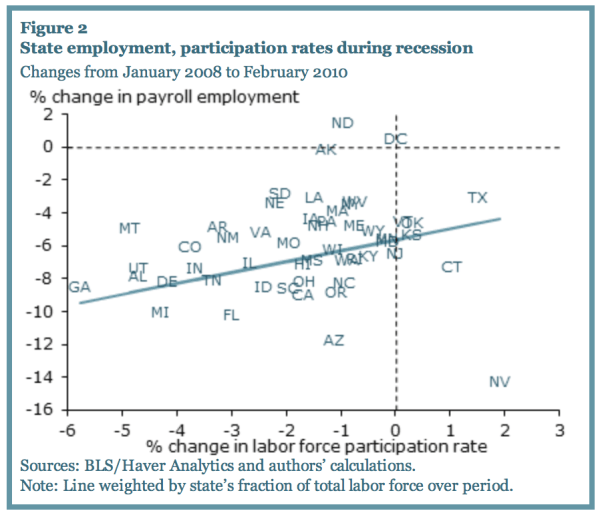
Figure 2 displays the relationship between the percentage changes in state-level labor force participation rates and payroll employment in the most recent downturn. The figure shows wide cross-state variation in the extent of job loss and changes in participation. The upward-sloping blue line shows that changes in employment and participation are positively related across states. Larger declines in employment are associated with larger declines in labor force participation rates. This systematic relationship at the state level between the severity of employment losses and the decline in participation suggests that the drop in the national participation rate may also have an important cyclical component. These results reinforce the findings of other researchers who have found evidence of cyclicality in the labor force participation rate.
Chosen excerpts by Job Market Monitor

via FRBSF Economic Letter: Will Labor Force Participation Bounce Back? (2013-14, 5/13/2013).



 Job Market Monitor
Discussion
Trackbacks/Pingbacks
Pingback: The Slow Recovery of the US Labor Market / A CBO Report | Job Market Monitor - February 5, 2014
Pingback: Participation in the US – The decline | Job Market Monitor - August 19, 2014
Pingback: Participation in US – Ongoing structural influences with some crowding out of job opportunities for young workers research finds | Job Market Monitor - September 8, 2014