McKinsey partnered with Chegg Inc. to conduct a survey that gauges the attitudes of more than 4,900 recent graduates on a range of issues. The mix included attendees of four-year and two-year private and public colleges, as well as vocational and for-profit institutions. The survey primarily focused on students who graduated between 2009 and 2012, though some students still working toward their degrees were surveyed as well. (Adapted Chosen excerpts by Job Market Monitor to follow).
The gap between higher education’s undeniable value and the concerns many recent graduates nonetheless report should become the impetus for change. In a sense, the “voice of the graduate” revealed in this survey amounts to a cry for help—an urgent call to deepen the relevance of higher education to employment and entrepreneurship so that the promise of higher education is fulfilled.
-*-
The key findings are reviewed in the pages that follow; the reports also notes important questions these student perspectives raise. In a nutshell, although students voice some serious concerns for higher education, they also point to tremendous opportunities.
Students largely believe they are overqualified for the jobs they find themselves
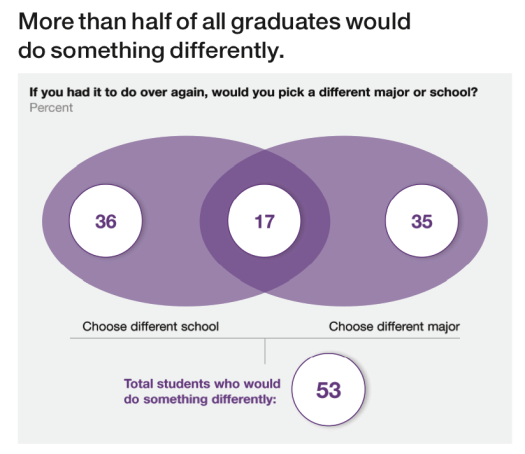
in after graduation, saying many don’t require a college degree. Many students also feel unprepared for the world of work; the transition from campus to office today is anything but seamless. Half of all graduates express regrets, saying they would pick a different major or school if they had to do it all over again. Students also say that when they were deciding what college to attend, they didn’t consider graduation rates or the job and salary records of graduates.
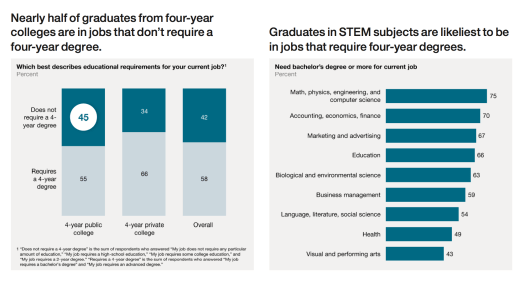
When it came to their transition to work, students felt disappointed—many, even those at top institutions, were unable to find work in their chosen field.
For example, assuming that our sample is broadly representative of the nation’s 1.7 million college graduates last year, roughly 120,000 Americans who would rather work elsewhere took jobs as waiters, salespeople, cashiers, and the like. That’s one every five minutes.
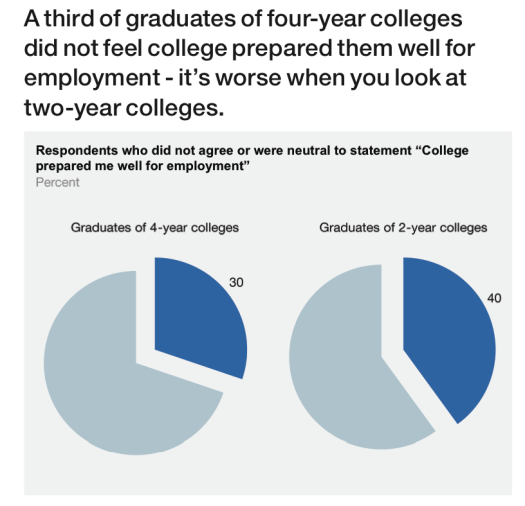
Liberal-arts and performing-arts graduates tend to be lower paid, deeper in debt, less happily employed, and slightly more likely to wish they’d done things differently. By contrast, those who majored in business management or science, technology, engineering, or mathematics (STEM) fields feel readier for the workplace and more satisfied overall.
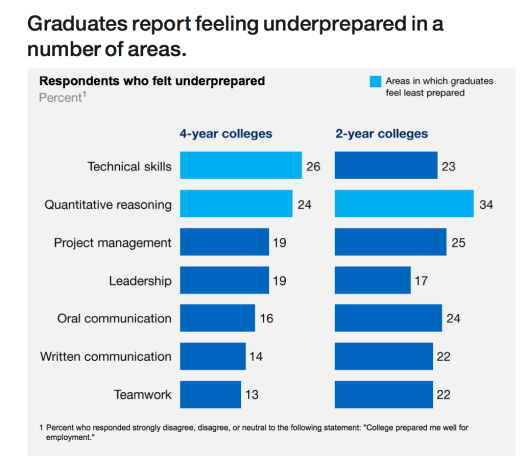
Finally, in searching for a job, most graduates report using a “do it yourself” approach; the vast majority do not use career services offered by their college or tap into alumni networks to help find a job.
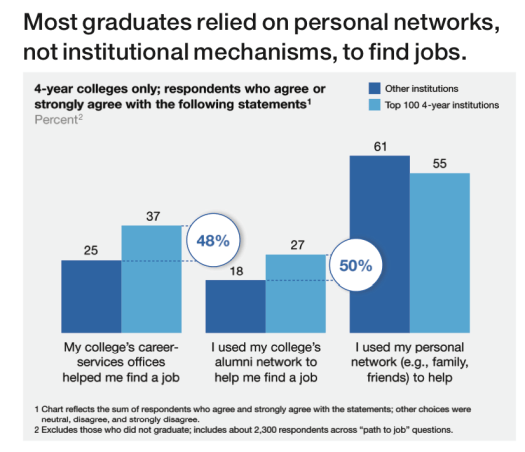
Source: Voice of the Graduate McKinsey on Society.
Full Report @:



 Job Market Monitor
Discussion
Trackbacks/Pingbacks
Pingback: Job Search Tool for Grads / LaunchPad connects job seekers with professional advisors | Job Market Monitor - May 14, 2013
Pingback: US / Half of College Grads Are Overqualified For Their Current Job | Job Market Monitor - May 29, 2013
Pingback: The Skills Gap in US / Don’t Blame Students for it | Job Market Monitor - October 9, 2013
Pingback: UK / Almost half of graduates work in non-graduate jobs, says ONS | Job Market Monitor - November 22, 2013
Pingback: Grads in US / Finding a good job has indeed become more difficult | Job Market Monitor - January 17, 2014
Pingback: Skills Gap in US – We need to kill this zombie writes Krugman | Job Market Monitor - April 8, 2014
Pingback: US – Public, private or a top 100-ranked school do not make a difference in workplace engagement or well-being study finds | Job Market Monitor - May 7, 2014
Pingback: Overeducation in US – 66% of workers remaining overeducated after one year research finds | Job Market Monitor - June 3, 2014