‘In order to address an immediate and long-term funding problem, the Social Security Amendments of 1983 gradually increased the Full Retirement Age (FRA), changed the actuarial adjustment for individuals claiming benefits between the early and full retirement ages, and increased the delayed retirement credit. Together, these changes increase the financial gain to individuals who delay claiming their Social Security benefits. Recent work has shown that individuals are delaying retirement in response to the incentives laid out in the 1983 Amendments ‘ write Norma B. Coe, Mashfiqur Khan, and Matthe W S. Rutledge in STICKY AGES: WHY IS AGE 65 STILL A RETIREMENT PEAK? on crr.bc.edu. *
However, a large share of people continue to claim their Social Security benefits at age 65 they add.
The paper explores two potential explanations for the “stickiness” of age 65 as a claiming age: Medicare eligibility and workers’ lack of knowledge about their future Social Security benefits.
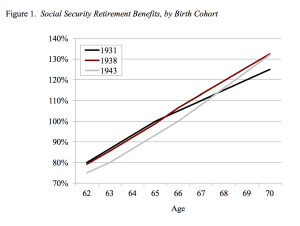
First, the author analyze the impact of Medicare eligibility by comparing two groups – one has an FRA of exactly 65; the other, between age 65 and 2 months and age 66. They find that the group with later FRAs who do not have access to retiree health benefits through their employer are more likely to claim Social Security at age 65. They interpret this finding as evidence that Medicare eligibility persuades more people to retire, because they can begin receiving federal health coverage. Individuals without access to retiree health insurance at work are 7.5 percentage points more likely to retire soon after their 65th birthdays and are 5.8 percentage points less likely to delay retirement until the FRA than those with that insurance. This result fits into extensive research showing that access to health insurance is an important component of the retirement decision.
On the question of whether misinformation about Social Security benefits may drive individuals to claim at age 65, they find that some individuals are unable to accurately forecast their retirement benefits. However, their analysis suggests that there is no relationship between this confusion and the age 65 peak for claiming Social Security.




 Job Market Monitor
Discussion
Trackbacks/Pingbacks
Pingback: US / 47 per cent of working now expect to retire later survey finds | Job Market Monitor - October 15, 2013
Pingback: Older Workers in US / Attitudes on work and retirement | Job Market Monitor - October 16, 2013
Pingback: US – 71 percent are adequately prepared for retirement RAND finds | Job Market Monitor - August 12, 2014