Most long-term workers who were laid off in the different economic contexts of the early 1990s and the early 2000s managed to find work and earn wages or salaries during the next five consecutive years.
However, many experienced earnings losses when they returned to work. The magnitude of losses varied significantly depending on factors such as labour market conditions and the employment trajectory individuals experienced prior to losing their jobs.
From 2000 to 2003, a period of relatively low unemployment in Canada, 977,000 people aged 21 to 55 who had a ‘stable attachment’ to the labour market were permanently laid off. (‘Stable attachment’ refers to six or more consecutive years earning wages or salaries prior to the layoff.)
Of this group, 650,000, or 66%, subsequently found work and received wages or salaries over the next five consecutive years.
In contrast, during the high-unemployment period of 1990 to 1993, nearly 1.1 million core-aged workers with a stable attachment to the labour market were laid off. About 54% of them found work and received earnings over the next five years.
The study divided these workers into three groups: roughly 20% had high seniority; about 30% had low seniority; and the remaining one-half had previously been laid off.
Five years after being displaced, previously laid-off workers who lost their jobs during the early 1990s experienced losses in earnings ranging from 15% to 30%. The losses of their counterparts laid off during the early 2000s ranged from 2% to 15%.
For workers who had been previously laid off―a group that represents a significant segment of displaced workers―better labour market conditions mitigated long-term losses in earnings.
In contrast, many high-seniority workers experienced substantial long-term earnings losses in both periods.
For instance, high-seniority men aged 36 to 55 experienced long-term earnings losses that ranged from 16% to 27% during the early 1990s and from 15% to 23% during the early 2000s.


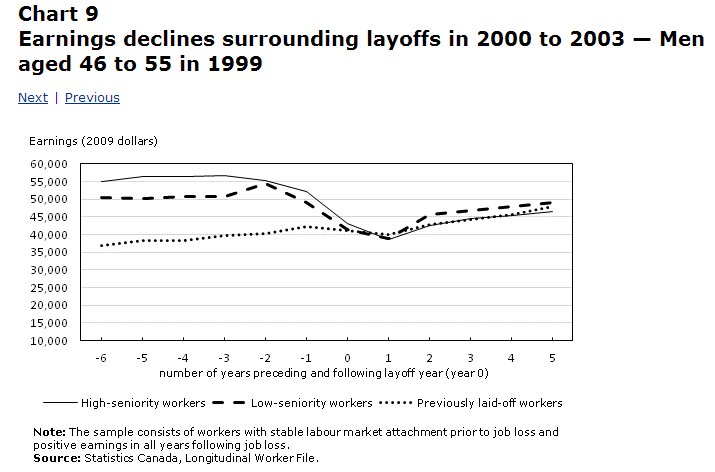 .
.
 Choosen excerpts by Job Market Monitor from

via The Daily — Earnings losses of displaced workers with stable labour market attachment, 1990 to 2003.



 Job Market Monitor
This is very attention-grabbing, You are an excessively skilled blogger.
I have joined your rss feed and sit up for seeking extra of your great post.
Additionally, I’ve shared your website in my social networks
Posted by http://flydrops.com/ | August 11, 2014, 3:00 pm