When the economic shocks that cause recessions in different economies have large common components, there may be lessons to be learned by studying how different economies respond write Thomas F. Cooley, B. Ravikumar, and Peter Rupert in Bouncing Back from the Great Recession: The United States Versus Europe in Federal Reserve Bank of St. Louis Economic Synopses (Adapted choosen excerpts by JMM to follow)
The effects of the Great Recession of 2008-09 have been wreaking havoc on the U.S. economy for nearly five years. Many authors have used the depth of the recession and the sluggish recovery to compare the recent recession to previous recessions, including the Great Depression. For instance, Glenn Hubbard, chairman of the Council of Economic Advisers from 2001 to 2003, recently compared the current recovery to the recoveries from the 1973 and 1981 recessions.1 Why is this the right comparison?
Certainly we cannot expect the shocks that hit an economy to always have the same economic outcomes. Even if the causes of the Great Depression were the same as those of the Great Recession, the economy of the 1930s is not the economy of today, so we should not expect it to respond in the same manner.
When the economic shocks that cause recessions in different economies have large common components, there may be lessons to be learned by studying how different economies respond. This essay looks at six major economies in Europe—France, Germany, Italy, the Netherlands, Spain, and the United Kingdom—and compares them with the United States on two key economic variables: gross domestic product (GDP) and unemployment. Since aggregate demand has been used as the basis for the policy responses in the United States and Europe, this essay also compares the paths of consumption and investment.
Figure 1 shows GDP in the United States and the major European economies. Several findings are apparent. First, the size of the contraction was much steeper in Europe: GDP in Germany, the United Kingdom, and Italy fell more than GDP in the United States. Second, the recovery in the United States has been steady, similar to the recovery in Germany. The other European economies are still below their 2008 peaks.

Unemployment has been the persistent problem with the U.S. recovery.
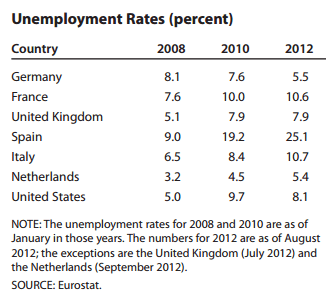
The table shows that the U.S. unemployment rate was initially lower than the unemployment rate in most European countries. While the U.S. unemployment rate has been falling from its high of 9.7 percent in January 2010, the unemployment rate in European countries (except Germany) has been on an upward trend since 2008…

via Economic Synopses – Research Publications – St. Louis Fed.



 Job Market Monitor
Reblogged this on ZYNKIN NEWS and commented:
No chance ….it will get worse as the problem is nobody can agree to any solution because they do not know one
Posted by Z | November 18, 2012, 11:30 am