So it turns out the United States is not, in fact, the educational wasteland tech industry lobbyists would have you think.
Companies like Microsoft often claim that America is suffering from an economically hobbling shortage of science, math, and computer talent. The solution, they argue, is to let employers fill their hiring gaps by importing tens of thousands of educated guest workers beyond what the law currently allows. Much as farmers want to bring in field workers from Mexico on short-term visas, software developers desperately want to bring in more coders from India…
Our Programmer Surplus
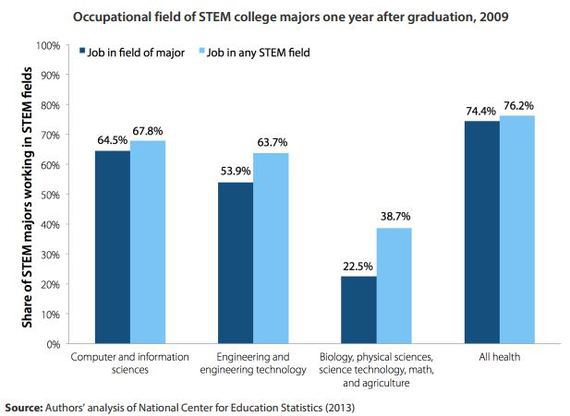
Colleges, for instance, are already minting far more programmers and engineers than the job market is absorbing. Roughly twice as many American undergraduates earn degrees in science, technology, engineering, and math disciplines than go on to work in those fields. As shown in the EPI graph below, in 2009 less than two thirds of employed computer science grads were working in the IT sector a year after graduation.
Meanwhile, the unemployment rate for programmers is still stuck well above its pre-recession average.
Could it be that schools aren’t teaching their students the right stuff, that despite their fancy credentials, today’s grads lack the programming chops or logical prowess needed to succeed at a Google or Microsoft? Not so much.

In industries where talent is scarce, economists generally expect wages to rise, as desperate companies go chasing after what few qualified souls they think can do the job. That’s exactly what’s happened to oil and gas engineers over the last decade during the energy boom, for instance. But while there have certainly been anecdotal accounts of Silicon Valley firms tossing outrageous sums at elite college students, in the big picture, programmer salaries have been stagnant ever since the dotcom bubble went bust more than a decade ago. The pattern holds whether you look at the national data, or just at traditional tech centers such as Silicon Valley, the Route 128 corridor outside Boston, Dallas, or Austin, where you’d expect competition for talent to be hottest.
Chosen excerpts by Job Market Monitor

via America’s Tech Talent Shortage Is A Myth – Business Insider.



 Job Market Monitor
Discussion
No comments yet.