US Job Market Nearly ‘In Recession’
“…Some economists and analysts now wonder if the BLS seasonal adjustments are somehow off a bit. If the financial crisis and recession mucked with the seasonal ebb and flow of the economy, then the adjustments that BLS makes for its monthly reports might be a bit skewed. Some jobs reports might look much better than they actually are. And others might look worse” writes Brad Plumer in Wait, the U.S. economy actually lost 1.2 million jobs in July? on washingtonpost.com.
Calculated Risk rigthly notes:
One way to remove the seasonal factors is to look at the 12 month net change in payroll jobs. This graph shows the 12 month net change for both total employment and private employment.
Over the last 12 months, the economy has added 1.94 million private sector jobs, and 1.83 total non-farm payroll jobs (the public sector has lost 111 thousand jobs over the last 12 months).
Note that the red line has been above the blue line for the last few years – this is very unusual and is due to the decline in employment at all levels of government (especially state and local).

Source: calculatedriskblog.com
But the main point, from our point of view, is that the Job Market is nearly entering ‘in recession’.
In statistical terms, we call this type of data ‘seasonnal differences’ because it takes away the seasonal factor under some conditions namely, this factor is additive and always the same for a given month, whathever the year.
One could argue that those conditions rarely hold. So could take a ‘robust’ transformation that will get rid of those conditions. This is what is done with the 3 months moving median. A very robust procedure.
The figure below presents the results. And it is to be noted that the shapre of the later months is not altered. The curve is pointing down.
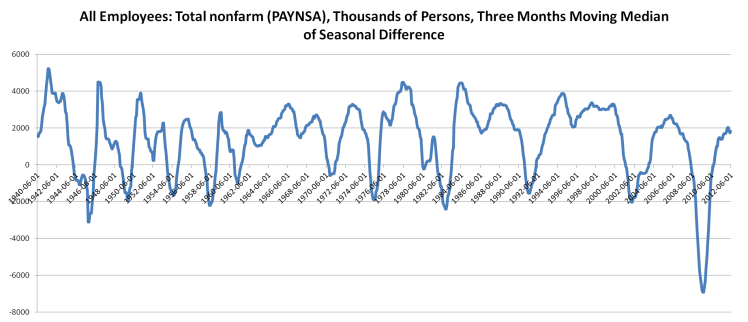
You might wonder what is happening with the ‘timing’ when one takes ‘seasonal differences’. The answer is simply nothing.

Source: research.stlouisfed.org
You can see by yourself from this FRED graph with shaded areas representing the past recessions. The job market is usualy late in coming into recession, we say il lags behind. But sharp drops are clearly associated with recessions. This might be happening the last couple months. Let us hope not. Otherwise, United Kingdom will not be alone double dipping.



 Job Market Monitor
Discussion
Trackbacks/Pingbacks
Pingback: France – A Second Recession In Three Years « Job Market Monitor - August 10, 2012
Pingback: US – 5 Reasons Why the Job Market is Going In Recession « Job Market Monitor - September 7, 2012
Pingback: États-Unis – 5 Raisons pourquoi le marché de l’emploi plonge vers la récession « Moniteur de l'Emploi - September 7, 2012
Pingback: États-Unis – 5 Raisons pourquoi le marché de l’emploi plonge vers la récession « Moniteur de l'Emploi - September 13, 2012