- Statistics Canada’s Labour Force Survey (LFS) underestimates the rapidly growing non-permanent resident (NPR) population. This undercount potentially distorts important economic indicators, such as nominal wage growth and unemployment rates, because NPRs disproportionately influence these measures as a growing share of new labour market entrants.
- To address this data gap, this E-Brief recommends revising the LFS to better identify NPRs by including specific questions about study or work permits and exploring the possibility of linking survey data to immigration records for improved accuracy.
—————–
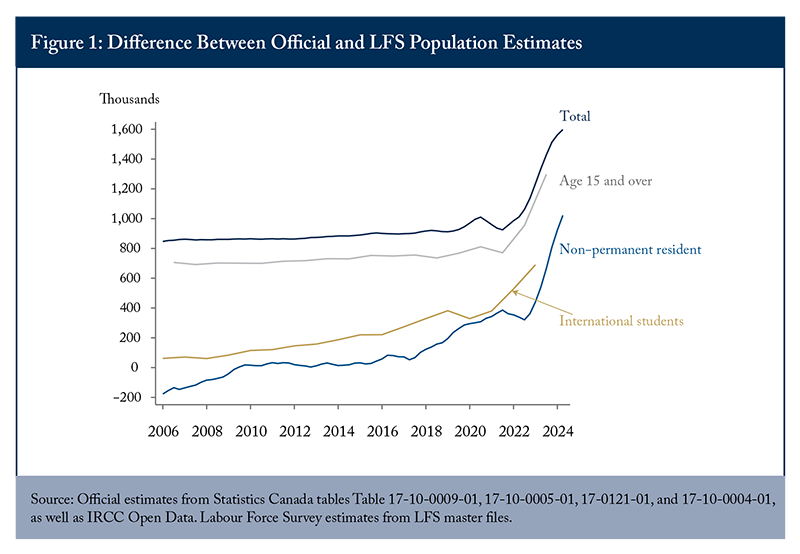
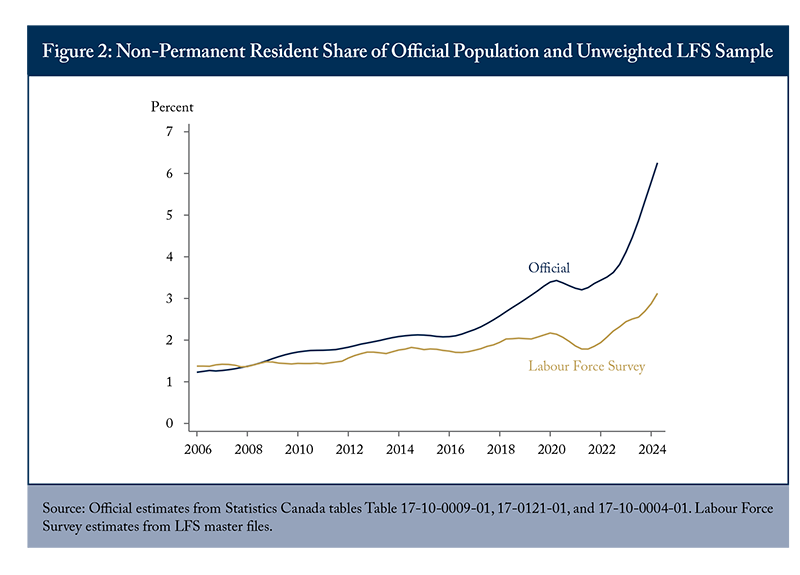
By the second quarter of 2023, NPRs comprised 6.8 percent of Canada’s population but only 3 percent of individuals sampled by the LFS. The undersampling of NPRs in the LFS is not inherently problematic. The problem arises because the LFS sampling weights fail to correct for the lower response rates of NPRs. NPRs are a distinct demographic group that is younger and, in recent years, are likely to be concentrated in the low-wage service sector. Because their employment patterns and wage outcomes are different, their underrepresentation inevitably skews LFS results.
More importantly, changes over time in average wage rates and unemployment rates are not driven by workers who are established in their jobs. Rather, these changes are driven by new labour market entrants. In recent years, this has overwhelmingly been NPRs in Canada. The fact that the LFS is unable to identify this growing segment of the population is a first-order problem that needs to be addressed.
The growing underrepresentation of NPRs in the LFS highlights a fundamental limitation of the survey in capturing this increasingly significant demographic group. While such limitations may have been acceptable when the NPR population was small, the current size and importance of this population make the issue far-reaching. Beyond its implications for government policymakers and economists, this underrepresentation distorts our understanding of labour market dynamics, immigration trends, and economic policy. Addressing this gap is far from a technical improvement – it’s a necessity for informed decision-making in an era of rapid demographic change.
While the federal government plans to lower the NPR share of the population to 5 percent by January 2027, the Bank of Canada is skeptical that they will be successful.9 NPRs are likely to comprise a significant share of the Canadian labour force for many years to come.
A first step in improving the representativeness of the NPR population in the LFS is to revise the LFS questionnaire so that NPRs are directly identified. The survey questionnaire first asks all respondents about their country of birth. Those who indicate they were born outside of Canada are then asked whether they are a “landed immigrant” and the year they became one. Foreign-born respondents who indicate they are not landed immigrants should then be asked if they currently hold a study visa or work permit or are asylum claimants. In this way, NPRs would be directly identified in the LFS. For nearly all research purposes, what is most relevant is the date a migrant arrived in Canada, rather than when they obtained permanent residency status. This distinction is important because temporary immigration arrivals have increasingly surpassed those through permanent residency. The current question asking landed immigrants when they landed should, therefore, be replaced with a question asking all foreign-born residents, including NPRs, when they first arrived in Canada.10
Before introducing these changes in the basic monthly questionnaire, an LFS supplement should be used to gauge the measurement error in the current data. This includes determining the extent to which NPRs are mistakenly identified as landed immigrants due to respondent or interviewer misunderstanding of the term “landed immigrant.” Alternatively, Statistics Canada could explore the feasibility of linking LFS respondents’ data to their temporary permits and landing records in the Immigration Longitudinal Database (IMDB).
Increasing the representation of the NPR population, particularly international students, in the LFS survey could significantly improve the accuracy of the LFS’s estimates of nominal wage growth and unemployment rates. It would also clarify whether NPRs are displacing existing residents and suppressing their wages.
Chosen excerpts by Job Market Monitor. Read the whole story @ The Growing Data Gap on Canada’s Temporary Resident Workforce – C.D. Howe Institute



 Job Market Monitor
Discussion
No comments yet.