Understanding the relationships between skills gives us insights into the needs of the labour market and the complexities of understanding skill demands. This report demonstrates how online job postings serve as a valuable source of labour market information that can be used to better understand the relationships between skills and to highlight trends in skill demands.
Using three replicable methodologies—frequency measurement, association through normalized pointwise mutual information, and predictors based on directional relationships—this report explores skill connections based on mentions of skills in job postings. Understanding the connection(s) between two skills gives us insights into the nuances of skill demand and how the demand for a specific skill can change across circumstances.
To demonstrate our approach, the report includes three case studies focusing on the most in-demand skills:
- Teamwork. As this skill is broadly requested across occupations, offering a point of consistency for exploring how relationships between skills shift with different approaches.
- Communication skills. With varied demand across occupations, these provide an example of how context affects the relationships between skills.
- Customer service skills. Primarily associated with sales and service roles, we explore how specialized skills function within their primary occupational group and in other fields.
These case studies illustrate how advanced methodologies can uncover actionable insights into skill demand and relationships to inform workforce planning, career development and policy-making. By sharing how to use data from online job postings to analyze the relationships between skills, the Labour Market Information Council (LMIC) is setting the stage for new research to address the evolving needs of Canada’s labour market.
KEY FINDINGS
In 2023, there were 4,552 unique skills extracted from almost 3.1 million job postings. Notably, the most unique skills appear in a limited number of postings, with only 710 skills appearing in 500 or more.
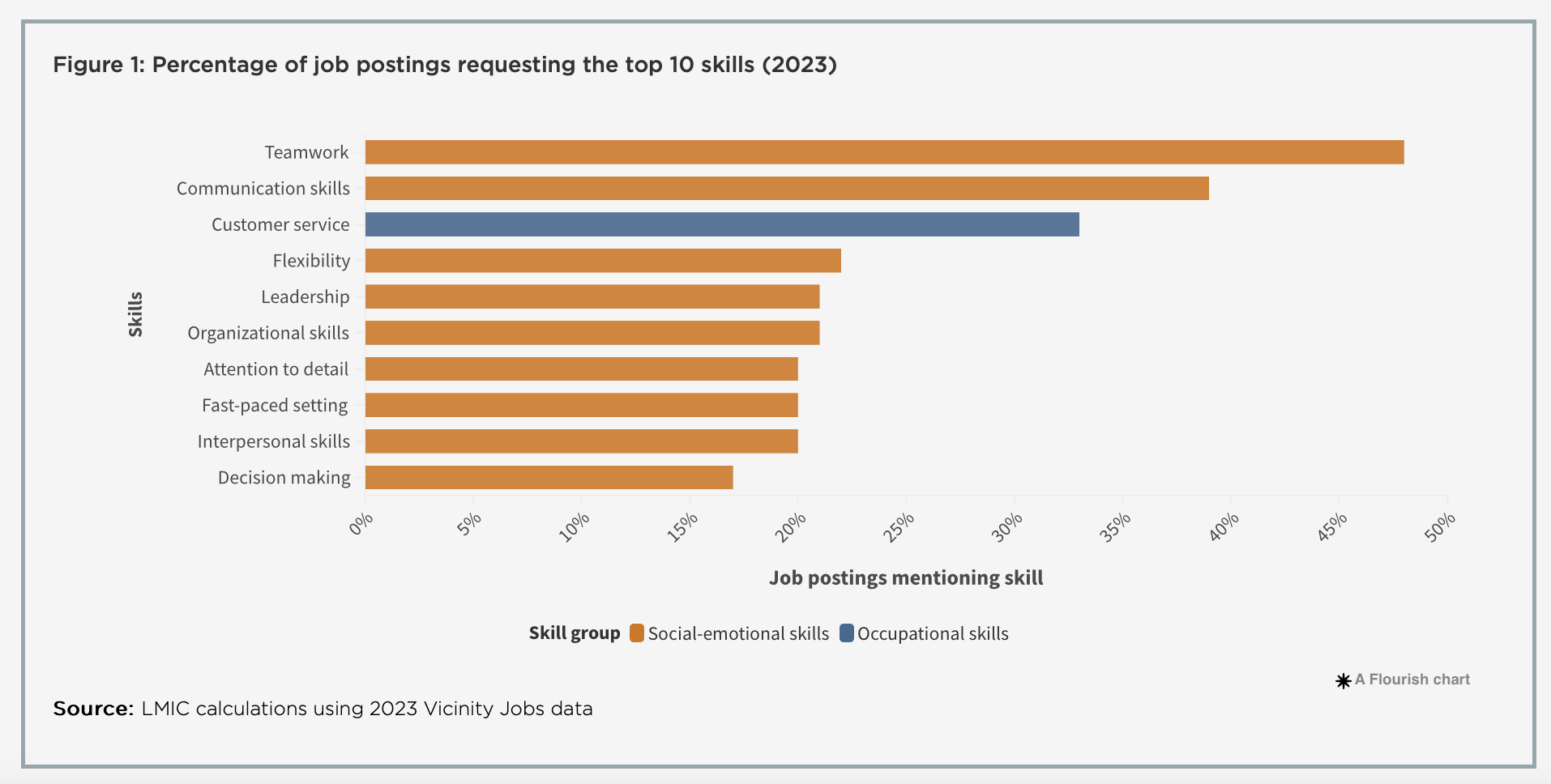
Social-emotional (or soft) skills account for nine of the 10 most frequently requested skills. Customer service (primarily associated with sales and service roles) is the only occupational skill among the top 10.
Teamwork, communications skills, and customer service are the most frequently requested skill types, appearing in 48%, 39% and 33% of postings, respectively.
Relationships between skills vary across occupations, indicating employers’ different expectations for skills depending on occupation.
Certain skills predict the presence of others in postings. For example, strong writing skills correlate with demand for overall communication skills; being goal-oriented is often requested alongside teamwork skills; and operating a cash register is linked to demands for customer service skills.
Chosen excerpts by Job Market Monitor. Read the whole story @ Connecting Skills: Using online job postings to unravel the demand for skills in the labour market — LMIC-CIMT
Related Posts
New Technologies and Artificial intelligence – How they are transforming tasks : analyzing 170 million online job postings
Technology has long brought change to the nature of work, and to the skills required for the most desirable, best-paying jobs. But until recently, new technology – even robotics – has tended to mean automating repetitive or arduous tasks, while often leading to new types of tasks for workers. The emergence of artificial intelligence (AI) … Continue reading
Job Postings on Online Platform for IT Occupations – Posting duration is fairly short and a small share of postings receive the bulk of applications
In work with Brenda Samaniego, Steven J. Davis, the William H. Abbott Professor of Economics at the University of Chicago Booth School of Business, uses job postings from an online platform for IT occupations, Dice.com, to learn about the life cycle of a job ad. Davis and Samaniego find that posting duration is fairly short: … Continue reading
Skill Disruption Index – The key skills in the average job have changed 37% in five years
The key skills in the average job have changed 37% in five years. Track the change with our new Skill Disruption Index. Based on analysis of more than 15 million job postings, this research demonstrates that the top 20 skills requested for the average job in the US have changed in the last five years, … Continue reading
AI Skills – 150 000 AI-related job postings in the US in 2018
Artificial Intelligence (AI) is reshaping economies and societies. While often in their infancy and with much potential to be fulfilled, AI technologies promise to overhaul production by improving efficiency, reducing costs, multiplying product and service offerings, and supporting decision-making, among others. As AI permeates economies and societies, it nevertheless raises questions and fuels anxieties, including … Continue reading
(Update) Pathways and Job Transitions in Canada – OpportuNext, a new free tool
The global pandemic has hit Canada’s employment landscape hard and forced many Canadians to transition to new opportunities in search of stability. Many jobs in industries such as travel, hospitality and retail have temporarily vanished, causing tens of thousands of people to look for new employment opportunities. Helping Canadians adapt to these very real and … Continue reading
Digital Skills in Online Job Ads in Germany – The share that required at least one digital skill rose from 38.1% in 2014 to 47.5% in 2018
Digitalization is becoming commonplace in the world of work. Of all the online job ads analyzed for the study, the share that required at least one digital skill rose from 38.1% in 2014 to 47.5% in 2018. In terms of the digital intensity of different types of jobs, the findings show that, in 2018, almost … Continue reading
Skills, Employers and Grads – Job posting data to complement existing labour market information systems
What skills do employers seek in graduates?Using online job posting data to support policy and practice in higher educationEmployers increasingly reach job seekers through online job postings, particularly for jobs requiring a higher education qualification. Job postings available online provide a rich source of real-time and detailed data on the qualifications and skills sought by … Continue reading
Future of Work in Ireland – Six groups with the largest number of persons employed whose jobs were at high risk of automation
The COVID-19 pandemic has triggered a seismic change in the way in which the labour market operates globally, with the fundamental relationship between the workplace and the workforce likely to be changed on a long-lasting basis. The future world of work, in particular at occupational level, should see a continued embracing of practices being utilised recently … Continue reading
Digital Skills Most In Demand in Job Postings in Canada – Not highly technical programming languages, but everyday digital skills
To illuminate the different combinations of skills that Canadians need to be competitive in the labour market, we have partnered with Burning Glass Technologies (Burning Glass) to examine job posting data from January 2012 to December 2018. This data covers all of the English- language online job postings in Canada, and reflects the combination of … Continue reading
Jobs and Skills – What’s Trending
Technology is driving change in the job market; change that can be tracked by the speed of growth, according to a new study from Boston Consulting Group and Burning Glass Technologies. The study examines more than 95 million online job postings over three years to identify both the fastest-growing jobs and fastest-growing skills in the … Continue reading
Future of Work – Computerization of white collar jobs
For centuries, advances in labor-saving technology have been met with fear that such technology will eliminate jobs. In the computer era, seminal work by Autor, Levy, and Murnane (2003) clarified that certain jobs are most at risk from technology, in particular so-called routine jobs which are made up of tasks most easily substituted for by … Continue reading
Skills in Postings in Europe – Cedefop’s findings
Since mid-2018, Cedefop’s online job vacancies data retrieval system has collected around 32 million unique vacancy postings in Czechia, Germany, Spain, France, Ireland, Italy and UK. Their labour markets equal around two-thirds of employment in the EU. 79% of the online job vacancies has been collected from private online job portals, 15% from public portals … Continue reading
The Future of Work – Job Transition Pathway Optimization Model for reskilling and upskilling
As the types of skills needed in the labour market change rapidly, individual workers will have to engage in life-long learning if they are to achieve fulfilling and rewarding careers. For companies, reskilling and upskilling strategies will be critical if they are to find the talent they need and to contribute to socially responsible approaches … Continue reading
Online talent platforms economic impacts in the United States, the United Kingdom, Germany, Japan, China, India, and Brazil
Online talent platforms are increasingly connecting people to the right work opportunities. By 2025 they could add $2.7 trillion to global GDP, and begin to ameliorate many of the persistent problems in the world’s labor markets, write James Manyika, Susan Lund, Kelsey Robinson, John Valentino, and Richard Dobbs in a report issued by McKinsey Global … Continue reading
US – Top 10 creative jobs in demand
Everyone knows the top-paying jobs are typically found in science and business. However, there are plenty of top-dollar career options for professionals whose passions are in the creative fields: coming up with new and original ideas, projects or products. CareerBuilder and Emsi compiled a list of the top 10 creative jobs the labor market needs … Continue reading



 Job Market Monitor
Discussion
No comments yet.