In this research, we explore what’s holding back Canada’s productivity growth—and therefore the country’s prosperity—and suggest ways to give it a boost.How could Canada unlock more private sector investment without costly publicly funded incentives? In which sectors of the economy is weak productivity growth the most concerning? Could taking advantage of technologies such as artificial intelligence be the answer to help bolster productivity?
Key findings
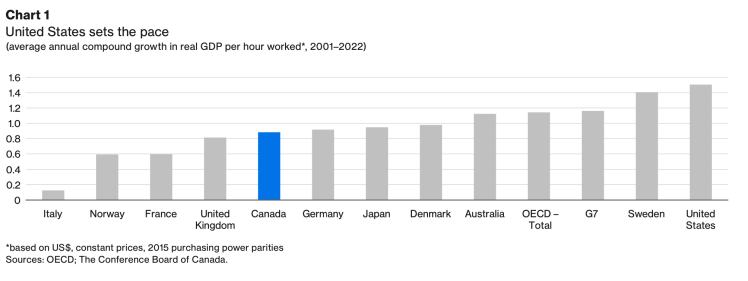
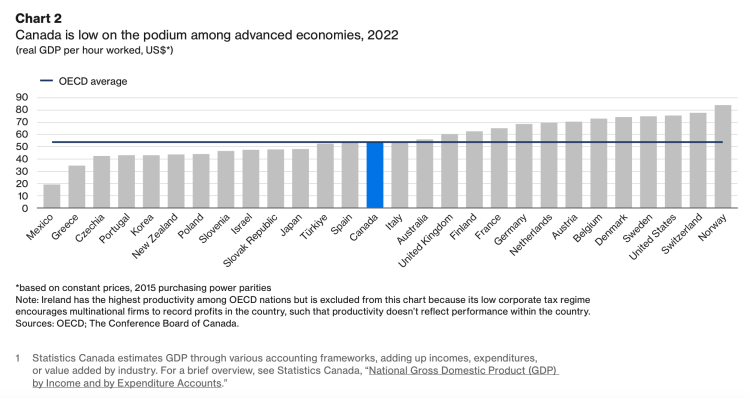
• Canada has a productivity problem. Labour productivity growth
is lagging that of many developed economies. Understanding and
addressing the factors driving this poor performance is critical if
Canada is to maintain its long-term prosperity.
• Increased educational attainment and skills have contributed steadily
to Canada’s productivity growth, but capital intensity and efficiency
have had setbacks and have contributed unevenly across industries.
• Weakening business investment reduced productivity growth by
0.5 percentage per year over the past decade. If that slowdown had
not occurred, nominal GDP would be roughly $130 billion (4.2 per cent)
higher today.
• To enhance productivity growth, Canada must focus on unlocking
private sector investment. A review of the competitiveness of the
country’s regulatory and corporate tax regime with other jurisdictions
should be a starting point.
• A lack of competition is also detrimental to business investment.
Eliminating internal trade barriers, a long-standing problem, could
provide a solid boost to Canada’s prosperity.
• The good news is Canada’s businesses are becoming more
knowledge-intensive, and adopting technologies such as AI may
provide the next productivity boost our country so desperately needs.
Chosen excerpts by Job Market Monitor. Read the whole story @ Cracking the Productivity Code: Charting a New Path to Prosperity – The Conference Board of Canada
Related posts
Canada-US Labour Productivity Gap – The top 10% of the income distribution accounts for two-thirds
Gross domestic product (GDP) per adult in Canada fluctuated between 70% and 90% of that of the United States between 1960 and 2020. Behind this gap lie large, systematic differences in relative incomes across the Canadian and US income distributions. There are small differences in average incomes among lower percentiles of the income distribution while … Continue reading
Skills and Productivity in Canada – Skills shortages explain 7 per cent of the gap between U.S. and Canadian productivity
Skills shortages hamper Canada’s productivity growth. If there had been no skills shortages over the past 20 years, Canada’s GDP would be 1.8 per cent, or $49 billion, larger. Key findings • Skills shortages hamper productivity growth. We estimate Canada’s GDP would be up to 1.8 per cent, or $49 billion, larger today if there … Continue reading
Investment and Productivity in Canada – Investment per worker declined by 20% from 2006 to 2021, significantly in large and medium-sized firms
Investment in fixed capital has been weak in Canada since the mid-2000s. The ratio of investment to net capital stock and investment per worker declined after 2006, especially after 2014. As a result of this investment slowdown, the growth in labour productivity declined after 2006. This paper examines the sources of this weakness in capital … Continue reading
Productivity in Canada – Gone into reverse in the past five years
Not only has Canada’s productivity lagged the U.S. for decades, the trend has actually gone into reverse in the past five years. It is not news that Canada’s productivity performance is listless and lagging U.S. trends. That has been going on for decades. But what is news is that productivity has actually gone into reverse … Continue reading
Slowing Labour Force Growth in Canada – The country can no longer rely on labour force growth to offset its poor investment and productivity record of recent years
Most projections show that the growth of Canada’s labour force will continue to slow for years, with growth dependent on immigration as our population ages. However, the pandemic has reinforced the fact that projections about the future are inherently uncertain. Already, immigration fell sharply in 2020. The pandemic’s effect on the long-term course of labour … Continue reading
Labour productivity in Canada, QIV 2018 – Declines for the second time in four quarters
Labour productivity of Canadian businesses decreased 0.4% in the fourth quarter, after rising the two previous quarters. This decline reflected the continued growth in hours worked, while business output remained at about the same level as in the previous quarter. Chosen excerpts by Job Market Monitor. Read the whole story at The Daily — Labour productivity, hourly compensation and unit … Continue reading
Human Capital and Labour Productivity in Canada – HC contribution to productivity growth is substantial
“The good fortune of bountiful natural resources is not enough to ensure rising incomes for Canadians in the long term. Growing labour productivity is the most important determinant of future economic welfare and on that measure, Canada is falling behind its major trading partners.” writes Serge Coulombe in Lagging Behind: Productivity and the Good Fortune … Continue reading
Canada – Labour productivity of a firm engaging in offshoring was 6.8% higher StatCan finds
Offshoring refers to the sourcing of intermediate inputs for domestic production abroad. Specifically, in this paper, offshoring refers to goods imported directly by manufacturers, including both intra- and inter-firm transactions across international borders. Excluded, because of data limitations, are goods imported through intermediaries as well as services. Firms engaging in offshoring are found to be … Continue reading
Canada – Labour productivity rose 1.8% in Q2
Labour productivity of Canadian businesses rose 1.8% in the second quarter, after edging down 0.1% in the first quarter… In the United States, labour productivity of American businesses rose 0.6% in the second quarter, following a 1.3% decline in the first quarter. For Canadian businesses, labour costs per unit of production increased 0.3% in the second quarter, one-third of the … Continue reading
Canada / Labour productivity fell 0.5% in the third quarter
The labour productivity of Canadian businesses fell 0.5% in the third quarter, following a 0.6% decline the previous quarter. It was the second consecutive decrease after three quarterly gains. Chart 1 Productivity in Canadian businesses declines once more The decline in productivity in the third quarter took place in a context where business output remained at the same level … Continue reading
OECD – Canada: Overall productivity has actually fallen since 2002
Canada has weathered the global economic crisis comparatively well but will have to become more productive to sustain its high standard of living, according to OECD’s latest Economic Survey of Canada… The report identifies sluggish productivity growth as the main long-term challenge facing Canada’s economy. Per capita income has increased in recent years, as more people … Continue reading



 Job Market Monitor
Discussion
No comments yet.