What will work be like in the future?
To build an understanding of what the next five decades may hold in store for workers, BCG engaged with more than 150 futurists through panel discussions and opinion surveys. Contrary to popular fears that the future will offer fewer work opportunities for people, most experts anticipate that rewarding work options will be plentiful. Individuals, organizations, and communities that build new skills will flourish. Economic sectors such as regenerative industries and areas that require strong creativity will offer new paths to sustainability and personal satisfaction.
Key Takeaways
Experts anticipate that jobs will blossom over the next fifty years—even as technology becomes more prevalent and climate challenges persist.
- With policies in place to build tomorrow’s critical skills, entire populations will benefit from new opportunities and clarified purpose.
- Jobs will be plentiful in regenerative, community-based economic models that support nature-based activities.
- High-demand skills will include interpersonal communications, holistic security, creativity, and continuous learning that begins with a community’s early schooling.
Four Boundaries That Frame the Future
Over the next several years, emerging technologies and cultural transformations such as generative AI and the rising influence of younger generations will continue to change the day-to-day experience of workers. It is not inevitable, however, that these large-scale global challenges will leave organizations and communities behind.
Leaders that wish to build employment policies and business strategies to support long-term job creation must respect several boundaries—a term frequently used in discussions of the future—that frame a successful future economy. (See Exhibit 1.) Staying within these boundaries will keep communities in an environment of prosperous job cultivation. Straying outside these limits may lead society to harmful outcomes. The four critical boundaries are as follows:
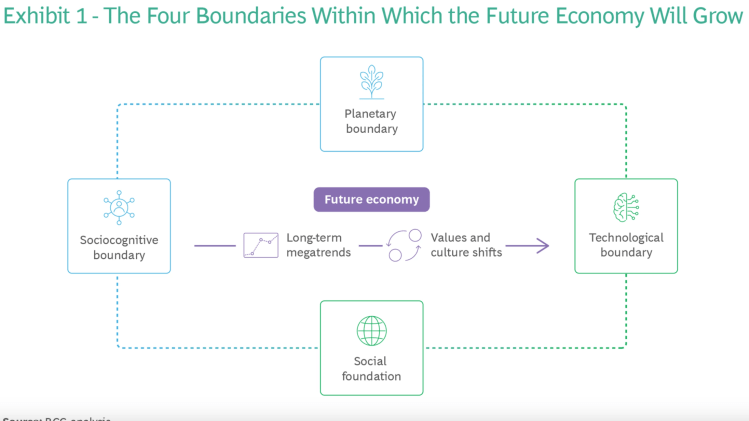
- Planetary Boundary. This boundary defines the environmental health that sustains humanity and enables it to thrive. Today’s economy violates this boundary with high carbon emissions and unsustainable manufacturing processes, and the situation could get worse. A scenario in which we humans cross this boundary too frequently—or exceed it to such an extent that we reach a point of no return—could cause critical damage to the planet.
- Technological Boundary. With AI evolving at a frenetic pace, the ever-shifting line between safe and hazardous use of technology can be difficult to define. But we must keep our bearings in this terrain. If humanity loses control of its technological assets—including robotics, geo-engineering, and biotechnologies—or misuses them, it risks advancing into a setting where the damage caused becomes irreversible.
- Social Foundation. The world of the future must deliver sufficient vital resources and conditions—water, food, shelter, and peace—to satisfy humanity’s basic needs. If inadequate supplies of these elements weaken society’s economic and infrastructural foundation, the world’s stability will weaken as well.
- Sociocognitive Boundary. When truth, trust, creative expression, and other essential elements sustain our collective mental health, we can make well-informed decisions about our collective future. Fake news, disinformation, and similar trends push humanity beyond this boundary, destroying social cohesion and impeding large-scale collaboration.
Chosen excerpts by Job Market Monitor. Read the whole story @ Foreseeing Future Work Opportunities | BCG



 Job Market Monitor
Discussion
No comments yet.