“Immigration targets slashed!” “Drastic reduction in temporary residents.” “Canada to reduce new immigration by 21 percent.”
These sorts of headlines dominated the news after the federal government’s announcement to reduce Canada’s intake of permanent residents by 21 percent over the next three years, alongside new measures aimed at bringing the temporary immigrant population in line with the prior goal.
But the story really depends on the angle.
Yes, Canada’s new targets are considerably lower than recent immigration inflows and the previously set targets of 500,000 new permanent residents in 2025 and 2026. And yes, Ottawa also plans to reduce the share of temporary residents in our population to 5 percent of Canada’s population by early 2027, down from today’s historic high of more than 7 percent, requiring a reduction of more than 30 percent in their population. However, comparing these new targets to the recent exceptional influx presents a distorted picture.
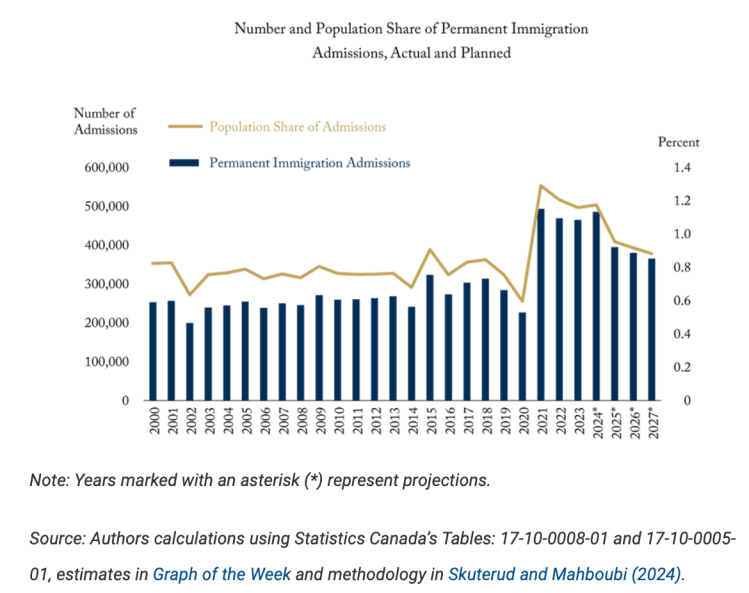
A more meaningful comparison is the two decades before the pandemic – when Canada’s immigration rate averaged 0.77 percent of the population (around 262,000 permanent residents annually).
Even with the planned reductions, Canada’s new targets still demonstrate a commitment to high immigration levels. The new targets for 2025, 2026, and 2027 – 395,000, 380,000, and 365,000, respectively – remain well above pre-pandemic levels (see Figure). Even the 2027 target of 365,000 exceeds any pre-2020 figure, representing 0.9 percent of Canada’s population and matching the highest pre-pandemic rate.
Canada’s new permanent immigration target rate of 0.9 percent of the population not only remains high by historical standards but also by global standards. The planned intake rate of 0.9 percent of the population is well above immigration levels in other major countries: the United States (0.3 percent), the United Kingdom (0.8 percent), and Australia (0.6 percent). Furthermore, the 5 percent cap on temporary residents remains significantly above the pre-pandemic peak of 3 percent in 2019.
However, while Canada maintains this relatively high intake rate, the emphasis should now be on ensuring that immigration benefits Canadians, both existing and new. The economic objective should be to enhance GDP per capita, rather than simply increasing the population.
For immigration to improve Canadians’ well-being, immigrants need to succeed. That requires refining the selection process to prioritize applicants with skills that align with Canada’s long-term needs rather than simply filling low-wage positions. Canada’s Express Entry system could be optimized by raising selection thresholds and requiring stronger language skills to attract individuals most likely to integrate successfully and contribute economically. A targeted approach that emphasizes applicants with high human capital and expected income would bolster productivity, increase GDP per capita, and support Canada’s vision of a prosperous, high-skill economy.
Immigration is central to Canada’s identity, and it will remain so under these new targets. Now we need to look beyond the sheer numbers and ensure that immigration delivers maximum benefits for everyone in Canada.
Chosen excerpts by Job Market Monitor. Read the whole story @ Don Drummond and Parisa Mahboubi – Mind the Spin Around Changes in Canadian Immigration Targets | C.D. Howe Institute | Canada Economy News | Canadian Government Policy



 Job Market Monitor
Discussion
No comments yet.