Wage growth is a key indicator that central banks monitor because labour costs are an important component of production costs and inflation. However, average wage growth can be a misleading measure of inflationary pressures. This is because it is a simple average of the wages earned by millions of people who have different skills, levels of experience and occupations. As a result, the average wage fluctuates based not only on labour market conditions but also on the composition of the workforce. However, wage growth driven by compositional changes is generally not informative about inflationary pressures and creates fluctuations that should be looked through.
A new wage growth measure
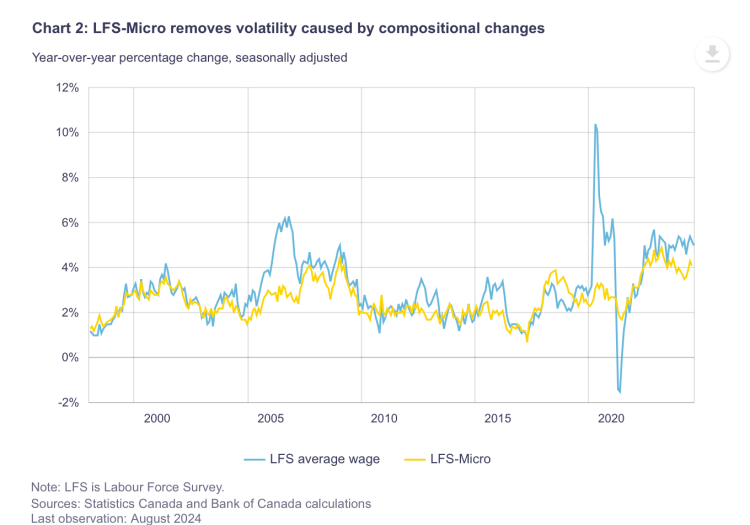
To achieve these goals, we introduce a new measure of underlying wage growth that we call LFS-Micro. This measure works within the limitations of the publicly available microdata from the LFS to calculate a measure of underlying wage growth that is separate from shifts in the composition of the Canadian workforce. We believe this approach improves our ability to monitor inflationary pressures coming from the labour market.
We find that composition-adjusted wage growth averaged 3.9% between January and August 2024. While this is still elevated relative to its history, it is significantly below the average wage growth of 5.1% recorded over the same period. Additionally, we find that a change in the occupational makeup of the workforce is the largest compositional effect, mostly due to an increase in the prevalence of high-earning management jobs.
Chosen excerpts by Job Market Monitor. Read the whole story @ Beyond the averages: Measuring underlying wage growth using Labour Force Survey microdata – Bank of Canada



 Job Market Monitor
Discussion
No comments yet.