Gross Domestic Product per capita is widely used to gauge differences in living standards across countries. Higher levels of per capita output are generally found in more developed economies with advanced infrastructure, better health care and education systems, and higher levels of access to technologies and innovation.
This article provides some additional perspective on the extent to which recent declines in Gross Domestic Product per capita represent a departure from the long-term trend in per capita growth, while highlighting factors that may effectively bolster per capita growth through improvements in business productivity. Drawing on recent research at Statistics Canada that examines the link between investment, competition and productivity, the article provides a guide to understanding how Canada fell behind and how it can get back to trend.
Chart 1 presents Canada’s real GDP per capita over the last four decades, along with a measure of long‑term trend growth (and a linear extrapolation of the long-term trend out to 2033). Since 1981, real GDP per capita has grown at an average annual rate of 1.1%, increasing from about $36,900 per person to $58,100 per person in inflation-adjusted dollars. The shock of the COVID-19 pandemic, coupled with falling per capita output in recent quarters, has left real GDP per capita 7% below its long-term trend, equating to a decline of about $4,200 per person. To return to its pre-pandemic trend over the next decade, GDP per capita would need to grow at an average annual rate of 1.7% per year.
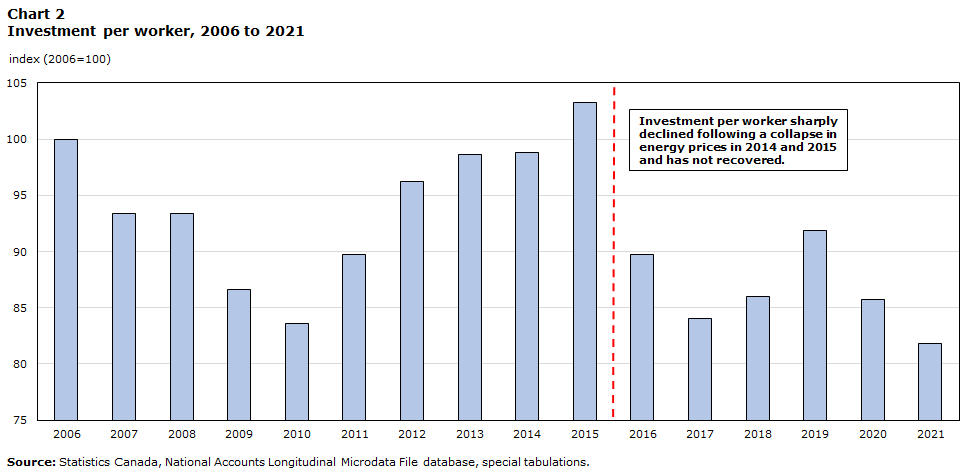
Improvements in productivity will require sustained increases in capital spending. New research by Gu (2024) underscores the link between investment and productivity growth. Indeed, the amount of fixed capital invested per worker was the most important source of labour productivity growth over the past 30 years. After increasing during the 1990s until 2006, investment per worker began to decline, especially after the collapse in commodity prices in 2014 and 2015. As of 2021, investment per worker in business sector industries was about 15% lower than in 2006 (Chart 2). Weaker competition between firms following the mid 2000s—through rapidly decreasing firm entry rates—further limited the amount of investment spending per worker, accounting for 30% of the decline.

Chosen excerpts by Job Market Monitor. Read the whole story @ Canada’s gross domestic product per capita: Perspectives on the return to trend



 Job Market Monitor
Discussion
No comments yet.