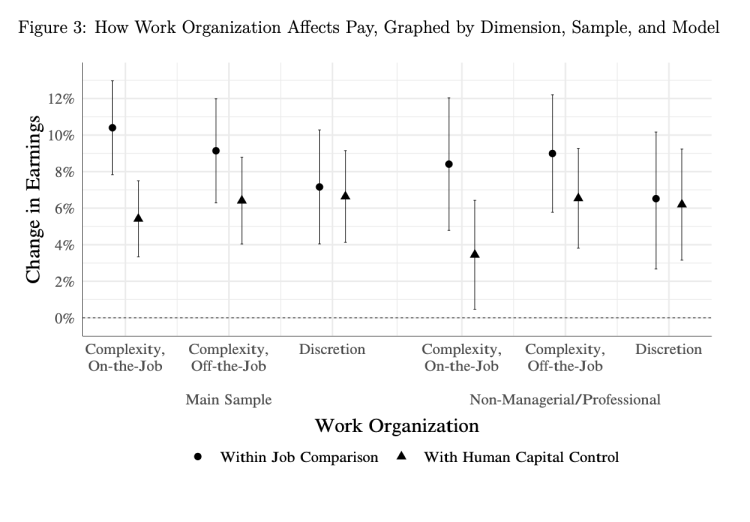
High-paying factory jobs in the 1940s were an engine of egalitarian economic growth for a generation. Are there alternate forms of work organization that deliver similar benefits for frontline workers? Work organization varies by type of complexity and degree of employer control. Technical and tacit knowledge tasks receive higher pay for signaling or developing human capital. Higher-autonomy tasks elicit efficiency wages. To test these ideas, we match administrative earnings to task descriptions from job postings. We then compare earnings for workers hired into the same occupation and firm, but under different task allocations. When jobs raise task complexity and autonomy, new hires’ starting earnings increase and grow faster. However, while half of the earnings boost from complex, technical tasks is due to shifting worker selection, worker selection changes less for tacit knowledge tasks and very little for adding high-autonomy tasks. We also study which employers provide these jobs: frontline tacit knowledge tasks are disproportionately in larger, profitable manufacturing and retail firms; technical tasks are in newer health and business services; and higher-autonomy jobs are in smaller and fast-growing firms. These results demonstrate how organization-level allocations of tasks can undergird high-paying jobs for frontline workers.
Unfortunately, there is currently no economy-wide, workplace-level data on actual work tasks that could be used as an alternative to job postings. The findings in our analysis, alongside other recent research on work tasks, therefore, give warrant for further investment in task-related data collection. The Bureau of Labor Statistics’ American Time Use Survey, for example, uses a time diary instrument to ask detailed questions about respondents’ leisure activities.
Notwithstanding this limitation, our study makes several contributions. First, we show that, across many firms and occupations, organization-level task allocation decisions affect earnings. This challenges both canonical labor economics models—which abstract away from organizational variation—and bargaining power approaches—which emphasize that positional and institutional power, rather than task performance, determine pay. Within labor market and within occupation, we show substantial variation in task allocations that account for variation in earnings. This suggests that even absent macro-level changes in technological development or frontline workers’ institutional power, meso-level organizational
changes have scope to increase workers’ pay.
Second, we show how insights from organizational case studies can be scaled up to study
many occupations and firms across the economy. Discussions of task-driven learning and signaling of workplace control are common in organizational ethnographies and case stud- ies of tasks and work organization in specific occupations and workplaces. But these rich insights are rarely tested in representative, economy-wide data. Moreover, we provide a systematic framework in which to organize these insights as a function of task exceptions and analyzability. These contributions motivate further research on what drives variation in how employers organize work.
Indeed, finally, for practitioners, we identify broad paths through which work organization can support higher-paying frontline jobs. While few employers seek to increase labor costs while holding all else equal, many are newly focused on retention and recruitment of frontline workers. Insofar as a tight labor market forces employers to raise pay for these workers, then determining how to adjust work organization to boost productivity and support these wages becomes crucial. While our results are not an artifact of labor market tightening—we adjust for time-varying and occupation-specific local labor market dynamics—we place our results in the broad context of rising pay at the bottom of the pay scale during the period we study. Employers that shift toward more complex or higher-discretion frontline work organization are able to increase pay.
Chosen excerpts by Job Market Monitor. Read the whole story @ “Work Organization and High-Paying Jobs” by Dylan Nelson, Nathan Wilmers et al.



 Job Market Monitor
Discussion
No comments yet.