This paper studies the long-run effects of government-led construction of manufacturing plants on the regions where they were built and on individuals from those regions. Specifically, we examine publicly financed plants built in dispersed locations outside of major urban centers for security reasons during the United States’ industrial mobilization for World War II.
Our results indicate that government-funded plant construction during WWII generated large lifelong benefits for children growing up nearby. We estimate that having a plant built in one’s birth county led to an unconditional increase in men’s average wage earnings of $1,200 (2020 dollars) in each year over two decades. From the perspective of the localities where plants were built, a $24,000 increase in earnings over twenty years for each of the nearly 1.2 million men born 1922–1940 in treated counties implies a combined earnings increase of approximately $29 billion dollars over that period. This figure is likely a significant understatement of the total gains accruing the prewar population of treated counties, as it does not reflect any earnings gains for these cohorts over the first two decades after WWII, nor does it include any postwar earnings gains for either older cohorts of incumbent residents born before 1922 or younger cohorts born after 1940.58 Even after accounting for those additional years and cohorts, the resulting figure would still not reflect earnings gains for those born in adjacent counties, which our estimates suggest could be of similar magnitude to those in the treatment counties themselves. Although our data do not allow us to give a full accounting of income gains to local residents from 1945 onwards, our estimates suggest it is highly plausible that the net present value of the earnings gains for incumbent residents exceeded the initial $60 billion in government investment, a portion of which was recovered through post-warsales of the plants. Thus, setting a side any military value, wartime plant construction appears to have been an effective means of raising local incomes, providing what could be called place-based “predistribution.”
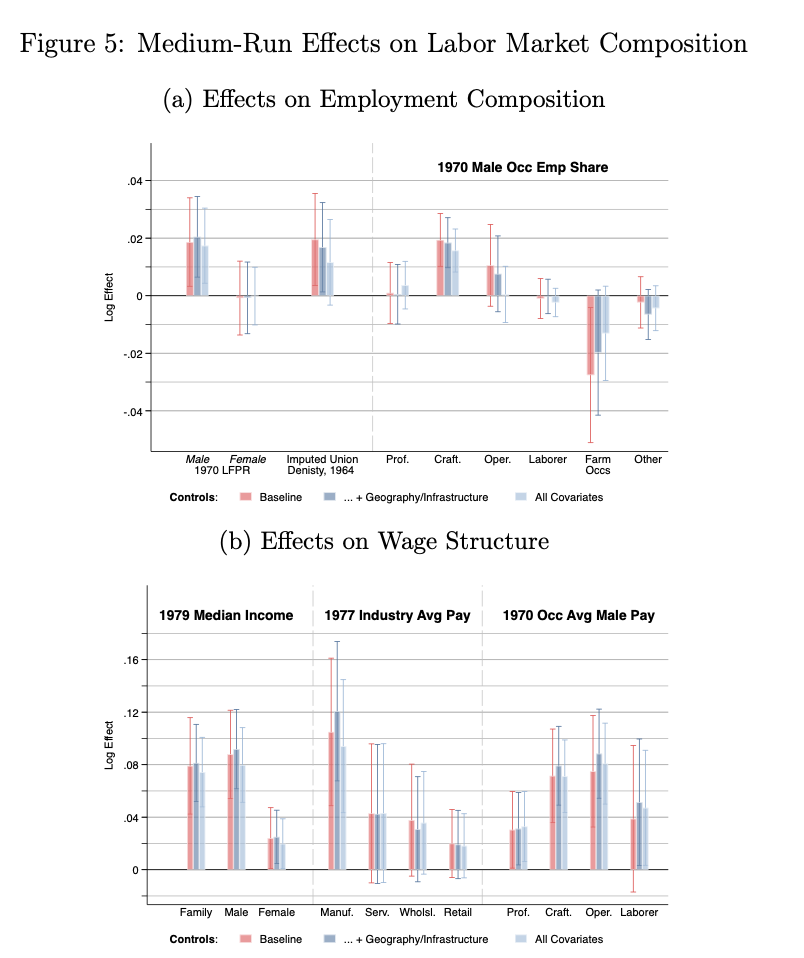
Yet, while our findings offer evidence that policies that attract manufacturing invest- ment into a region can succeed at increasing upward mobility in the local population, the results also highlight potential limitations of such policy efforts. In particular, our analysis suggests that a key mechanism by which plant construction benefited local residents was the persistent expansion of employment in jobs that offered higher-wage opportunities to workers from the region than would have been available to them otherwise. Importantly, such increases in high-wage work are not a necessary consequence of policies that attract local investment; for instance, in simple spatial equilibrium models with perfect mobility across regions and fully competitive labor markets (Roback, 1982), one would expect no change in local wages within skill groups. In our setting, the observed increases in wages for semi-skilled blue collar jobs are likely at least partly a reflection of the specific institutional context of the war emergency and the postwar era. The urgency of the wartime industrial mobilization led simultaneously to the adoption of production techniques that were intensive in the untrained labor at hand, changes in norms surrounding equity and fairness, and in- creased institutional bargaining power of unions in sectors engaged in war production, while American manufacturing firms established global economic dominance in the wake of WWII in part due to the widespread destruction in major European and Asian economies—these all likely contributed to conditions that empowered semi-skilled manufacturing workers to secure significant wage gains after the war. In addition, the expansion of semi-skilled work opportunities in less-industrialized regions of the U.S. created new opportunities for oc- cupational and skill upgrading, which may have driven some of the observed increases in educational attainment among children from low-income families.
Chosen excerpts by Job Market Monitor. Read the whole story @ “The Long-Run Impacts of Public Industrial Investment on Local Development” by Andrew Garin and Jonathan Rothbaum



 Job Market Monitor
Discussion
No comments yet.