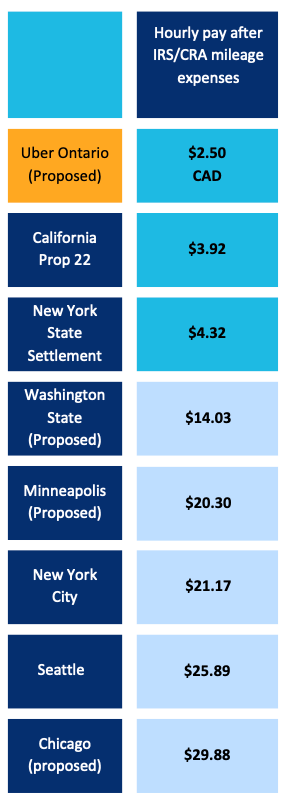
On February 12, 2024, the RideFair Coaliton and the Rideshare Drivers Association of Ontario released a report documenting below-minimum wage pay in Toronto’s ride-hailing sector. The report contextualizes Uber Canada’s report of drivers’ median “earnings per engaged hour,” $33.35 as of November 2023, and uses City of Toronto and Canada Revenue Agency data to estimate what proportion of time drivers spend engaged, and what kind of costs they have to pay. After these critical factors are taken to account, the report estimates drivers earn only $6.37 per hour – consistent with findings in other cities. These findings are consistent with screenshots of weekly earnings provided by current ride-hail drivers.
A legal hourly minimum wage was established in Ontario in 1920, and “establishes a wage floor to prevent employers from taking unfair advantage of employees with little or no bargaining power.”1 Even employees performing piece work or commission-based work are entitled to receive a minimum wage for their labour; workers receive the higher of performance pay earned or minimum wage per time spent.2
With the rise of gig work, companies have begun avoiding these longstanding and hard-won labour standards, and ride-hailing services are at the forefront of this rights erosion.
This report uses company-provided figures and historical City data to estimate that in late 2023:
Toronto ride-hail drivers received an estimated median pay3 as low as $6.37/hr, well below Province’s 2023 hourly minimum wage of $16.55.
Annualized, Toronto’s ride-hail drivers collectively lose as much as $200 million as a result of earnings below the Province’s hourly minimum wage floor.
These estimates, derived from company reports, are corroborated by driver experience. Ninety-six snapshots of weekly pay statements submitted by Toronto ride-hail drivers between October 2023 and January 2024 paint a picture in which drivers’ hourly pay is frequently below Ontario’s $16.55 hourly minimum wage even before expenses were considered. After estimated expenses are taken into account, none of the 96 weekly pay statements reached Ontario’s $16.55 minimum hourly wage; in many cases, drivers lost money.
These findings mirror estimates of gig driver hourly pay in other jurisdictions, including California ($6.20/hour), Seattle ($9.63/hour) and Denver ($5.49/hour).4 Columbia Business School economist Len Sherman estimates Uber overstates by more than double what drivers could expect to be paid per working hour net of “high and increasing operating expenses.”5
How is it possible that our laws allow widespread below-minimum wage work in 2024? Platform companies like Uber are promoting a new form of piecework, where they contend:
- Platforms should only be required to pay workers for “engaged time” (picking up and dropping off passengers), not all time worked, and with no obligation to ensure drivers spend enough time engaged;
- Platforms need not take into account the large and growing costs associated with acquiring and operating a car, all of which are downloaded onto drivers;
- Platforms should be able to avoid the obligations of employers, from payroll taxes and contributions to statutory employment rights – shifting the costs of supporting precarious workers onto other taxpayers.
Chosen excerpts by Job Market Monitor. Read the whole story @ Legislated Poverty – The Ride Fair Coalition



 Job Market Monitor
Discussion
No comments yet.