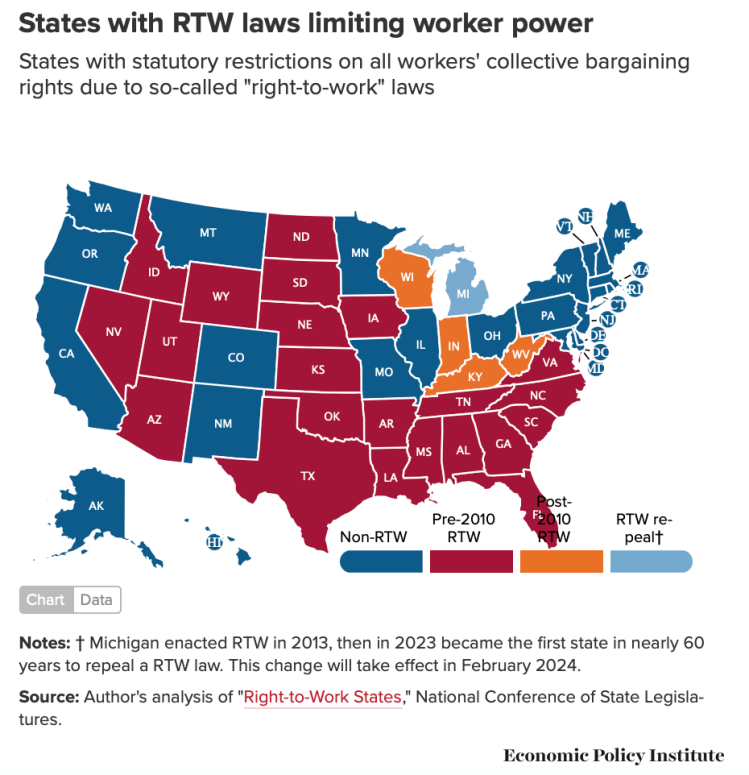
This week, Michigan’s 2023 repeal of a so-called “right-to-work” (RTW) law takes effect. Meanwhile, New Hampshire’s state legislature is once again debating a RTW bill at a moment when it could not be clearer that RTW laws damage states’ economies by accelerating income inequality and reducing job quality, without delivering any job growth.
RTW laws—and the phrase “right to work” itself—are intended to deceive and confuse. The misleadingly named policy is designed to make it more difficult for workers to form and sustain unions and negotiate collectively for better wages, benefits, and working conditions.
Key findings:
Data show that states with so-called “right-to-work” (RTW) laws have lower unionization rates, wages, and benefits compared with non-RTW states.
On average, workers in RTW states are paid 3.2% less than workers with similar characteristics in non-RTW states, which translates to $1,670 less per year for a full-time worker.
Claims that weakening unions will lead to state job growth have proven inaccurate. There are no measurable employment advantages between RTW and non-RTW states.
Chosen excerpts by Job Market Monitor. Read the whole story @ Data show anti-union ‘right-to-work’ laws damage state economies: As Michigan’s repeal takes effect, New Hampshire should continue to reject ‘right-to-work’ legislation | Economic Policy Institute



 Job Market Monitor
Discussion
No comments yet.