During the COVID-19 pandemic, the use of digital skills and platforms enabled a major shift towards remote work. This rapid change required many industries and workers to adapt to new technological tools and concepts even as digitization had been trending upward before the pandemic.This project used machine-learning methods and data from nine million Canadian job postings collected from January 2020 to June 2023 to understand how demand for digital skills has changed since the pandemic and the importance of non-technical or soft skills even in digital workplaces and occupations.The project found that the most in-demand digital skills continue to be for general workforce tasks – low-intensity digital skills that are relevant regardless of sector or industry. With the rise of AI in the last year, demand for artificial intelligence skills is growing, but overall higher digital intensity skills saw less change in demand over the course of the pandemic. There was also significant growth in demand for non-digital health, safety, and environmental skills, reflecting the widespread impact of health protocols. The project also showed that employers are still seeking hybrid (digital and non-digital) skills – most often general workforce digital skills paired with teamwork, communication skills, and time management.Training providers and decision makers should integrate the findings of this analysis into their programming decisions – ensuring that the cultivation of general workforce digital skills is not lost, as these are the skills most sought out by employers across a range of sectors and industries.
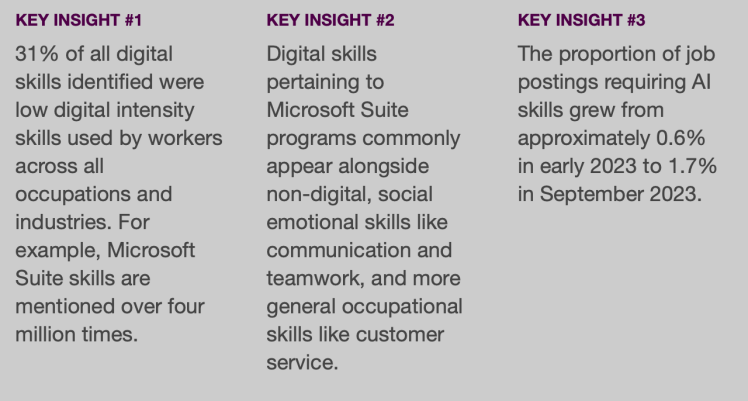


From the extensive research and data analysis in The Skills Algorithm, some key findings emerge:
1. Six broad skills clusters are formed across all occupations. Captured from 9 million job postings from 2020 to 2023, these skills clusters— spanning the highest digital intensity (high-tech skills) to the lowest (sales and merchandising skills)—are shaped by the occupational tasks that require them, from high tech skills for software development to trades skills used for construction or automotive jobs. Each skills cluster contains a mixture of digital and non-digital skills, with each skill varying in digital intensity.
2. Analyzing only the digital skills, five sub-clusters were identified. Digital skills, representing 2,198 of the 4,964 total unique skills (or 44 percent), are typically those with the highest digital intensity. These digital skills sub-clusters remained relatively consistent with the four identified in the precursor report I, Human (2019), though two new sub- clusters emerged: Industrial Modelling and Geospatial Software and Design and Marketing.
3. The most in-demand digital skills were for general workforce tasks. Among all digital skills, the low digital intensity skills for using Microsoft Suite programs (Excel, Word, Access) were the most common in job postings by a vast margin, consistent with the 2019 study. Other digital skills
with significant growth in job posting occurrences included artificial intelligence and others for high digital intensity occupations, e-charting software in health care, and general workforce skills associated with remote work.
4. There were notable changes in skills demand during the pandemic. Amid public health concerns, the pandemic induced a change in the skills profiles of workers through digitization and remote work. While the proportion of digital skills listed by employers in job postings fell during the pandemic, there was also small but significant growth in demand for lower digital intensity general workforce skills such as use of Zoom and Microsoft Teams video conferencing platforms, whereas higher digital intensity skills typical of tech sector workers saw less change in demand. There was also growth in demand for non-digital health, safety, and environmental skills such as the use of protective gear and first aid.
5. Employers are seeking hybrid (digital and non-digital) skills. Reinforcing the findings of I, Human (2019), this study revealed the complementarity of digital and non-digital skills, reflected in employer demand expressed in job postings. A number of these hybrid skills—teamwork, communication, interpersonal and leadership skills— are transversal, commonly in demand across all or most of the digital skills sub-clusters, though they vary depending on the specific occupational profile.
Implications for policy, workforce planning and education
The analysis and findings of this study are important for government policymakers focused on education and labour market development, industry and organizational leaders, practitioners in human resources and workforce planning, and postsecondary administrators and system leaders, among other audiences. This section outlines key implications and some actionable opportunities that emerge from The Skills Algorithm, focused on the strategic alignment of skills demand in the economy with the current and future labour supply pipeline.
The report presents a detailed picture of the skills demand in the Canadian labour market to 2023, zooming in on and differentiating the various categories of digital skills. The findings suggest a few significant implications for policy, workforce planning, and education in Canada.
First, the skills employers are seeking from workers are evolving at pace, and the workforce disruption and accelerated digitization of the pandemic has amplified this process in some ways. This likely reflects the emergence of new jobs in some instances, but more significantly that the occupational profiles of existing jobs are shifting to reflect demand for new digital and non-digital skills. The present and future talent pipeline to the labour market, higher education, training and skills development program providers must be adapting just as quickly to keep up.
Second, there continues to be significant demand for high digital intensity skills in the ICT industry and other sectors of the economy, reflected in the high- tech skills cluster and across the Software/Product Development and Data and the Cybersecurity and System Infrastructure digital skills sub-clusters. Demand for some of these high intensity digital skills, such as in AI coding skills in C++ and C#, have been growing briskly. Yet, the most ubiquitous demand from employers continues to be for low digital intensity general workforce skills. These types of skills should be recognized as the new “baseline” for most jobs in our modern economy.
The most ubiquitous demand from employers continues to be for low digital intensity general workforce skills. These types of skills should be recognized as the new “baseline” for most jobs in our modern economy.
Third, public narratives and the education and workforce policy discourse has been highly focused on the need to develop digital skills for today’s economy, prioritizing education and training in the STEM disciplines (typically more aligned to medium- and high-intensity digital skills). This report does not discount the importance of developing that talent pipeline, but it reinforces the finding that employers are seeking workers with a blend of digital and non- digital skills—and notably with hybrid and transversal skills like teamwork, communication, leadership, and project management.
For the report’s various audiences, a few actionable opportunities or recommendations emerge:
1. Large employers and industry intermediaries should incorporate this type of skills demand analysis into their workforce planning. For major Canadian employers like governments and banks, sector associations, chambers of commerce and other intermediaries that support small and medium enterprises (SMEs), leveraging this type of analysis will allow more responsiveness to the changing skills profiles of jobs and their workforce. Open access to granular skills-demand data, and do-it-yourself tools like Labour Market Information Council’s Canadian Job Trends Dashboard presenting this skills data, would be key enablers. Furthermore, this analysis could be done at a more granular geographic and industry level, which enables workforce planners and employers to provide more targeted workforce preparation and skills training. The Dais and other research and advisory organizations with expertise in Labour Market Information (LMI) analysis can offer support.
2. Governments should use skills demand analysis to inform education and skills policymaking and the design of skills development funding programs. The federal, provincial, and territorial governments set policy and funding for postsecondary policy and student aid programs, employment and training systems, and a variety of skills development and upskilling programs. Governments should explore how skills demand analysis can inform policymaking, and where it can be used to incentivize funding programs to achieve better outcomes for learners, workers, employers, and the workforce broadly.
3. Education and training providers should adopt agile approaches to adapting programs and curricula to reflect changing skills demands. Recognizing that workforce skills demand trends will continue to evolve rapidly and unpredictably, education and training providers should incorporate skills demand data into program planning to stay on top of skills trends, inform the ongoing adaptation of existing curricula, and the launch of new programs. This ensures graduates are equipped for the evolving job market and ensure responsiveness to labour market demands from employers or to respond to the changing industrial composition of the Canadian economy.
4. Education and training providers, and government funders, should use skills demand analysis to focus resources on upskilling for the most in-demand skills. Microcredentials and other alternative credentials have been proliferating, offering short programs for postsecondary students and increasingly upskilling professionals, focused narrowly on development of a skill or competency, often with industry or employer partners. Providers, employers and learners will all benefit where these programs are aligned to timely information on workforce skills demand and gaps.
5. Canadian policy researchers and education and skills partners should conduct further analysis on the linkages between higher education programming, employer skills demand and job outcomes. Academic institutions, industry, government, skills data providers, and non- profit intermediaries all play a role in helping to close the skills development knowledge gap. The Dais at Toronto Metropolitan University is eager to continue this work, building on the findings and implications of The Skills Algorithm.
Chosen excerpts by Job Market Monitor. Read the whole story @ The Skills Algorithm: Digital Skills Demand Across Canada’s Labour Market – Future Skills Centre • Centre des Compétences futures



 Job Market Monitor
Discussion
Trackbacks/Pingbacks
Pingback: Compétences, compétence et « La compétence professionnelle – Une grande variété de significations | Job Market Monitor - May 3, 2024