The Construction Skills Fund 2 (CSF2) was funded by the Department for Education (DfE) and administered and implemented by the Construction Industry Training Board (CITB). Funding of £7.5 million was awarded to 14 projects (hubs) to deliver training and job brokerage.
Training activities took place between April 2020 and March 2021, with participants’ outcomes monitored until September 2021. Hubs were mobile training facilities situated on construction sites which provided training to become construction site ready for people who were either unemployed or looking to change career. The hubs aimed to be employer-led, meeting the skills needs for specific roles and creating entry level pathways into the construction sector through the delivery of information, advice and guidance, training and testing for the Construction Skills Certification Scheme (CSCS) card, training for in-demand entry level construction skills, and providing job brokerage.
This evaluation aimed to explore pathways to employment through the hubs, assess the quality of employment outcomes, explore cost effectiveness of the programme, and draw on lessons learned for skills and employment support policy. The report draws on analysis of audited management information covering April 2020 to September 2021, and longitudinal hub case-studies, including interviews with hub staff, partners and participants, and a value for money analysis using information provided by the hubs.
Key findings
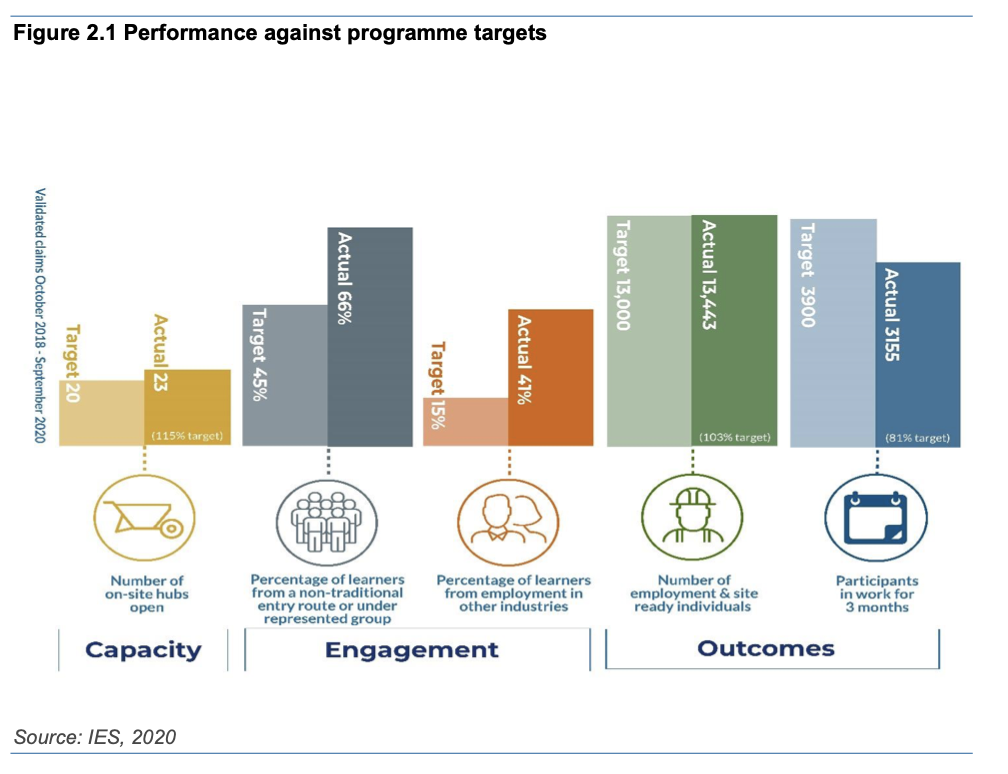
■ The programme exceeded its targets for number of hubs established, participants from groups traditionally under-represented in the construction industry and career changers and the number of participants becoming employment and site ready (ESR).
■ However, it did not meet its target for the proportion of ESR participants finding sustained employment of at least three months (23% compared to target of 30%)13.
■ Of those participants that sustained job outcomes, the average (mean) number of days between their ESR date and employment start date was 43 days. The median number of days was much lower however, at 17 days. Almost four in ten participants (37%) who achieved a sustained employment outcome did so within a week, with a further 11 per cent within two week and 15 per cent within four weeks. Combined, 62 per cent of all sustained job outcomes started within a month of the ESR date.
■ Male participants, those from white backgrounds, people without a health condition or disability, 16-25 year olds, those with a previous level one or two qualification, those attending an existing hub and those with a background in construction were significantly more likely than their counterparts to achieve a sustained job outcome.
■ After controlling for all other factors: participants from ethnic minority backgrounds were 10 percentage points less likely to find sustained work than those from a white background. Further, participants from ethnic minority groups were less likely to have a sustained job outcome than those with identical qualifications that were from white ethnic backgrounds. This was the case across all qualification levels except for participants with no or Entry level qualifications.
■ On average, newly established hubs had a lower conversion from ESR to sustained employment than previously existing hubs. This is likely to reflect the time it takes to build strong partnerships with employers to ensure effective job brokerage.
■ A lower proportion of participants enrolling in the later stages of the programme achieved a sustained job outcome. This may be explained by several factors including: the economic impacts of Covid-19, more new hubs operating later on, and high volumes of participants enrolling in later phases making it difficult for hubs to keep in touch evidence job outcomes.
■ Employer involvement in the design and delivery of training, and active participation in recruitment and selection of participants meant the employer was more committed to the hub and therefore more likely that it delivered job outcomes.
■ Around three-quarters of survey respondents in or about to start work reported that the hub contributed to helping them to get their job.
■ Seventy-eight per cent of participants did not find work. Of these, almost two-thirds stated that they wanted to work in construction. When asked what might help them to find work, respondents not in work most commonly reported that more training, work experience or a higher-level qualification would help them.
Source: Evaluation of the Construction Skills Fund 2 | Institute for Employment Studies (IES)



 Job Market Monitor
Discussion
No comments yet.