The distribution of job quality across workers and the change in job quality over time can be measured by job-domain indices or single-index job-satisfaction.
We have analysed the changes in job quality in OECD countries over a twenty-year period, where job quality is measured both via indices of a number of specific job characteristics and an overall job satisfaction score. There are four broad conclusions.
First, there are only minor differences between men and women in terms of what is valued in a job, and there has been broad stability in these values over time. The job aspects that both men and women consider as the most important in all years are job security and job interest, followed by autonomy; income and hours are among the least-important aspects of work.
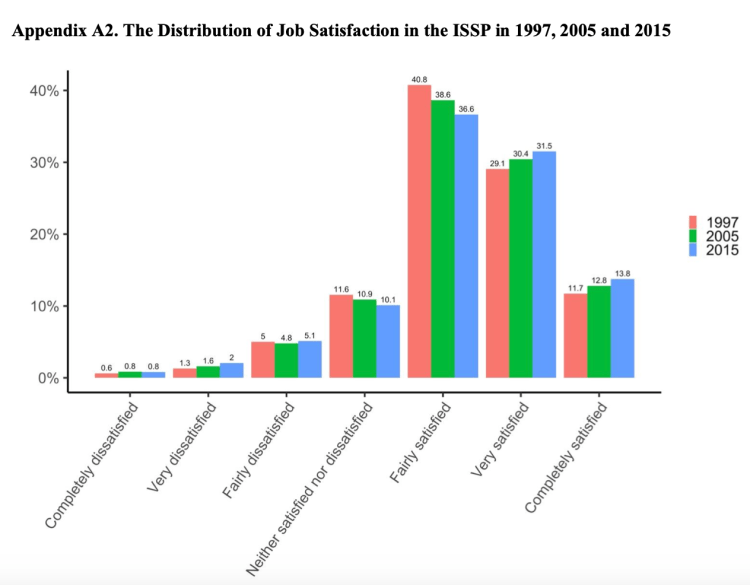
Second, the analyses of all main job characteristics that appear in discussions on job quality and of overall job satisfaction seem to suggest an improvement in job quality between 1997 and 2015. The percentage of workers reporting their income as high rose, as did the percentage reporting good promotion opportunities, job security, and good job content. In addition, a rising percentage of employees want to spend more time at work. Counterbalancing this good news, both stressful work and hard work increased, in line with work intensification. The net effect of these various changes seems to have been positive, as the percentage of workers with high job satisfaction has risen over this 20-year period.
Third, these results continue to hold in regression analyses with a variety of control variables, so that the job-quality movements do not seem to reflect either the changing structure of the workforce in terms of sex, age, and education, or lower hours of work and higher earnings. The regression analysis also shows that the 1997-2015 rise in job satisfaction is entirely explained by the eight job-quality measures that we analyse. The estimated coefficients in this regression underline the importance of good relations at work (especially with respect to management), as well as job content, stressful work, promotion opportunities and income.
Last, the benefits of higher average job satisfaction may be dampened by greater inequality in its distribution (especially if this implies the increasing prevalence of very poor- quality jobs). This does not seem to have been the general case across the 13 OECD countries that we analysed here, with there being only small movements in inequality over the period analysed.
There will always be causes for concern about the quantity and quality of jobs in the labour market, as a result of recessions, immigration and job automation for example. We find no evidence here of any systematic deterioration in job quality over a fairly long time period, but on the contrary a number of findings suggest improvements. Better job quality is good news for workers but arguably also for firms, given the well-known relationships between worker job satisfaction and their quitting and productivity .
Chosen excerpts by Job Market Monitor. Read the whole story @ Twenty Years of Job Quality in OECD Countries: More Good News? | IZA – Institute of Labor Economics



 Job Market Monitor
Discussion
No comments yet.