Foundation skills landscape
There is clear consensus about the strong value of foundation skills. Multiple researchers have demonstrated the relationship between literacy and numeracy skills and positive outcomes for individuals, communities and the economy.
A variety of terms have been used to describe foundation skills including core, generic, basic or enabling skills. Broadly speaking, they all have the same meaning and intent – skills that enable a person to participate in life, the community and the workforce.
Foundation skills are often considered to include language, literacy and numeracy and digital (LLND) skills, and depending on the situation, the definition can also extend to other employability and life skills such as collaboration, problem solving and teamwork.
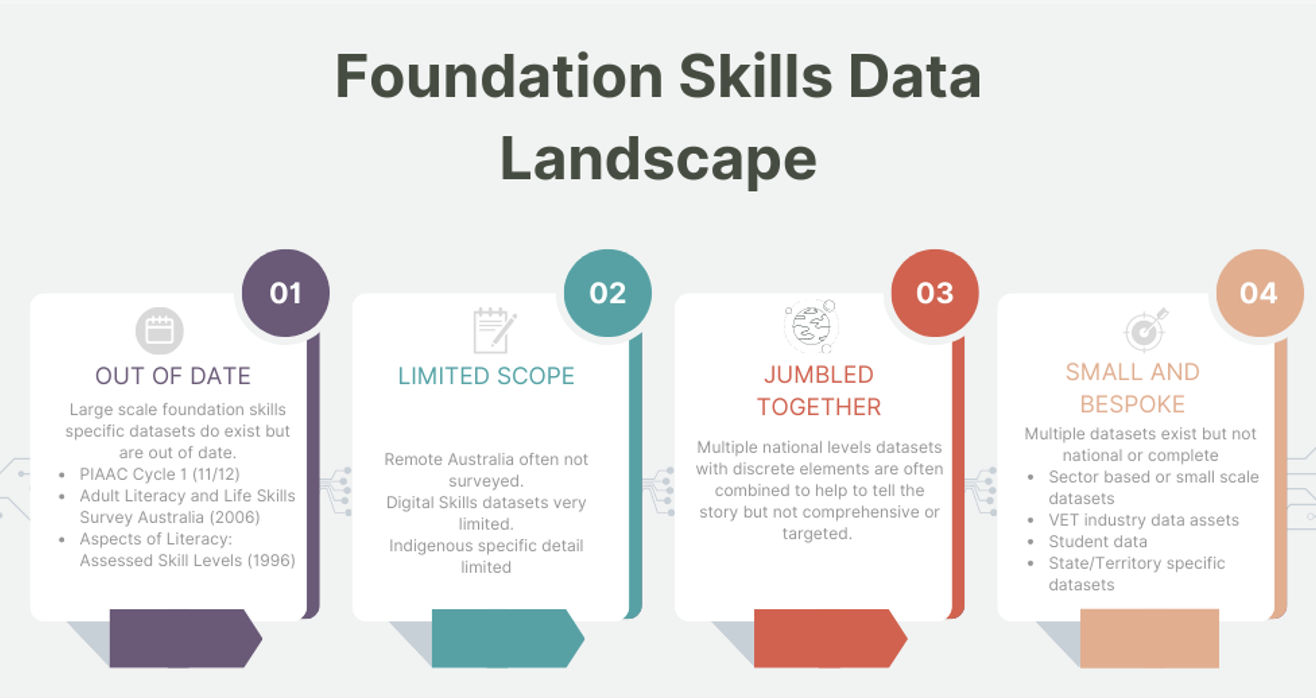
The most recent national data available on adult foundation skills (literacy, numeracy and problem solving) is the OECD’s Programme for the International Assessment of Adult Competencies (PIAAC) survey. The latest survey was run in 2011/12.
PIAAC is a survey of adult foundation skills (literacy, numeracy and problem solving) and is conducted in 10-year cycles. It measures the key cognitive and workplace skills needed for individuals to participate in society and for economies to prosper. PIAAC collects both background information about the participant and the results of a direct assessment of their skills.
Australia has temporarily withdrawn from the PIAAC Cycle 2 program (due to be run in 2023). The JSA national survey does not replace Australia’s participation in PIAAC but will instead bridge a gap in the existing foundation skills data landscape. Comparability with PIAAC, both nationally and internationally, is unlikely, but efforts will be made to ensure comparability with other key data assets as identified through stakeholder engagement. For more information on Australia’s PIAAC outcomes see appendix A.
Definitions
For most people, literacy and numeracy have a relatively clear meaning. To retain some international comparability, JSA intends to follow and use the PIAAC Cycle 2 OECD definitions for literacy and numeracy. These definitions are as follows:
Literacy
Literacy is accessing, understanding, evaluating and reflecting on written texts in order to achieve one’s goals, to develop one’s knowledge and potential and to participate in society.
Literacy is a core requirement for developing higher-order skills and for positive economic and social outcomes. Previous studies have shown reading literacy to be closely linked to positive outcomes at work, to social participation, and to lifelong learning.
Numeracy
Numeracy is accessing, using and reasoning critically with mathematical content, information and ideas represented in multiple ways in order to engage in and manage the mathematical demands of a range of situations in adult life.
Numeracy is a skill parallel to reading literacy, and it is important to assess how these competencies interact, since they are distributed differently across subgroups of the population.
Digital Literacy
While literacy and numeracy are still fundamental to learning, digital literacy has emerged as another critical life skill. There is no single agreed definition of digital literacy. Two different definitions have been proposed for feedback as part of this paper.
The first relates primarily to the ability to use digital technologies:
‘Digital literacy is the ability to use digital technologies—both hardware and software—safely and appropriately, while also using digital information to solve problems and handle security and safety challenges created by technology’.
The second is a broader interpretation adopted from the Australian Curriculum Assessment and Reporting Authority:
“To participate fully in learning, work and life, digital literacies required need to reflect application of skills and knowledge of using digital technology tools”.
———————————————
Jobs and Skills Australia (JSA) is leading the development of a new national study on adult literacy, numeracy, and digital skills. To assist with this study a discussion paper has been developed and is now open for comment.
Foundation skills, like the ability to read, write and engage with technology, are a critical foundation for meaningful work and active participation in the community. A lack of basic literacy or numeracy skills, or both, often results in exclusion from education, training and secure work, as well as difficulty engaging in society more broadly. Yet the data on the situation in Australia is over a decade old.
The Foundation Skills Study consists of three elements:
a survey of Australian adults to assess their current skills levels a feasibility study into how best to assess the literacy, numeracy, and digital literacy levels of First Nations people analysis of Commonwealth administrative and other data to ‘drill down’ into the results for priority groups.
The purpose of this discussion paper is to support Jobs and Skills Australia in developing and delivering the survey and feasibility study. Getting the design right is critical to ensuring the study delivers on the promise of building an evidence base for foundation skills in Australia.
Chosen excerpts by Job Market Monitor. Read the whole story @ Foundation Skills Discussion Paper | Jobs and Skills Australia



 Job Market Monitor
Discussion
No comments yet.