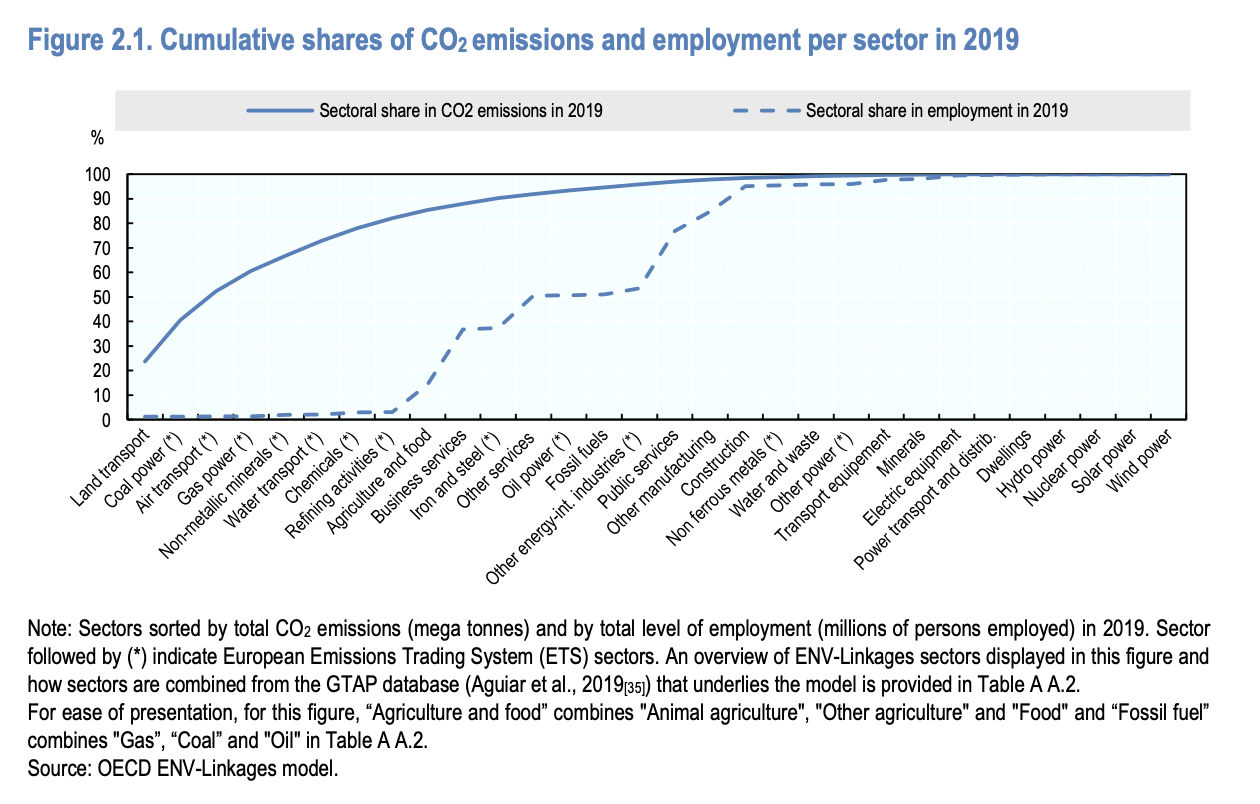
If countries are to achieve ambitious climate targets, climate policies will need to be accompanied by strong investments in skills policies. Skills policies, which comprise education and training policies targeted at both young people and adults, can play an essential role in ensuring that greening the economy does not lead to new forms of vulnerability. Skills policies can facilitate the reallocation of workers away from sectors that will shrink because they are responsible for a large share of carbon dioxide (CO2) emissions into sectors that will expand. To help workers effectively transition requires identifying not only economy-wide changes in skills demands but also the degree of similarity in the skillsets needed to perform different jobs, as well as projected trends in employment and the relative size of different employment opportunities.
This paper considers the case of the European Union’s Fit for 55 policy targets aimed at reducing greenhouse gas emissions and quantifies the impact of the policy package on labour markets and the demand for skills. In particular, the paper explores the effect of the Fit for 55 policy targets on five occupational categories: 1) Managers and Officials; 2) Professionals; 3) Service and Sales Workers; 4) Clerical Workers; and 5) Blue collar and Farm Workers.
The paper combines a modelling analysis of the impacts of the Fit for 55 policy targets on labour markets with an empirical analysis on the demand for skills, which is based on matching labour market changes for sectors and occupations to skills information from positions advertised online in those same sectors, on the demand for skills. Given the distribution of workers in 2019 in different European Union countries, sectors, and occupations, the paper also considers distributional implications and key target groups for the design of upskilling and reskilling interventions to facilitate the reallocation of workers across sectors and occupations that are projected to decline most. Key demographic groups include gender, level of education, age, and propensity to engage in adult education and training.
Key findings include:
- Overall employment is projected to increase by 1.3% in the Fit for 55 scenario between 2019 and 2030, whereas it would have grown by 3% had the Fit for 55 policy package not been implemented.
- By 2030, the employment of blue collar and farm workers is projected to decrease by 3% in the Fit for 55 scenario (whereas it is projected to decrease by 2% in a scenario in which the policy was not implemented) and increase by 4-5% for other occupations (whereas it is projected to increase by 5-6% in a scenario in which the policy was not implemented).
- Upskilling and reskilling interventions to facilitate the reallocation of workers across sectors and occupations should consider the distribution of affected workers in different countries. For example, blue collar workers in the ‘mining of coal and lignite’ sector will be highly negatively affected. Most of these workers in 2019 were employed in five countries: Bulgaria, the Czech Republic, Germany, Poland and Romania.
- Participation in training is low among workers in general but appears to be especially low among highly impacted workers, such as blue collar workers in the ‘mining of coal and lignite’ sector. In four out of ten countries with blue collar workers employed in the ‘mining of coal and lignite’, none. of these workers reported having participated in any form of formal or non-formal training in the four weeks preceding the interview.
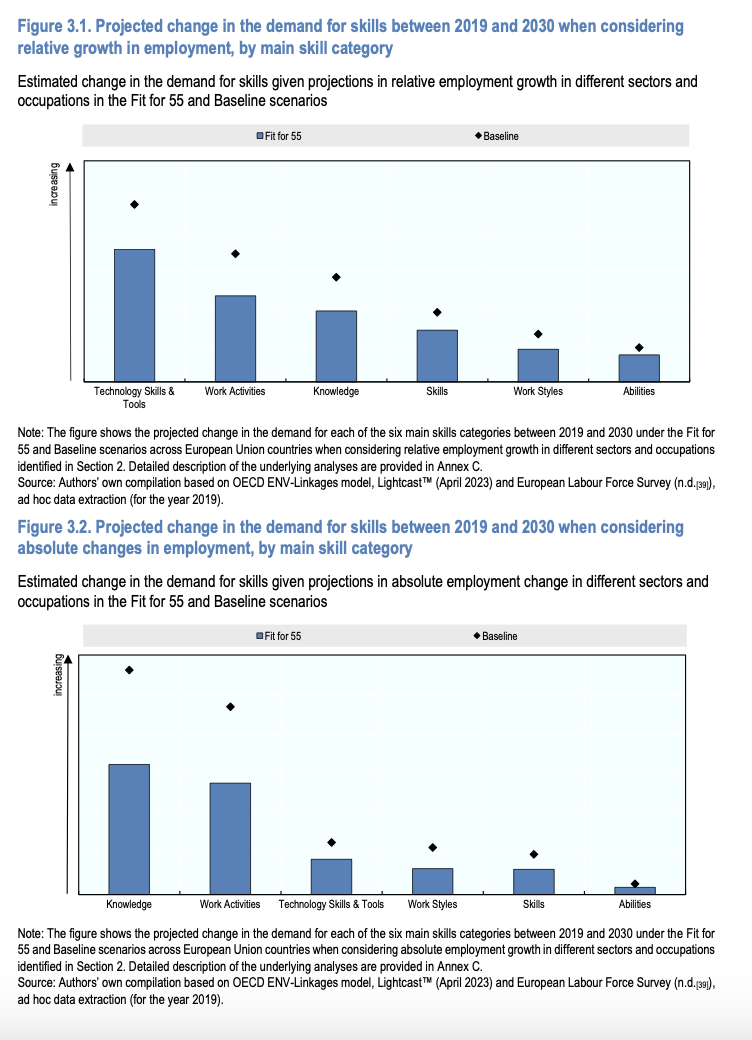
- The skills categories that are projected to grow the most in demand between 2019 and 2030 with the implementation of the Fit for 55 policy include: interacting with computers; thinking creatively; analysing data and information; and communicating with persons outside an organisation, skills for which demand will grow as a result of technological adoption.
- Other skills for which demand will increase include sales and marketing; computers and electronics; language; economics and accounting; customer and personal service; administration and management; and communications and media. Most of these skills are essential in the business services and public services sectors.
- Skills related to operating and maintaining equipment and tools are projected to decline the most in demand with the implementation of Fit for 55 targets.
Chosen excerpts by Job Market Monitor. Read the whole story @ The effects of the EU Fit for 55 package on labour markets and the demand for skills | OECD Social, Employment and Migration Working Papers | OECD iLibrary



 Job Market Monitor
Discussion
Trackbacks/Pingbacks
Pingback: Green Skills and Battery Workforce in US – DOE and DOL Announce a Battery Workforce Initiative National Guideline Standards | Job Market Monitor - April 19, 2024