This paper presents the results of a large-scale survey of undergraduates in England, concerning their envisaged career choices and how they made them. This gives a more complete account of those who do and do not want to be teachers than usual in the existing literature based primarily on prospective/existing teacher accounts. The paper looks at the issue of shortages, the reasons why people might be deterred from teaching, and summarises the methods used in our new study, followed by the results. The results cover descriptive analyses, and a comparison of responses from those who considered being a teacher (or not), those who had applied to train as a teacher (or not), and those intending to teach. These results are put together in two logistic regression models, one predicting/explaining who considered teaching, and the second explaining who then intends to become a teacher. Conclusions are drawn in the final section.
How to address teacher shortages
Various initiatives have been used to try and attract trainee teachers to shortage areas and subjects. These include targeted advertising, bursaries and scholarships for shortage subjects, loan forgiveness, paid internships, incentive payments for teaching in shortage regions, and more specific local approaches like the UK Future Scholars programme. These programmes are rarely robustly evaluated, and there is little evidence that any of them are effective.
A major problem is that so much of the prior research in this area has only been based on evidence collected from teachers in training, or from existing and resigning teachers. In the same way that so much research on widening participation to higher education is distorted by only considering those who apply to or enter university, work on teacher supply largely ignores the key group of those who might have become teachers but decide against. It is surely the barriers and facilitators from the perspective of this group that we need to uncover if we wish to improve teacher supply. Those already training or already practising may have useful views on the process, but whatever problems they have faced these have not deterred them so far. It is remarkable that so little prior research has taken this into consideration.
Our study addresses is based on a generic career questionnaire for undergraduates across all subjects in 53 universities in England – coupled with illustrative comments from follow-up interviews with some of the same students.
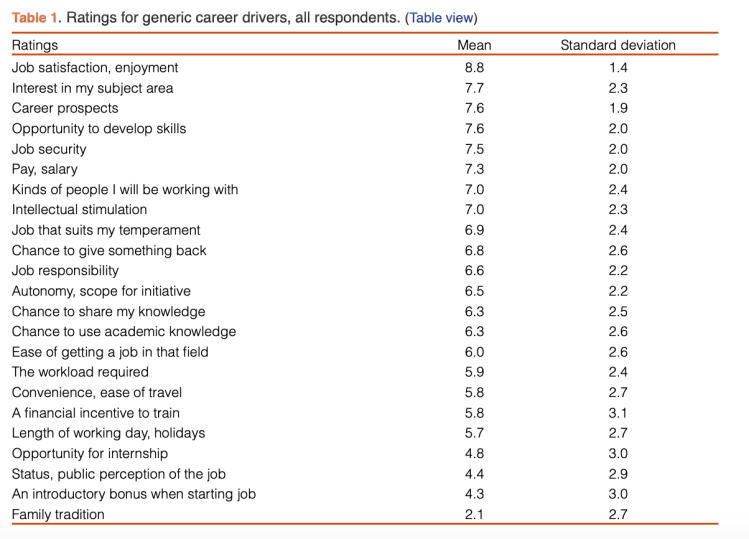
When considering their likely future career (with no focus on teaching yet), respondents were mostly concerned with job satisfaction/enjoyment (Table 1). Pay, job security, promotion prospects, an opportunity to develop new skills, and interest in their subject of study, were all also highly rated. Following a family tradition was the least important factor, along with the status of the job, getting an introductory bonus, and the chance for an internship.
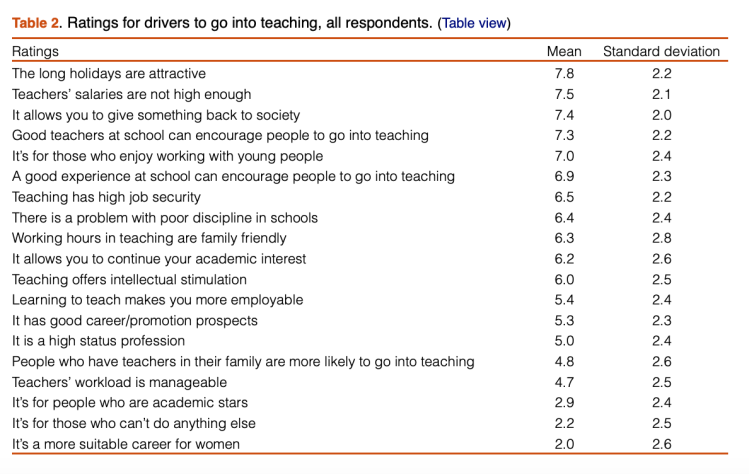
Thinking specifically about teaching as a possible career, the biggest reported attractors for all respondents was the long holidays, and the chance to give something back to society (Table 2). The biggest deterrent to a teaching career was that teacher salaries are not considered to be high enough. Respondents generally did not agree that teaching is a career for those unable to do anything else, or one especially suited for women (a factor that was included because it has been reported in other studies).
Chosen excerpts by Job Market Monitor. Read the whole story @ Who wants to be a teacher? Findings from a survey of undergraduates in England



 Job Market Monitor
Discussion
Trackbacks/Pingbacks
Pingback: Teacher in US – Low job satisfaction and few are optimistic about the future | Job Market Monitor - April 15, 2024