“Policies to support labor supply are not the domain of the Fed: Our tools work principally on demand.” –Federal Reserve Chairman Jerome Powell, November 30, 2022
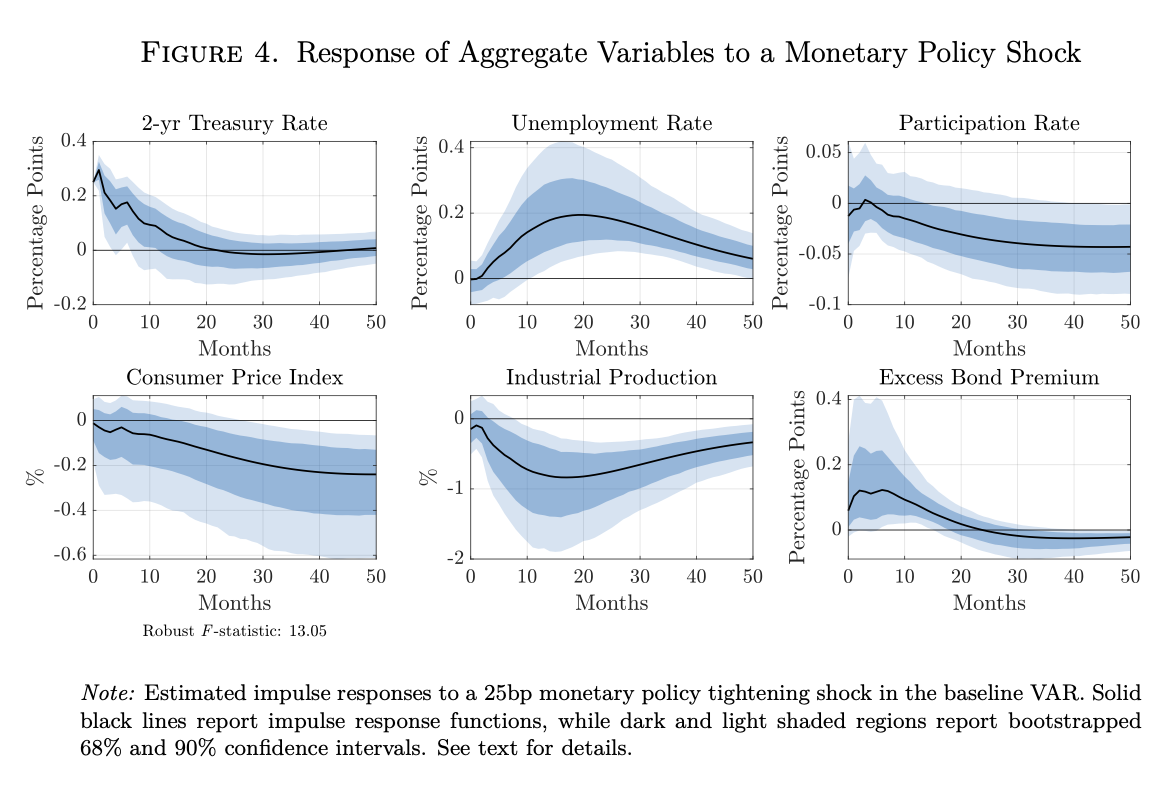
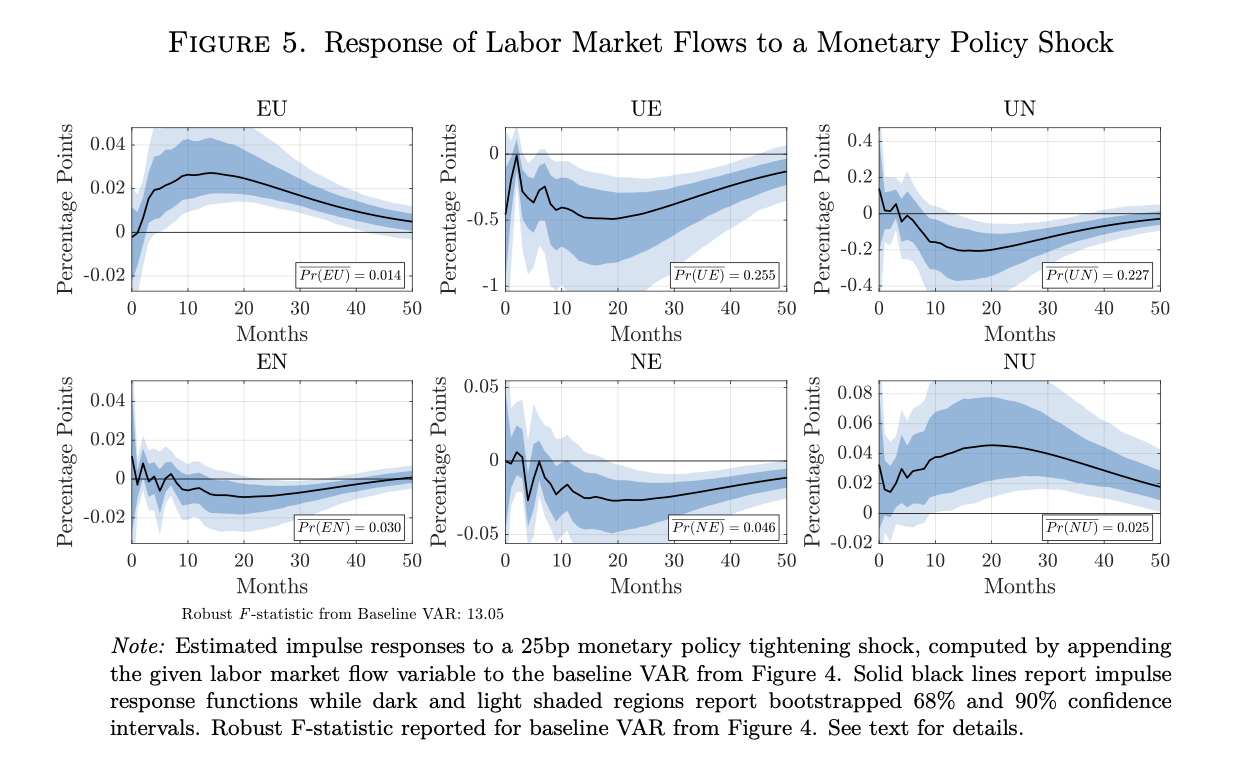
This paper offers new empirical evidence of a sizeable labor supply response to monetary policy. Using high-frequency identified monetary policy shocks from FOMC announcements and Fed Chair speeches, we show that a contractionary monetary policy shock generates quantitatively important increases in labor supply by decreasing the rate at which workers quit jobs to non-employment and stimulating job-seeking behavior among the non-employed. Thus, the decline in labor demand from a monetary policy tightening is partially offset by an increase in labor supply. We show that if the response of supply-driven labor market flows is held fixed, the overall procyclical response of employment to monetary policy would be roughly twice as large.
An empirical contribution of our paper is to highlight the large and cyclical role of quits to nonparticipation. Previous research has shown that the vast majority of separations from employment to unemployment are due to layoffs rather than quits. We have shown that the opposite is true for separations from employment to nonparticipation. Our flow-based accounting framework reveals that, in response to a contractionary monetary policy shock, the decline in quits to nonparticipation is roughly as important as the increase in job-seeking behavior among the non-employed in dampening the overall decline in employment.
Given the importance of supply-driven flows revealed by our estimates, models intended to generate a realistic employment response to monetary policy may require a greater role for labor supply than currently considered in the New Keynesian literature. This may be especially true for models with an explicit role for heterogeneity à la Kaplan, Moll and Violante (2018). In a partial equilibrium setting, we have shown that a model with frictional labor markets, an active participation decision, and sufficiently strong income effects is likely to be consistent with our empirical findings. We believe that incorporating such features into a fully-fledged New Keynesian model is an important topic for future research.
Chosen excerpts by Job Market Monitor. Read the whole story @ The Labor Demand and Labor Supply Channels of Monetary Policy | NBER



 Job Market Monitor
Discussion
No comments yet.