Policymakers are in the dark when it comes to dealing with the growing number of temporary residents in Canada. The large difference in estimates by Statistics Canada’s Labour Force Survey (LFS) and Immigration, Refugees and Citizenship Canada’s (IRCC) data on Canada’s temporary resident (TR) population demonstrates that more high-quality information on the size and work activity of this group is needed, according to a new C.D. Howe Institute report.
Main facts
- In 2022, Canada’s population grew by more than 1 million people for the first time in its history. Although the federal government’s ambitious targets for new permanent residents are receiving much attention, the reality is that 58 percent of 2022’s record-breaking population increase reflected growth in the temporary resident (TR) population.
- Temporary residents are workers, students and asylum claimants who have been authorized legally to enter Canada for temporary purposes through work permits, study visas or temporary resident visas.2 While all TRs need somewhere to live or stay while in Canada, many are also engaged in paid employment.
- To understand the impact on the economy of Canada’s growing TR population, we need high-quality data on the size of that population. For housing market analysts, accurate estimates of the TR population are critical for gauging housing demand. For labour economists, the contribution of the TR population to alleviating labour shortages and possibly also to distorting wage outcomes of workers in the permanent resident (PR) population is equally important.3 Unfortunately, there is reason to believe that Statistics Canada’s Labour Force Survey is failing to capture work activity in the TR population, and the significance of this measurement issue is quickly growing.
To be sure, the growth of Canada’s TR population is not new. It largely reflects a deliberate policy shift since 2010 to “two-step immigration,” whereby applicants for permanent residency who have Canadian work experience are prioritized in immigrant selection. Consequently, migrants have an incentive to work in Canada before applying for PR status.
Although work activity in the TR population historically was limited to holders of work permits – so-called temporary foreign workers – since March 2003 eligible foreign students have been permitted to work off-campus during their studies; since June 2014 they have not been required to obtain a work permit to hold a job. Since entries of work permit and study permit holders have increased at a faster rate than Canada’s labour force over the past decade, we expect the TR contribution to Canadian employment to have increased in an important way, but how much is unclear.
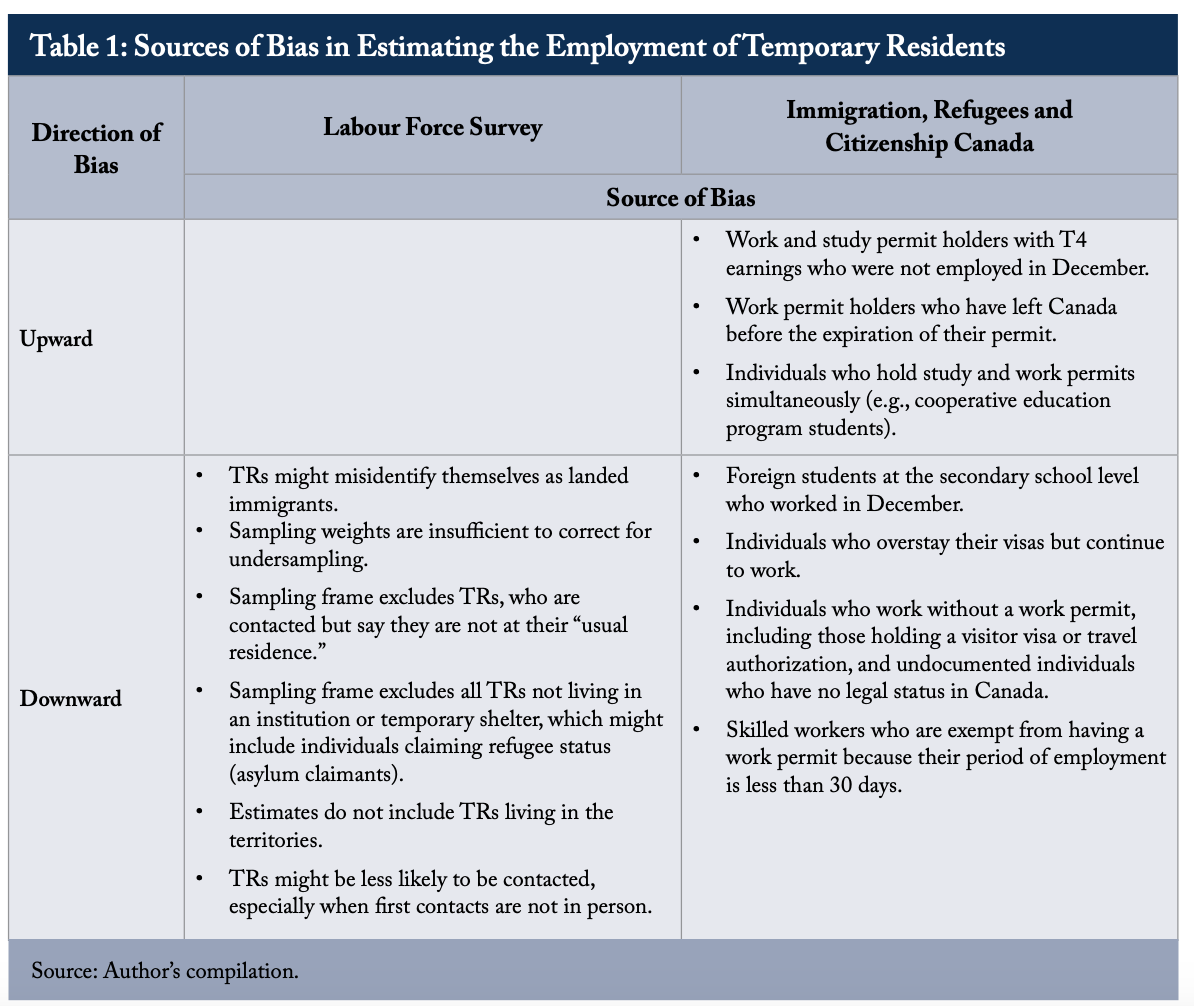
This E-Brief updates an earlier analysis by O’Donnell and Skuterud (2022) aimed at shedding light on the extent to which the Labour Force Survey – Statistics Canada’s flagship survey for labour market activity in the population – might be underestimating the growing TR component of the workforce. The E-Brief does this by estimating temporary residents’ share of Canadian employment using two data sources: the Labour Force Survey, which samples Canadian households every month and identifies the work activity of individuals ages 15 and older; and administrative data from Immigration, Refugees and Citizenship Canada on the number of study and permit holders on December 31 each year.
For multiple reasons, both data sources are likely to provide biased estimates. Fortunately, not only is there little ambiguity regarding the direction of bias in each data source, but the bias is in opposite directions. Whereas the Labour Force Survey almost undoubtedly underestimates employment among TRs, administrative data certainly overestimate it. Consequently, one can be confident that the range in the two estimates bounds the truth. The problem is that the margin of difference between the estimates has grown fivefold since 2006, putting labour market analysts increasingly in the dark.

Chosen excerpts by Job Market Monitor. Read the whole story @ Canada in the Dark about Temporary Residents in the Workforce | C.D. Howe Institute | Canada Economy News | Canadian Government Policy



 Job Market Monitor
Discussion
No comments yet.