As world markets continue to adjust, governments and businesses need to remain agile and adapt — or risk missing out on significant opportunities that positively impact companies, the economy, and society. New LinkedIn data reveals how a skills-first approach to the labor market, in which people are hired based on skills rather than degrees or certification, can help policymakers and governments create initiatives that strengthen the workforce — while businesses worldwide can benefit from more diverse talent pools and more equitable hiring processes.
How can we all, collectively across government, business, and the workforce, take a fundamentally new approach to human capital?
We know that great talent is everywhere — but opportunity is not. The future labor market will be about analyzing, accessing, and mobilizing people’s potential and skills in new ways. This starts with taking a skills-first approach to talent: putting skills at the forefront of talent strategies by recognizing an individual for their capabilities and breaking down roles into the capabilities required to do them well. We have to expand the hiring process beyond titles and companies, degrees and schools, and focus instead on skills and the many different ways those skills can be acquired. With online learning, certificate programs, apprenticeships, and other training opportunities, employers do not need to rely entirely on prior job titles and degrees to assess a candidate’s abilities. Employers should also consider skills acquired through partial college completion and look for the many transferable skills gained during military service.4 Businesses can and should remain adaptable and competitive by leveraging skills data to inform smarter
talent strategies.
The good news is this shift is already underway. Employers are showing signs of embracing this new way of thinking about talent.

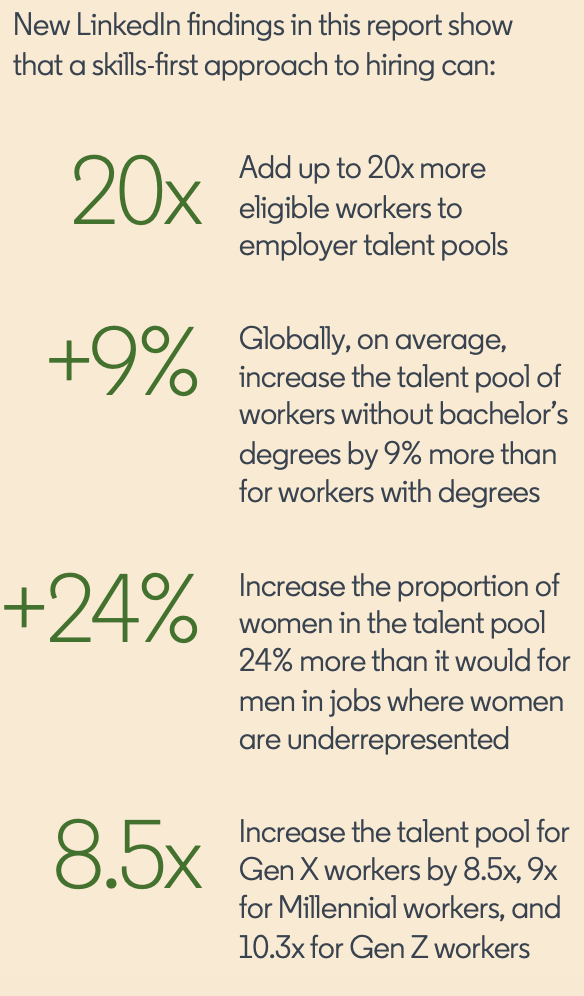


Source: Skills-First: Reimagining the Labor Market and Breaking Down Barriers



 Job Market Monitor
Discussion
No comments yet.