How have the working lives of young people in their thirties, the “hard core” of the economically active population in employment, been affected by the health crisis of 2020? The results of the Génération survey: Covid et après? (After Covid what?) serve to document the varied situations of these economically active individuals in the face of the crisis. Whether they were in stable or precarious employment, whether they were working in sectors exposed to or unaffected by the crisis, whether or not they had children, how did these young employees or self-employed workers get through the crisis?
No change of situation for those in stable employment
While 82% of the economically active individuals in employment saw no change in their employment situation between March 1 2020 and May 2021, the continuance rate was particularly high (from 86 to 92%) for those who were state employees, on open-ended contracts or self-employed, that is to say those who were already stabilised in their jobs. Most of the self-employed seem to have weathered the health crisis successfully; the level of support available to them undoubtedly contributed to this resilience. Having been established in their positions on average for the same length of time as their employed counterparts, they actually experienced less disruption than the latter group, since 92 % were able to continue their activity.
More “crisis-enforced moves’ for employees on temporary contracts and low seniority
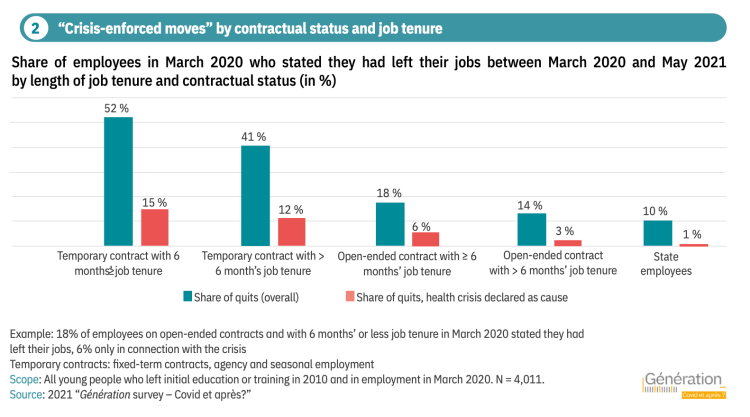
Job tenure and employment status influenced the crisis-related job losses. Employees on temporary contracts were four time more likely than those on open-ended contracts to be affected, and recent arrivals were also more likely to lose their jobs. Nevertheless, longer job tenure did not compensate for the negative influence of precarious employment status (see figure in Box 2). Those individuals obliged to look for work during the pandemic were successful to a greater or lesser extent. Of the economically active without a job on March 2020 and those who had left their job after this date, almost 60% had maintained a certain level of employment up until the survey, havingspent at least 7 months in work, with more than 30% of them having spent more than 12 months in work. Conversely, 17% of them experiencedsevere underemployment, having spent less than 3 months in work during the period. While some – whether they were unemployed (19%) or lost their jobs during the period (17%) – had been able to turn their initial situation to good advantage in order to undergo training, this training (lasting at least two weeks) does not seem to have played a decisive role in their return to employment as observed at the survey date, when 58% of those who hadreceived training were in employment, compared with 69% of those who had not undertaken training
More difficult situation on exit from crisis for those out of work in March 2020
More than half of the individuals who were looking for work at the beginning of the health crisis (54%), and a higher share of women (57%) than of men (52%), stated that they had not worked at all up until May 2021, while only 18% of them succeeded in working for more than six months during the observation period. In fact, the individuals who had been unemployed in March 2020 were the ones most likely to be unemployed in the spring of2021. While 34% of the women who were looking for work at the beginning of the period had found a job 14 months later, this share does not seem to be any different from what might have been observed without Covid. And indeed, the data for the 1998 cohort of leavers between March 2007 and May 2008 for a comparable age distribution shows that one third of those who had been unemployed at the beginning of the period were in work 14 months later.
Source: Has the crisis disrupted
thirty-somethings’ career trajectories?



 Job Market Monitor
Discussion
No comments yet.