Are micro-credentials set to disrupt professional and higher education to the same extent that Netflix disrupted the entertainment industry? Given the rapid acceleration of technology use and changes of work practices across many areas of employment during the [Coronavirus Disease 2019 (COVID-19)] pandemic – we are facing a world where learning, skill and knowledge agility and adaptability are key. There is a rush toward micro-credentials globally to meet these new employability and other learning needs. While micro-credentials offer a great deal of potential, there are also complexities regionally and globally. What are the opportunities and what can we learn from those at the front of the race? How do we design micro-credentials that have credibility?; This global whitepaper focusses on the challenges and considerations that are key to success in vocational, university and professional micro-credential learning market. The whitepaper describes trends and developments from around the world that explores the following questions:
(1) What is the potential of micro-credentials?
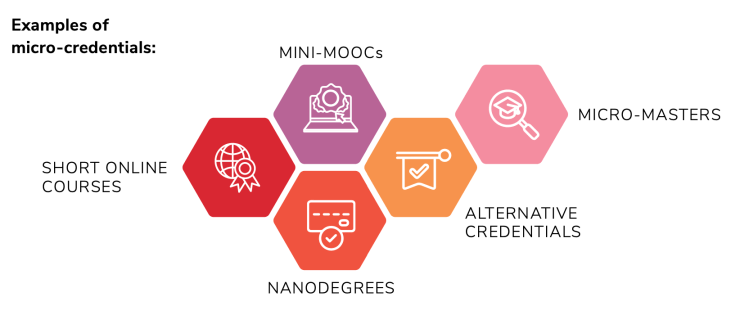
(2) What do we really mean by micro-credentials?
(3) How are micro-credentials quality assured and accredited?
(4) How do we architect an effective micro-credential ecosystem?
(5) What are 10 critical things we need to do to get started with micro-credentials?

Critical information requirements
• TITLE (in plain English)
• PROVIDER (including partner providers, co-branding partnerships
& industry endorsers)
• CONTENT/DESCRIPTION (structure, summary of content/ topics taught)
• LEARNING OUTCOMES (knowledge, skills and competencies acquired)
• LANGUAGE (of instruction)
• DELIVERY MODE (onsite (incl. location), online, blended, and whether synchronous or asynchronous engagement required)
• DATE OF DELIVERY (start/end with outline of schedule or whether self-paced)
• INHERENT REQUIREMENTS (physical resources required to undertake
the micro-credential)
• PRICE AND FINANCIAL ASSISTANCE (cost to learners including taxes, discounts, government funding and payment mechanisms)
• ASSESSMENT (method and type of assessment, location if onsite)
• CERTIFICATION (proof of learning outcomes being met)
• CREDIT/OTHER RECOGNITION (type of recognition – e.g. credit toward award courses or vendor/industry certifications, pathways or other recognition)
• QUALITY ASSURANCE (statement of quality assurance processes applied such as provider or CRICOS codes, regulator, and approach to academic integrity)
• PRE-REQUISITES (prior micro-credentials or level of experience that must be completed prior to the referenced micro-credential)
Recommended elements
⟶ EXPIRATION OF THE MICROCREDENTIAL
⟶ DEPTH OF LEARNING
⟶ JURISDICTION
⟶ INDUSTRY SUPPORT
⟶ RECOMMENDED PRIOR
⟶ STACKABILITY
⟶ INDUSTRY/ OCCUPATION
ANTHOLOGY WHITE PAPER
Minimum standards
1. Learning outcomes must be clearly stipulated.
2. When describing foundation or general capabilities, providers will consider the descriptors contained within the Australian Core Skills Framework. Note that additional capability taxonomies will be considered in a future version of this framework.
3. Micro-credentials require assessment/s. This assessment/s must assess the attainment of learning outcomes. For transparency reasons, the type of assessment/ assessment method must be clearly stated.
4. Micro-credentials are required to stipulate volume of learning and to have a minimum of one hour of volume of learning and less than that of an AQF award qualification.
5. Micro-credentials will consider signifying the mastery achieved by a micro-credential, where the primary purpose of a micro-credential is not credit-bearing. This can be
a best-fit or estimate.
6. Where applicable, micro-credentials will clearly stipulate industry-recognition, where the micro-credential is recognised by a professional body, satisfies or aligns to an industry standard or professional development requirement, or constitutes recognition towards an industry or vendor certification.
7. Where applicable, micro-credentials will clearly stipulate credit-recognition, where the micro-credential is recognised by an education institution for the provision of specified or unspecified credit or advanced standing. This stipulation should outline the nature of the credit and the AQF level/s of the qualifications that the micro-credential leads to (rather than mapping to the AQF level outcomes). Where the micro-credential is recognised for credit only when “stacked” with other micro-credentials, this should be clearly stipulated.
8. Where an issuing authority has not applied a regulated standard (i.e. the standards and academic integrity processes applied to award courses or components within
a training package) to a micro-credential, they must provide a statement of assurance of quality on the marketplace—e.g. a profile of the provider/ institution, a description
of the quality assurance processes undertaken, and the process for review/ updating the micro-credential.
This paper has taken us around the world to explore why micro-credentials have become such a hot topic. Global trends and perspectives highlight both their potential and their complexities. As with the disruptive innovator Netflix, Micro-credentials are unsettling the status quo of traditional models of professional and higher education. However, they are offering more choice to learners and employers, more access to those previously underserved, and potentially, a way to diversify higher education offerings to counteract the enrolment cliff that some institutions are set to experience. And there are significant global efforts to make sense of micro-credentials and the ways they can fit with qualifications frameworks and the broader education ecosystem. We are seeing the emergence of thoughtful, validating frameworks, efforts to address quality assurance and new technologies like blockchain that offer more secure verification methods.
So, can micro-credentials live up to all our expectations? Well, potentially yes, if we truly focus on understanding learner and industry needs and preferences, if we truly adopt innovative pedagogies, and if we design intentionally for ‘micro-credentials’ that offer meaningful, flexible learning with a great learner experience (think ‘bingeable’).
Source: A Global Perspective on the Potential and the Complexities of Micro-credentials | Anthology



 Job Market Monitor
Discussion
Trackbacks/Pingbacks
Pingback: Qualifications Frameworks in 2022 – Global inventory of national and regional frameworks | Job Market Monitor - March 7, 2024
Pingback: Alternative Credentials in Higher Ed in US – Ninety-four percent of respondents’ institutions offer alternative credentials | Job Market Monitor - March 10, 2024
Pingback: Micro-credential – How to choose it | Job Market Monitor - November 26, 2024