The Future of Jobs Report 2023 explores how jobs and skills will evolve over the next five years. This fourth edition of the series continues the analysis of employer expectations to provide new insights on how socio-economic and technology trends will shape the workplace of the future.
Analytical thinking and creative thinking remain the most important skills for workers in 2023. Analytical thinking is considered a core skill by more companies than any other skill and constitutes, on average, 9% of the core skills reported by companies. Creative thinking, another cognitive skill, ranks second, ahead of three self-efficacy skills – resilience, flexibility and agility; motivation and self-awareness; and curiosity and lifelong learning – in recognition of the importance of workers ability to adapt to disrupted workplaces. Dependability and attention to detail, ranks seventh, behind technological literacy. The core skills top 10 is completed by two attitudes relating to working with others – empathy and active listening and leadership and social influence – as well as quality control.
Employers estimate that 44% of workers’ skills will be disrupted in the next five years.Cognitive skills are reported to be growing in importance most quickly, reflecting the increasing importance of complex problem-solving in the workplace. Surveyed businesses report creative thinking to be growing in importance slightly more rapidly than analytical thinking. Technology literacy is the third-fastest growing core skill. Self-efficacy skills rank above working with others, in the rate of increase in importance of skills reported by businesses. The socio-emotional attitudes which businesses consider to be growing in importance most quickly are curiosity and lifelong learning; resilience, flexibility and agility; and motivation and self-awareness. Systems thinking, AI and big data, talent management, and service orientation and customer service complete the top 10 growing skills. While respondents judged no skills to be in net decline, sizable minorities of companies judge reading, writing and mathematics; global citizenship; sensory-processing abilities; and manual dexterity, endurance and precision to be of declining importance for their workers.
Six in 10 workers will require training before 2027, but only half of workers are seen to have access to adequate training opportunities today. The highest priority for skills training from 2023-2027 is analytical thinking, which is set to account for 10% of training initiatives, on average. The second priority for workforce development is to promote creative thinking, which will be the subject of 8% of upskilling initiatives. Training workers to utilize AI and big data ranks third among company skills-training priorities in the next five years and will be prioritized by 42% of surveyed companies. Employers also plan to focus on developing worker’s skills in leadership and social influence (40% of companies); resilience, flexibility and agility (32%); and curiosity and lifelong learning (30%). Two-thirds of companies expect to see a return on investment on skills training within a year of the investment, whether in the form of enhanced cross-role mobility, increased worker satisfaction or enhanced worker productivity.
The skills that companies report to be increasing in importance the fastest are not always reflected in corporate upskilling strategies. Beyond the top-ranked cognitive skills are two skills which companies prioritize much more highly than would appear according to their current importance to their workforce: AI and big data as well as leadership and social influence. Companies rank AI and big data 12 places higher in their skills strategies than in their evaluation of core skills, and report that they will invest an estimated 9% of their reskilling efforts in it – a greater proportion than the more highly-ranked creative thinking, indicating that though AI and big data is part of fewer strategies, it tends to be a more important element when it is included. Leadership and social influence ranks five places higher than suggested by its current importance and is the highest ranked attitude. Other skills which are strategically emphasized by business are design and user experience (nine places higher), environmental stewardship (10 places higher), marketing and media (six places higher) and networks and cybersecurity (five places higher).
Respondents express confidence in developing their existing workforce, however, they are less optimistic regarding the outlook for talent availability in the next five years.Accordingly, organizations identify skills gaps and an inability to attract talent as the key barriers preventing industry transformation. In response 48% of companies identify improving talent progression and promotion processes as a key business practice that can increase the availability of talent to their organization, ahead of offering higher wages (36%) and offering effective reskilling and upskilling (34%).
Surveyed companies report that investing in learning and on-the-job training and automating processes are the most common workforce strategies which will be adopted to deliver their organizations’ business goals. Four in five respondents expect to implement these strategies in the next five years. Workforce development is most commonly considered to be the responsibility of workers and managers, with 27% of training expected to be furnished by on-the-job training and coaching, ahead of the 23% by internal training departments and the 16% by employer-sponsored apprenticeships. To close skills gaps, respondents expect to reject external training solutions in favour of company-led initiatives.
A majority of companies will prioritize women (79%), youth under 25 (68%) and those with disabilities (51%) as part of their DEI programmes. A minority will prioritize those from a disadvantaged religious, ethnic or racial background (39%), workers over age 55 (36%), those who identify as LGBTQI+ (35%) and those from a low-income background (33%).
Forty-five percent of businesses see funding for skills training as an effective intervention available to governments seeking to connect talent to employment.Funding for skills training ranks ahead of flexibility on hiring and firing practices (33%), tax and other incentives for companies to improve wages (33%), improvements to school systems (31%) and changes to immigration laws on foreign talent (28%).
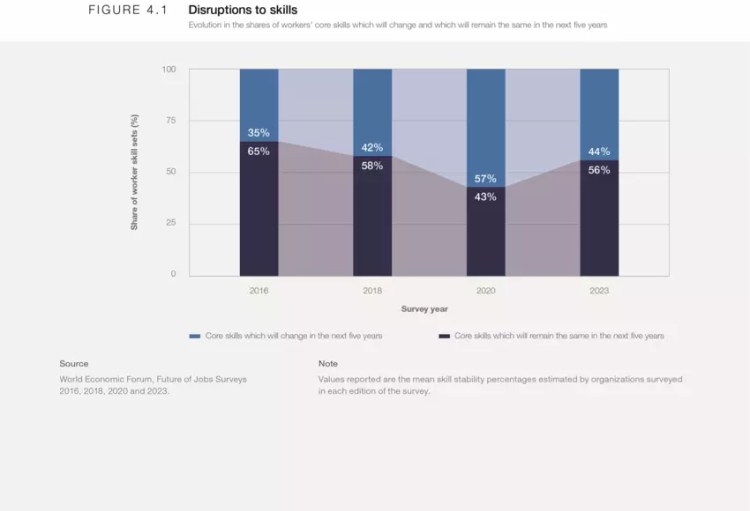

Source: The Future of Jobs Report 2023 | World Economic Forum



 Job Market Monitor
Discussion
Trackbacks/Pingbacks
Pingback: Employer-Sponsored Training in Canada – Firms invest $240 per employee annually and lag their international peers in rates and hours of instruction | Job Market Monitor - July 3, 2023
Pingback: Artificial intelligence (AI) and Skills – High-exposure occupations comprise a third of all vacancies in OECD countries in the sample | Job Market Monitor - April 30, 2024