In the post-pandemic economy, digital skills are crucial for Australia’s labour market as the pace of digitisation accelerates. This report is the third in a series that looks into what skills are growing the quickest across the job market, the cost business stands to lose by not addressing these gaps and the role of training to bridge the divide.
To fill skills gaps, surveyed businesses don’t seem to 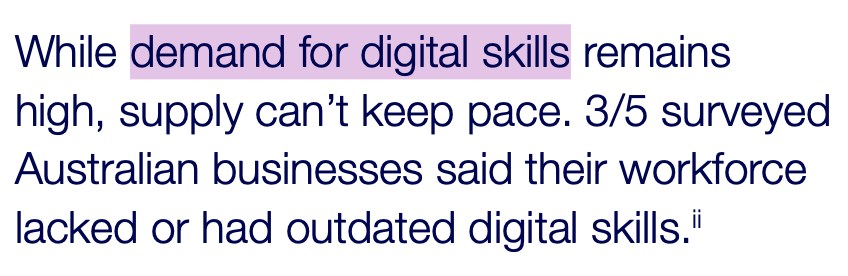
have a strong preference between upskilling employees (48%) and hiring externally (52%). There are pros and cons to each approach. Training can be an effective tool to enhance employee retention and engagement, but it needs to delivered the right way in order to be effective, and it can take substantial time and resources for employees to develop skills that align to business needs. At the same time, hiring externally is often effective in securing specific skills quickly, but businesses may need to pay a premium to attract staff with the skills they need. On average, businesses pay 18% more for new staff, equivalent to $12,000 per year for the average Australian employee.
A reliance on hiring externally – for example through sources of talent like migration, job seekers, and the graduate pool – to fill skills gaps has flow-on consequences for the sustainability of Australia’s labour-market. It can put pressure on an already tight supply of labour, particularly for workers with digital skills.
Modelling for this report finds that to address the existing digital skills gap, large Australian businesses would need to spend $1.5 billion this year on digital skills training, equivalent to an additional $885,355 per business. This represents around 0.3% of total business expenditure for the average large Australian business.v This cost of digital skills training reflects the cost for large businesses to solve current skill gaps, however, training would need to be undertaken each year to ensure Australian workers maintain their digital capabilities.
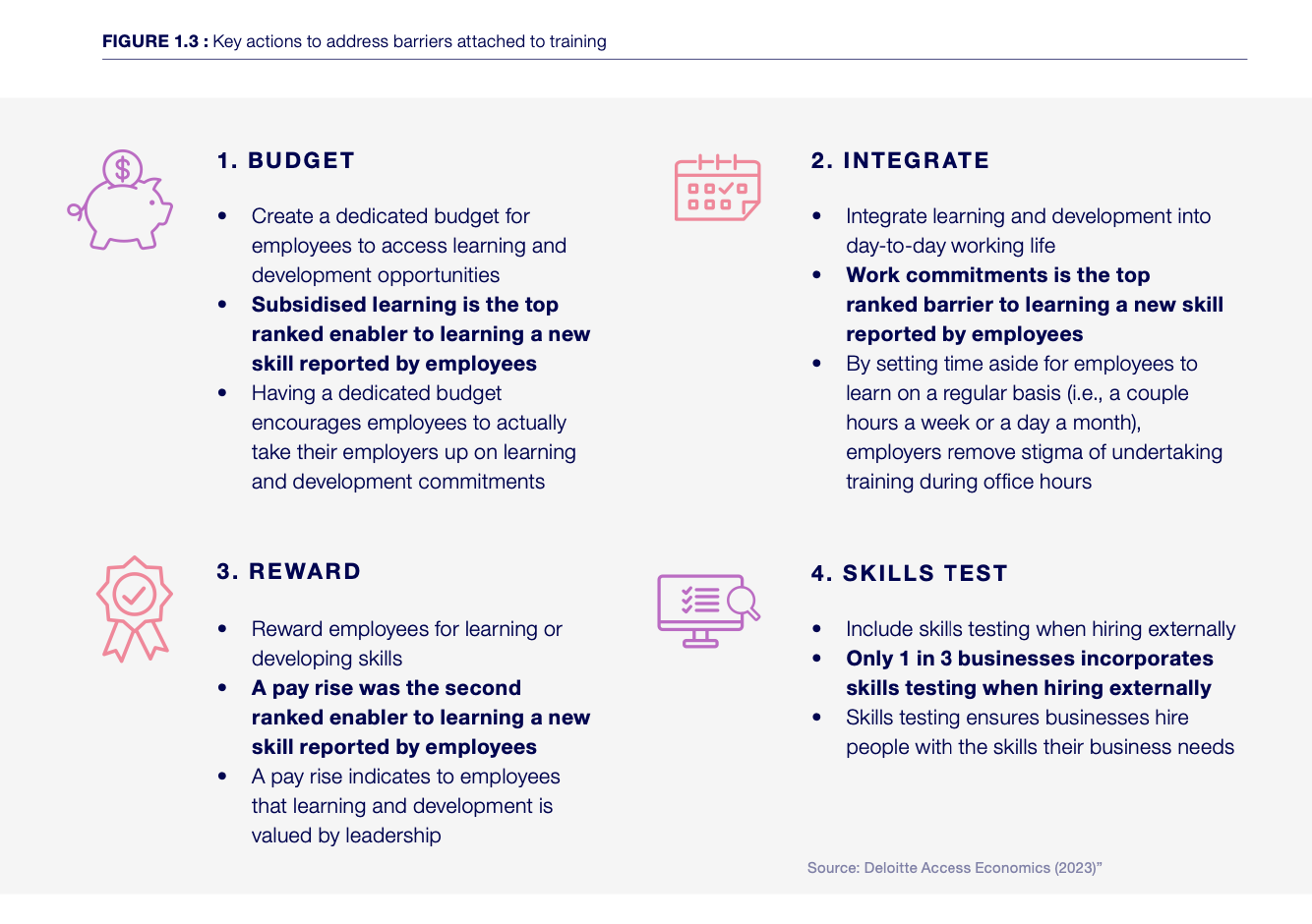
While the benefits of training are well-recognised, getting training right isn’t always easy. Training can be ineffective, costly and it can be difficult to find the time to dedicate to learning and development. Some of the key barriers to learning new skills reported by surveyed employees include work commitments (18%), the cost of training courses (12%) and lack of employer resources or support (9%). To help tackle these barriers, there are various actions employers can take to help get the most out of training. This includes establishing a dedicated learning and development budget, creating space for employees to undertake training by establishing time for regular learning at work, rewarding employees for undertaking training, and by testing job candidates’ skills before hiring (Figure 1.3).
Surveyed employers also recognise the benefits of upskilling as greater employee engagement and retention (53%), positively influences team culture and performance (46%) and cost effectiveness (44%). These factors give rise to a model of continuous learning, where frequent engagement in training and upskilling is key to keeping pace with evolving workforce needs.
Source: Ready, Set, Upskill: Prioritising skills for a resilient workforce | RMIT Online



 Job Market Monitor
Discussion
Trackbacks/Pingbacks
Pingback: Upskilling Pathways in Canada – Need to do more to connect working adults to opportunities | Job Market Monitor - July 3, 2023