In today’s increasingly digitized economies and societies, accessing and understanding data about learning outcomes, skills and credentials is critical to achieving the 2030 Sustainable Agenda, including Sustainable Development Goal (SDG), with its particular focus on quality and inclusive education, recognizing and offering lifelong learning opportunities for all. In this context, different stakeholders have different needs: education and training providers need learning data to build new programmes and learning pathways; employers need the data to understand where to find qualified workers; and learners and workers need data to discern which learning pathways are more likely to lead to career opportunities.
To date there has not been an efficient national or global system to collect, connect, search and compare up-to-date information about learning outcomes and credentials in a common language or format that can be universally understood and easily accessed. This lack of information and systems contributes to confusion, lack of trust and uninformed decision-making regarding the recognition of skills and quali cations within and across borders. It also leads to talent loss for economies and employers.
We urgently need a vision to reach a common international approach where all aspects of a person’s learning are electronically documented, authenticated and can be accessed at any time and anywhere, shared and amended by the owner or by an authorized party.
Nomenclature

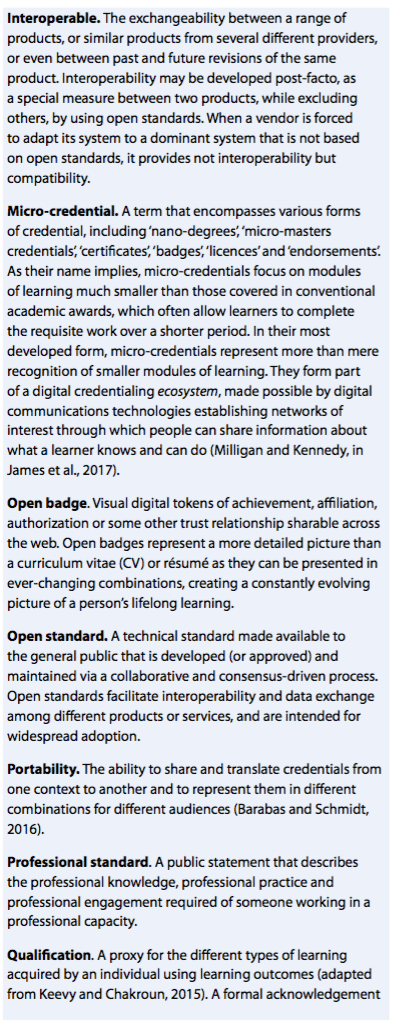
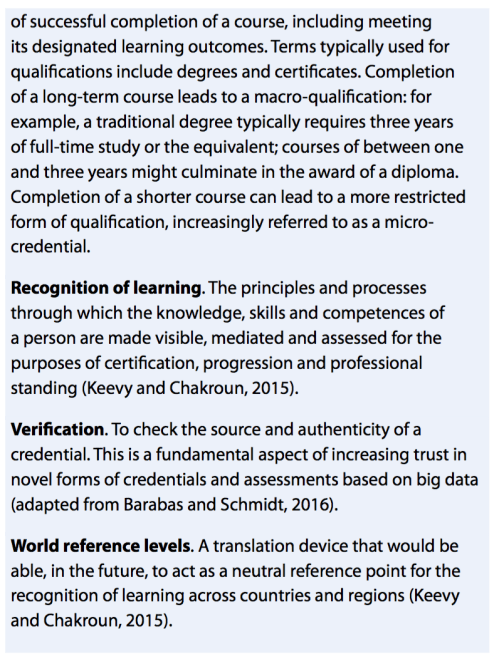

Based on the review of digital credentials, we have noted at least seven key implications for the recognition of learning:
1 Ubiquity and interoperability should be based on agreed standards.
2 There is no doubt that digitization is making representation a closer reality. However, we need to protect learners (users) within the ecosystem.
3 Digital technologies can lead to more transparent recognition of skills and qualifications required by employers, including transversal skills.
4 There is an inherent risk associated with open degrees and micro-credentials that the ‘whole will not be greater than the sum of the parts’. Stated differently, the risk is that the stacking to form a macro-credential will not be conceptually sound and as a result, it will not be recognizable by employers. Hence stacking (the combination of micro-credentials) may not always lead to coherent qualifications.
5 There exists an interesting duality between traditional (macro-) degrees and the way they are offered, leading to formal certification, and micro-credentials, largely offered through MOOCs and represented by open badges, leading to non-formal or partial certification. Quality assurance and governance systems need to be more responsive to these dynamics.
6 Digital credentials have the potential to enable the recognition of prior learning.
7 Government support and multi-stakeholder cooperation need to be e ective. The report highlights the importance of international cooperation.
Chosen excerpts by Job Market Monitor. Read the whole story at Digital credentialing: implications for the recognition of learning across borders



 Job Market Monitor
Discussion
Trackbacks/Pingbacks
Pingback: Skills and Credentials – We need a viable, globally recognised credential system | Job Market Monitor - November 28, 2019
Pingback: Skills and Credential Chaos in US – New reports find nearly one million credentials and $2t in yearly education and training expenditures | Job Market Monitor - March 1, 2021
Pingback: Alternative Credentials in Higher Ed in US – Ninety-four percent of respondents’ institutions offer alternative credentials | Job Market Monitor - March 10, 2024
Pingback: Micro-credential – How to choose it | Job Market Monitor - November 26, 2024